
Converting Search Data into Marketing Insights
SERPView Team
SEO Analytics
TL;DR:
- Transforming search data into marketing insights involves using it as real-time market intelligence to understand buyer needs and fears. Analyzing intent, correcting for position bias, and linking themes to revenue enable better content and campaign decisions. Consistent segmentation and deeper data use drive revenue growth beyond traditional SEO metrics.
Converting search data into marketing insights is the process of transforming raw search queries and engagement metrics into strategic decisions that drive better marketing outcomes. Most marketing teams treat search data as an SEO metric. The smarter use is as market intelligence: a real-time signal of what buyers need, fear, and compare before they ever talk to sales. Industry-standard search quality is measured using NDCG over 10,000 queries sampled weekly to monitor ranking quality and detect regressions. That same discipline applied to marketing analysis separates teams that react from teams that predict.
What tools and data do you need for converting search data into marketing insights?
The foundation of any search data analysis workflow is the right combination of data inputs, measurement standards, and processing infrastructure. Without these, you are analyzing noise instead of signal.
Core data inputs you need:
- Search query logs: Every query typed into your site search or captured via Google Search Console gives you raw intent data.
- Click events and CTR: Click-through rate tells you which results users chose, but raw CTR is misleading without position correction.
- Dwell time: Dwell times over 30 seconds are commonly used as proxy signals for successful search engagement when explicit satisfaction labels are missing.
- Zero-result queries: Queries that return no results are content gap alerts. They show you exactly where your site fails the user.
- GA4 and CRM data: Session quality, lead source, and pipeline stage data connect search behavior to revenue.
Standard metrics and evaluation frameworks:
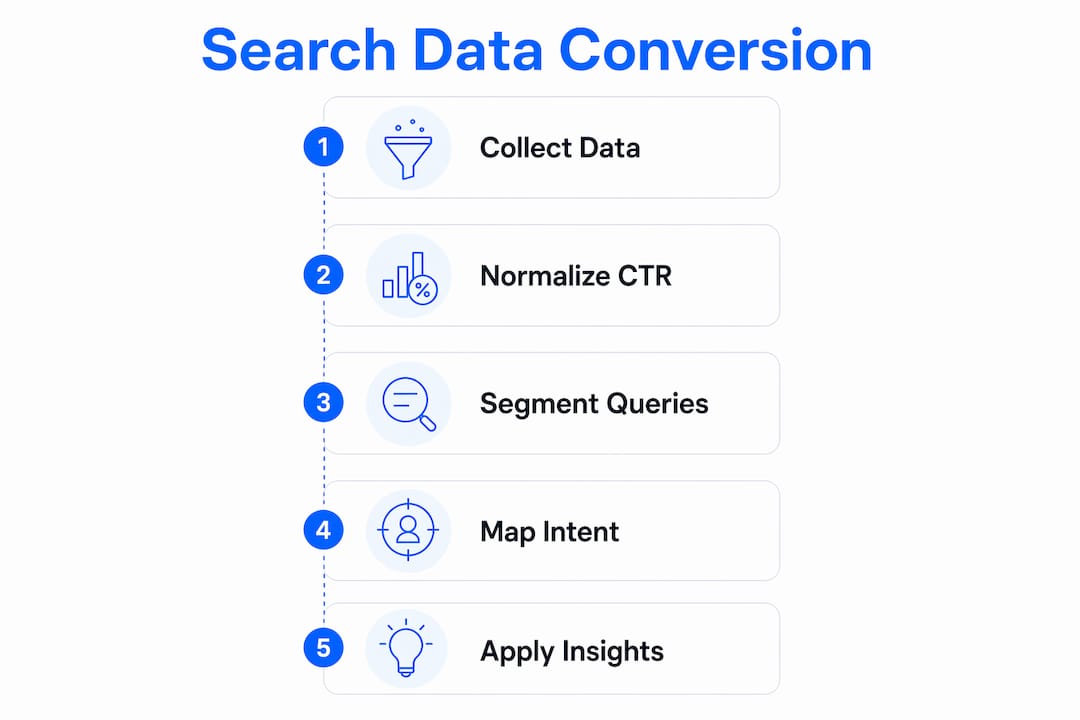
The NDCG (Normalized Discounted Cumulative Gain) standard measures ranking quality. CTR normalization using the Examination Hypothesis model corrects for position bias, so you know whether low clicks reflect poor content or simply poor placement.

Infrastructure for processing:
A well-built search analytics system uses asynchronous event ingestion to protect query latency while streaming aggregates feed fast dashboard queries. Tools like Kafka and Flink handle streaming pipelines at minute-level latency. Columnar stores like ClickHouse or BigQuery handle historical analysis at scale. Google Search Console paired with GA4 gives most marketing teams a workable starting point without custom infrastructure.
Pro Tip: Build your intent-mapped prompt libraries before you start AI-driven analysis. A 5–7 day workflow to map search visibility to downstream revenue is standard. Skipping this step means your AI outputs will reflect keyword patterns, not buyer intent.
How do you analyze and segment search data for meaningful insights?
Raw search data tells you what people typed. Segmented search data tells you what they meant and where they are in the buying process. The difference between the two is where marketing intelligence lives.
-
Segment by business meaning, not keyword similarity. Grouping “pricing” queries with “cost” queries is obvious. The real insight comes from separating “how much does X cost” (pricing uncertainty) from “is X worth it” (trust deficit). Segmenting queries by business meaning reveals trust questions, pricing concerns, and comparison triggers that generic keyword grouping misses entirely.
-
Cluster intent categories. Map queries into four buckets: problem awareness, brand queries, comparison searches, and pricing concerns. Each bucket maps to a different stage of the buyer journey and requires different content and messaging.
-
Correct for position bias. Raw click metrics overweight position 1 results and underweight everything below. Apply the Examination Hypothesis to normalize CTR data before drawing conclusions about content relevance. A page ranking at position 4 with a high normalized CTR is outperforming its placement. That is a content promotion signal, not a failure.
-
Use dwell time as a directional signal, not a verdict. Dwell time over 30 seconds suggests engagement, but it is not a perfect satisfaction proxy. Combine it with zero-result rate tracking and query failure analysis to get a complete picture of where users succeed and where they abandon.
-
Look at patterns, not spikes. A single day of high search volume for a topic means little. A consistent 6-week trend in comparison queries for your product category means buyers are actively evaluating alternatives. That is a campaign brief.
-
Use historical data for context. Seasonal patterns, product launch effects, and campaign-driven query surges all show up in historical search data. Comparing current query volume against the same period last year separates organic demand growth from noise.
Pro Tip: Check your types of search data insights regularly. Zero-result queries are the most underused signal in marketing. They tell you exactly what your audience wants that you are not providing.
How do you map search insights to marketing strategy and revenue impact?
Segmented search data becomes marketing intelligence when you connect it to pipeline, not just traffic. The highest-value question for B2B teams is which search themes create qualified pipeline, not just which keywords converted. That shift in framing changes everything about how you prioritize content and campaigns.
Connecting search themes to revenue:
- CRM integration: Match search query themes to lead source data in your CRM. If “enterprise pricing” queries consistently produce leads that close at higher rates, that theme deserves more content investment and paid budget.
- Pipeline attribution: Search engine marketing intelligence combines paid and organic search data with CRM insights to identify which campaigns create qualified leads. This is not a reporting exercise. It is a budget allocation tool.
- Funnel stage mapping: Problem-awareness queries need educational content. Comparison queries need proof points and differentiation. Pricing queries need clear value framing and objection handling. Map each intent cluster to the right content type and you stop publishing content that attracts the wrong audience.
- Competitor visibility signals: When comparison searches for your category spike, look at which brands appear alongside yours. That tells you who buyers consider as alternatives and shapes the narrative you need to build.
- Sales alerts from search trends: A sudden rise in “cancellation” or “alternative to” queries is a churn signal. Surface these to your customer success team before they show up in renewal data.
Thematic analysis for budget decisions:
Generic keyword tracking tells you which pages rank. Thematic analysis tells you which buyer concerns drive revenue. Allocate content budget to themes that correlate with pipeline creation, not themes that generate the most impressions. Use search performance and revenue data together to make that case internally.
Practical steps and common pitfalls when converting search data into marketing insights
The execution gap between “we have search data” and “we use search data to make decisions” is where most teams stall. A clear process closes that gap.
-
Define your business questions first. Before you pull a single report, write down what decision you are trying to make. “Which content topics should we prioritize next quarter?” is a business question. “What are our top keywords?” is not.
-
Gather and cleanse your data. Pull query logs, CTR data, dwell time, and zero-result rates. Remove branded queries from non-brand analysis. Correct for position bias using the Examination Hypothesis. Raw data without cleansing produces misleading conclusions.
-
Build intent-mapped prompt libraries. If you use AI platforms for analysis, your prompts need to reflect buyer intent categories, not keyword lists. Intent-mapped prompt libraries tie search visibility to downstream revenue and take 5–7 days to build properly. That investment pays back in every analysis cycle after.
-
Analyze with behavioral correction and segmentation. Apply the segmentation framework from the previous section. Look for patterns across intent clusters. Identify which themes show rising query volume, strong dwell time, and high conversion rates together.
-
Align insights with marketing goals and CRM outcomes. Every insight needs an owner and a decision attached to it. “Pricing uncertainty queries are up 40% this quarter” becomes actionable when it triggers a content brief, a sales enablement update, or a paid campaign adjustment.
Search data reveals buyer hesitation, comparison points, and unmet needs. Teams that treat it as market intelligence beyond SEO consistently outperform those that limit it to ranking reports.
Common mistakes to avoid:
- Ignoring position bias in CTR data. Raw clicks favor high-ranking pages regardless of content quality. Always normalize before drawing conclusions.
- Keeping search data siloed in the SEO team. Product, sales, and marketing all benefit from search intelligence. Siloed data produces siloed decisions.
- Over-focusing on individual keywords. Themes and intent clusters drive strategy. Single keywords drive tactics. Know which level you are working at.
- Underusing zero-result queries. These are the clearest content gap signal you have. Surface them in near real-time and assign them to content owners immediately.
Pro Tip: Connect your search data to client strategy by presenting insights in terms of pipeline impact, not traffic metrics. Finance and leadership respond to revenue language, not impressions.
Key Takeaways
Converting search data into marketing insights requires structured segmentation, position-bias correction, and direct alignment between search themes and pipeline outcomes.
| Point | Details |
|---|---|
| Segment by business meaning | Group queries by buyer concern (trust, pricing, comparison) rather than keyword similarity for richer intelligence. |
| Correct for position bias | Apply the Examination Hypothesis to CTR data before drawing any conclusions about content performance. |
| Map intent to funnel stages | Assign each query cluster to a funnel stage and match it to the right content type and messaging. |
| Connect themes to pipeline | Use CRM integration to identify which search themes produce qualified leads, then allocate budget accordingly. |
| Act on zero-result queries | Surface content gaps in near real-time and assign them to content owners to close unmet demand. |
Search data is more than an SEO metric. Here is what I have learned.
The most common mistake I see marketing teams make is treating search data as a reporting output rather than a strategic input. Teams pull a weekly keyword ranking report, celebrate position gains, and move on. The actual intelligence sitting in that data never reaches the product team, the sales team, or the content strategist who needs it most.
What changed my thinking was watching a B2B software company use comparison query trends to rewrite their entire sales deck. They noticed that “X vs. competitor” searches were rising sharply in a specific industry vertical. They built a targeted comparison page, briefed the sales team on the objections those queries implied, and saw deal velocity improve in that segment within two quarters. No new ad spend. No new product feature. Just better use of data they already had.
The challenge with AI-driven search platforms is that query behavior is shifting. Users phrase questions differently when talking to an AI than when typing into a search bar. That means your intent mapping frameworks need to evolve continuously, not just at the start of a project. Teams that build living prompt libraries and review them quarterly will stay ahead of teams that set them up once and forget them.
The cultural shift required here is real. Search data needs to move from the SEO analyst’s dashboard to a shared intelligence layer that product, sales, and marketing all draw from. That requires process, not just tools. Start by presenting one search insight per month in your cross-functional meeting. Make it revenue-linked. The conversation will follow.
— Utsav Chopra
How Serpview supports your search data analysis workflow
Serpview gives marketing analysts a unified dashboard that consolidates search analytics across multiple properties, removing the 1,000-row restriction that limits standard reporting tools. You get up to 50,000 rows of query data, which means you can segment, filter, and analyze at a depth that standard exports simply do not support.
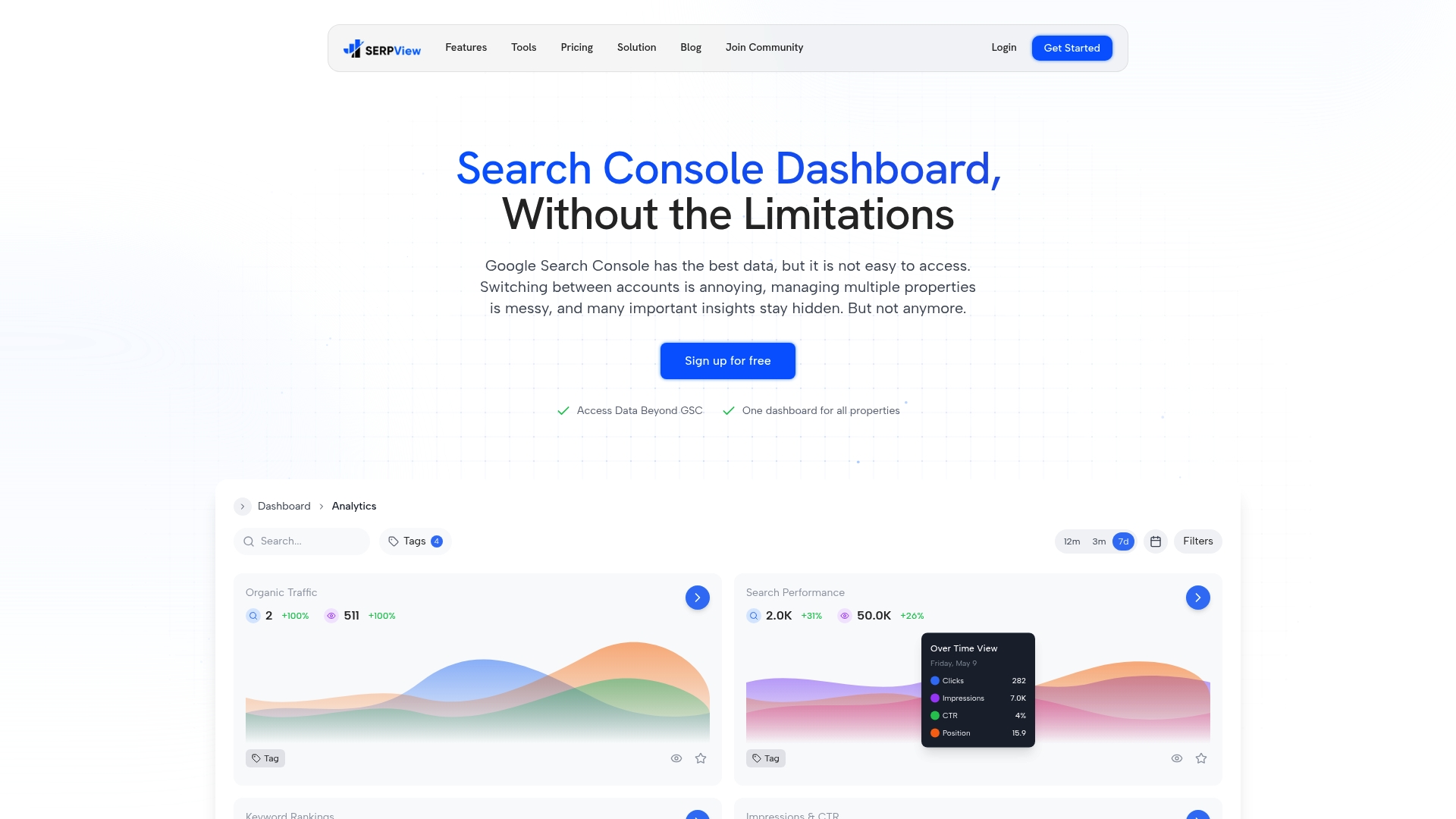
The custom annotations feature lets you tag site changes, campaign launches, and algorithm updates directly on your performance timeline. That context turns raw data into a story your whole team can read. Serpview’s query counting by ranking tier shows you exactly how query volume distributes across position bands, so you can prioritize the themes that deserve more visibility. If you are ready to move from keyword tracking to real marketing intelligence, Serpview gives you the data depth to do it.
FAQ
What is converting search data into marketing insights?
Converting search data into marketing insights is the process of transforming raw search queries, CTR data, and engagement metrics into strategic decisions about content, campaigns, and budget allocation. It goes beyond SEO rankings to treat search behavior as a signal of buyer intent and market demand.
How do you correct for position bias in search data?
Apply the Examination Hypothesis model to normalize raw CTR data by accounting for the click probability at each ranking position. This separates content quality signals from placement effects, giving you accurate relevance data.
What are zero-result queries and why do they matter?
Zero-result queries are searches that return no results on your site or in your content. They are direct evidence of unmet user needs and content gaps, and should be surfaced in near real-time so content teams can address them quickly.
How do you connect search insights to pipeline in B2B marketing?
Integrate search query themes with CRM lead source data to identify which content topics attract leads that convert to qualified pipeline. The focus should be on themes that correlate with revenue, not just traffic volume.
What is intent mapping in search data analysis?
Intent mapping is the process of categorizing search queries by buyer intent, such as problem awareness, comparison, or pricing concern, and linking those categories to funnel stages and revenue outcomes. Building a structured prompt library for AI-driven analysis typically takes 5–7 days to complete properly.
Recommended
Ready to unlock your full GSC potential?
SERPView helps you access all your Google Search Console data without limitations. Start your free trial today.
Get Started Free