
How Search Performance Drives Revenue for Marketers
SERPView Team
SEO Analytics

TL;DR:
- Search performance significantly impacts revenue by effectively attracting and converting high-intent visitors into paying customers. Improving internal site search and technical factors like site speed can recover substantial revenue, especially through better relevance, personalization, and faster load times. Focusing on revenue-driven metrics and integrating analytics data with sales models helps justify SEO investments and demonstrate its true financial contribution.
Search performance is defined as the measurable ability of your search channels to attract, engage, and convert visitors into paying customers. The role of search performance in revenue is more direct than most marketing teams realize. High-intent search visitors convert up to five times better than non-searchers and account for nearly half of total site revenue. Yet most teams still report on traffic volume and domain authority, two metrics that tell you almost nothing about financial outcomes. This guide explains which search metrics actually move the needle and how to act on them.
How does internal site search influence revenue?
Internal site search is one of the most underleveraged revenue assets in e-commerce and content-driven businesses. Visitors who use your site’s search bar are already in buying mode. They know what they want and they are asking you for it directly.
The numbers back this up. Search users convert at 2–5 times higher rates than visitors who browse without searching, and they generate about 44% of total site revenue despite representing only 24% of traffic. In Health and Beauty specifically, searchers convert at 17% versus 6% for non-searchers. That gap is not a rounding error. It is a revenue multiplier hiding in plain sight.
The problem is that most sites bleed revenue through two internal search failures:
-
Zero-result queries. When a visitor searches for a product you carry but your search engine returns nothing, that visitor leaves. Zero-result queries cause abandonment and direct revenue loss, especially when the visitor arrived through a paid acquisition channel.
-
Poor relevancy ranking. Returning results in the wrong order pushes high-margin or high-converting products below the fold. Visitors rarely scroll past the first few results.
-
Synonym and intent gaps. A search for “sneakers” should surface the same results as “trainers” or “running shoes.” Semantic mismatches silently kill conversions.
-
No personalization. Returning the same results for every visitor regardless of browsing history or location ignores the behavioral signals you already have.
Fixing these issues does not require more traffic. It converts the high-intent traffic you already paid to acquire. Internal search optimization delivers near-certain positive ROI because it closes leaks in your most qualified visitor segment.
Pro Tip: Run your top 50 revenue-driving queries through your own search bar every month. Note zero-result pages, irrelevant top results, and missing synonyms. Fix those before investing in any new acquisition channel.
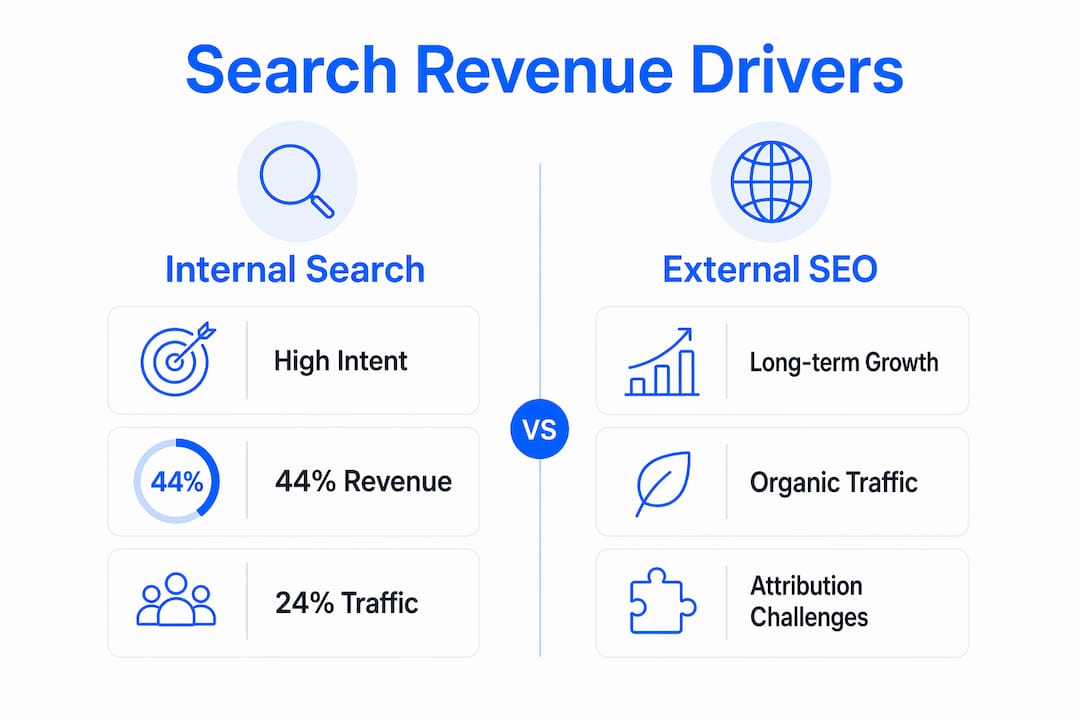
What is the long-term revenue impact of external SEO?
External SEO, meaning your organic search presence in Google and other engines, builds revenue over a longer timeline but at a dramatically better return than paid channels. Understanding this timeline is what separates teams that get SEO budget approved from those that don’t.
Well-executed SEO campaigns yield a 22:1 ROI on average, with cost per lead ranging from $30–$60 versus $150–$300 for pay-per-click advertising. That cost advantage compounds over time because organic rankings, once earned, do not disappear the moment you stop paying.
Revenue from SEO follows a predictable chain:
-
Visibility. Your pages rank for commercial queries. Impressions grow.
-
Engagement. Searchers click through. Your click-through rate improves as titles and meta descriptions align with search intent.
-
Pipeline. Visitors convert to leads or buyers. SEO revenue typically manifests within 3–18 months depending on your sales cycle length.
-
Lifetime value. Organic leads show 20–30% higher lifetime value than paid leads because trust is built during the discovery phase, before any sales conversation begins.
Attribution is where most teams get this wrong. Last-click models erase SEO’s contribution entirely when a customer later converts through a retargeting ad. Multi-touch attribution models, including first-click, linear, and position-based, reveal SEO’s true role as the first touchpoint in most customer journeys. Connecting your analytics platform to your CRM is the only way to track SEO’s influence on closed-won deals and prove its real contribution to revenue.
Pro Tip: Ask your sales team to add a “how did you first hear about us?” field to your CRM intake form. Organic search will appear far more often than your last-click attribution data suggests.
Why do traditional SEO metrics fail revenue goals?
Vanity metrics are the single biggest barrier between SEO teams and executive budget approval. Domain authority, total backlinks, and raw organic traffic do not reliably indicate business outcomes. They can all increase while revenue from organic search declines.
The shift required is from volume metrics to commercial intent metrics. A page ranking for 10,000 informational queries may generate zero revenue. A page ranking for 200 high-intent transactional queries may generate $50,000 per month. Volume tells you nothing without intent context.
| Outdated metric | Revenue-focused replacement |
|---|---|
| Domain authority score | Conversion-weighted visibility |
| Total organic sessions | Organic-attributed revenue by page |
| Total backlinks | Links from pages with commercial relevance |
| Average keyword ranking | Rankings for transactional and commercial queries |
| Bounce rate | Search session conversion rate |
Treating SEO as a revenue channel requires reporting at the category and page level, not the domain level. When you show finance that page X generates $40,000 per month in organic-attributed revenue, budget conversations change completely. The query counting approach used by Serpview gives you exactly this kind of granular visibility, breaking down which queries drive clicks, conversions, and revenue rather than just impressions.
How do technical factors amplify search-driven revenue?
Site speed is not just a user experience issue. It is a direct revenue lever with a measurable conversion relationship. Every 100ms improvement in load time correlates with a 0.7%–1.0% increase in e-commerce conversion rate. On a platform processing $10 million in annual volume, that translates to $70,000–$100,000 in recovered revenue per improvement cycle.

The SEO benefit of speed is equally concrete. Faster server response enables search engine crawlers to process significantly more pages per session, which expands your organic visibility across a broader set of queries. Slow sites get crawled less. Pages that don’t get crawled don’t rank. Pages that don’t rank don’t generate revenue.
Internal search performance and site speed work together. A fast site with a well-tuned internal search engine creates a compounding effect. Visitors find what they want quickly, convert at higher rates, and return more often. Site speed and internal search together create non-linear revenue gains by improving rankings, user engagement, and conversion simultaneously over 12–36 months. Monitoring your Core Web Vitals is the starting point for identifying which performance gaps are costing you the most revenue.
Pro Tip: Treat performance optimization as a compounding asset, not a one-time project. Schedule quarterly speed audits and track the revenue impact of each improvement cycle. The gains stack.
Key Takeaways
Search performance drives revenue through both internal and external channels, and measuring it with financial metrics rather than vanity metrics is the clearest path to sustained business growth.
| Point | Details |
|---|---|
| Internal search converts better | Search users generate 44% of site revenue despite being only 24% of traffic. |
| SEO ROI outpaces paid channels | Well-executed SEO yields a 22:1 ROI with cost per lead far below PPC. |
| Vanity metrics mislead budgets | Replace domain authority and raw traffic with conversion-weighted visibility and organic-attributed revenue. |
| Speed directly lifts conversion | Every 100ms load time improvement adds 0.7%–1.0% to e-commerce conversion rates. |
| Attribution models reveal true impact | Multi-touch attribution and CRM integration show SEO’s full contribution to closed revenue. |
Search as a profit center: what I’ve learned from the data
Most marketing teams treat SEO as a traffic function. That framing is the root cause of underfunded SEO programs and frustrated practitioners. When you report on sessions and rankings, you are speaking a language that finance and leadership do not care about. When you report on organic-attributed revenue and cost per acquired customer, the conversation changes immediately.
The insight that changed how I think about this: revenue does not come from growing traffic. It comes from improving the gap between a mediocre search experience and an excellent one. A site with 500,000 monthly visitors and a broken internal search engine leaves more money on the table than a site with 100,000 visitors and a well-tuned one.
The practical implication is that your first investment should almost never be more content or more links. It should be a thorough audit of what your existing search traffic is doing and where it drops off. Fix the leaks before you fill the bucket. Connecting analytics to your CRM is the step most teams skip, and it is the step that proves SEO’s value to the people who control the budget.
The cultural shift required is real. SEO teams need to sit closer to sales and finance, not just marketing. When an SEO manager can walk into a quarterly business review and say “organic search contributed $380,000 in closed revenue this quarter,” the program gets funded. That conversation starts with the right metrics, not the right rankings.
— Utsav
How Serpview connects search data to revenue outcomes
Serpview gives marketing teams and business owners the search analytics depth that standard tools don’t provide. Its unified dashboard consolidates data across multiple properties and surfaces up to 50,000 rows of query data, far beyond the 1,000-row limit that leaves most teams working with incomplete information.
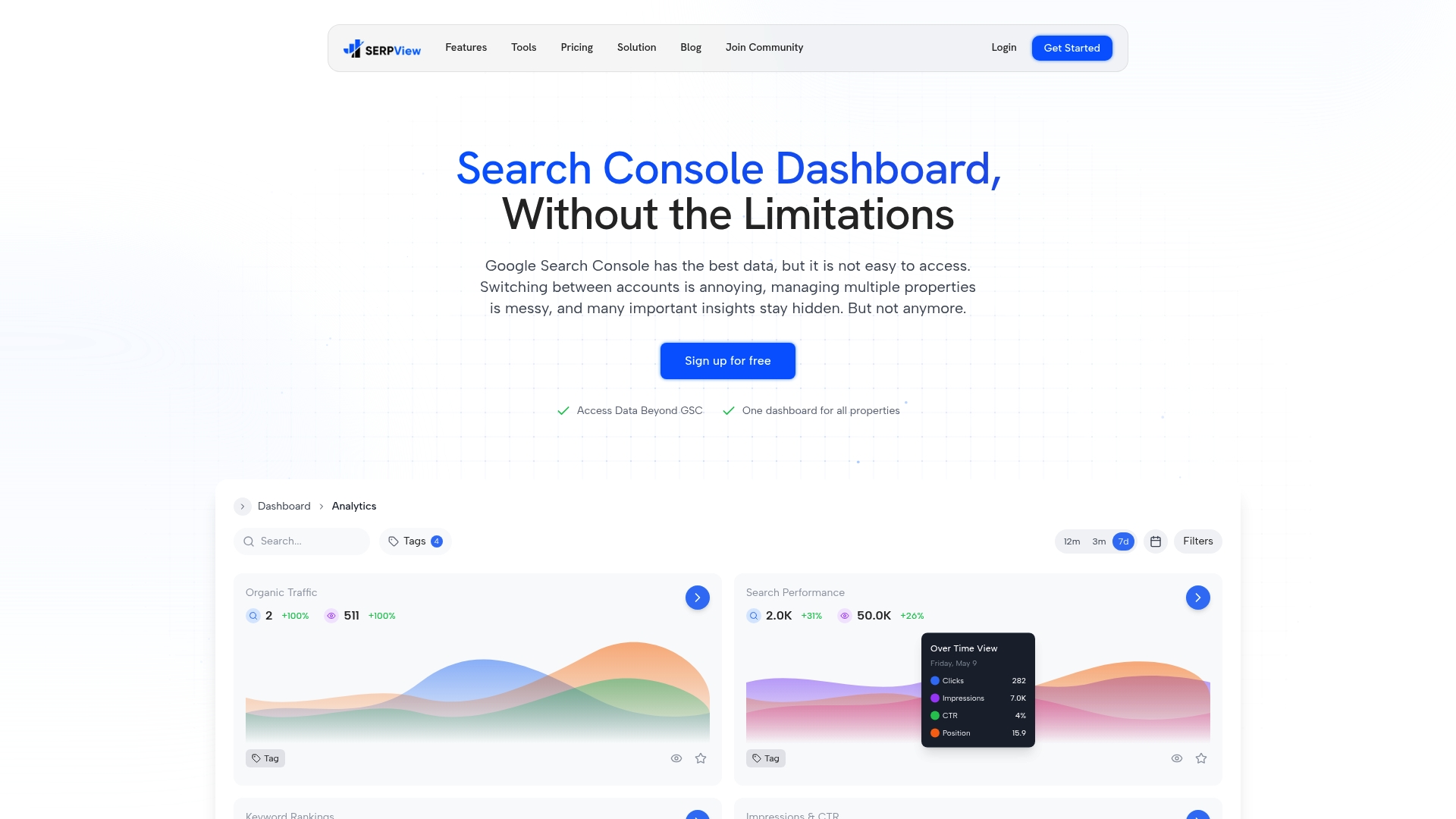
For revenue-focused reporting, Serpview’s query counting by ranking tier shows exactly which queries drive clicks and conversions at each position, so you can prioritize the pages with the highest commercial value. The Google Search Console glossary on Serpview clarifies how to read and act on the metrics that matter most. If you want to move from traffic reporting to revenue reporting, Serpview’s combined analytics feature is the practical starting point for connecting search performance to real business outcomes.
FAQ
What is the role of search performance in revenue?
Search performance determines how well your search channels attract and convert high-intent visitors. Optimized search, both internal and external, directly increases conversion rates and organic-attributed revenue.
How much revenue does internal site search generate?
Internal search users generate about 44% of total site revenue despite representing only 24% of site traffic, with conversion rates 2–5 times higher than non-searching visitors.
What SEO metrics actually predict revenue growth?
Conversion-weighted visibility and organic-attributed revenue by page are the most reliable indicators. Raw traffic and domain authority scores do not reliably predict financial outcomes.
How long does SEO take to generate revenue?
SEO revenue typically appears within 3–18 months depending on your sales cycle length. Shorter cycles in e-commerce see results faster than B2B businesses with longer decision timelines.
Does site speed affect search revenue?
Every 100ms improvement in load time correlates with a 0.7%–1.0% increase in e-commerce conversion rate, making site speed one of the highest-return technical investments for search-driven revenue.
Recommended
Ready to unlock your full GSC potential?
SERPView helps you access all your Google Search Console data without limitations. Start your free trial today.
Get Started Free