
How Search Data Informs Client Strategy in 2026
SERPView Team
SEO Analytics

TL;DR:
- Search data provides real-time insights into customer intent, market demand, and content gaps beyond traditional SEO metrics.
- It helps align content strategy with buyer behavior by analyzing query types, search intent, and zero-result signals to improve conversions and uncover unmet needs.
Search data is defined as the collection of queries, clicks, impressions, and behavioral signals that users generate when interacting with search engines. Understanding how search data informs client strategy gives marketing strategists and business consultants a direct window into customer intent, market demand, and competitive positioning. Approximately 80% of consumers use search engines before making a purchase. That figure alone makes search behavior one of the most reliable inputs for any client-facing strategy. Unlike surveys or focus groups, search queries reflect real customer questions and doubts without the filter of social desirability or researcher bias.
How search data informs client strategy: the core framework
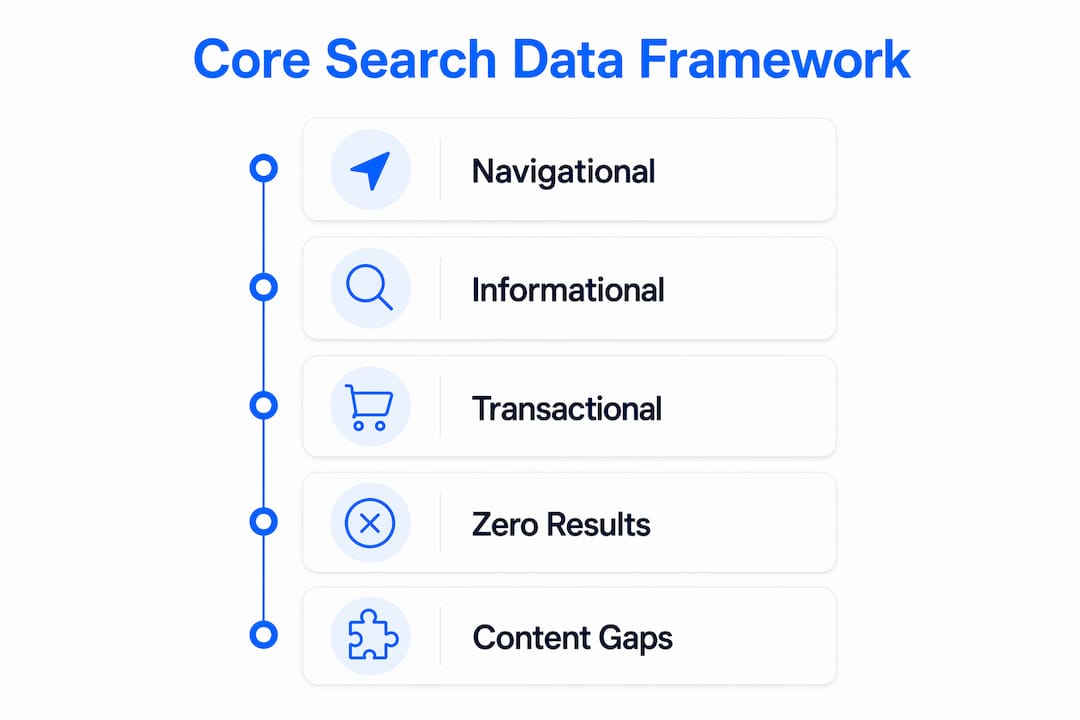
Search data falls into three query categories, and each one carries a different strategic signal. Navigational queries show brand awareness. Informational queries reveal where customers are in the research phase. Transactional queries signal purchase readiness. Recognizing the difference between these types is the first step toward aligning content and messaging with actual buyer behavior.

Search intent is the underlying goal behind any query. A user searching “how to reduce churn rate” wants education. A user searching “churn reduction software pricing” wants to buy. Treating both queries with the same content approach wastes budget and misses conversions.
Click-through rate (CTR) and impression data add another layer. A page with high impressions and low CTR signals a mismatch between the page title and what users actually want. That gap is a direct instruction to revise the content or the meta description.
Zero-result queries deserve special attention. When users search your client’s site and find nothing, they are telling you exactly what content is missing. Zero-result query analysis functions as a demand forecasting tool, revealing unmet needs before they become lost revenue.
- Navigational queries: Measure brand recall and direct traffic intent.
- Informational queries: Map the research phase and content consumption patterns.
- Transactional queries: Identify high-intent audiences ready to convert.
- Zero-result queries: Surface content gaps and unmet demand in real time.
Pro Tip: Export zero-result queries from your client’s internal site search monthly. Group them by theme and use them to build a content calendar that addresses real, documented demand.
How to find content gaps using search data
Identifying content gaps starts with Google Search Console (GSC). Pull the Queries report and filter for pages ranking in positions 5–20. These pages already have visibility but are not capturing clicks at the rate they should.
High impressions with low clicks on queries ranked in positions 5–20 indicate that content partially meets user intent but falls short. Addressing those gaps typically improves ranking by 2–3 positions within 30 days. That is a measurable, time-bound outcome you can present to any client.
The process for closing content gaps follows a clear sequence:
- Export GSC query data for the past 90 days. Filter by impressions greater than 500 and CTR below 3%.
- Cluster queries by topic. Group related queries to identify which content themes are underserved.
- Audit existing pages against each cluster. Determine whether the page answers the query fully or only partially.
- Prioritize by conversion potential. Not all gaps are equal. A gap in a transactional query cluster is worth more than one in a purely informational cluster.
- Rewrite or expand content to match the full scope of user intent for each cluster.
Conversion data adds critical context to this process. Low-traffic use-case pages converting at 8% versus high-traffic educational pages converting at 0.3% shows that traffic volume alone does not determine strategic value. A page with 200 monthly visits and an 8% conversion rate outperforms a page with 20,000 visits and a 0.3% rate. That insight changes how you allocate content investment for clients.
| Content Type | Traffic Level | Conversion Rate | Strategic Priority |
|---|---|---|---|
| Use-case pages | Low | 8% | High |
| Educational blog posts | High | 0.3% | Medium |
| Zero-result query pages | None | Unknown | Immediate gap fill |
| Mid-ranking query pages | Medium | Variable | Refinement target |
AI-assisted GSC analysis takes this further. AI-assisted analysis of GSC data can improve average search rankings by 2–3 positions in 30 days by identifying and filling content gaps on mid-ranking pages. The speed of that improvement makes it a compelling case study for client reporting.
Pro Tip: Use Serpview’s query counting by ranking tier to segment your client’s keyword portfolio by position band. This makes it far easier to identify which mid-ranking queries need content refinement versus which ones need a full rewrite.
Integrating search data with broader client business intelligence
Search data does not belong only in the SEO report. It belongs in the boardroom. Search behavior reveals customer hesitation points before any sales contact occurs, giving you market intelligence that traditional research methods cannot match.
The shift from SEO reporting to business intelligence requires mapping search behavior to actual buyer journeys. When a cluster of informational queries spikes around a specific product category, that is a signal for the sales team to prepare new enablement materials. When transactional queries for a competitor’s brand name increase, that is a signal for the product team to investigate pricing or feature gaps.
Cross-functional sharing of search insights produces compounding returns:
- Sales enablement: Share the exact language customers use in queries with sales teams. Scripts that mirror search language convert better because they match how buyers already think.
- Product development: Clusters of queries around missing features or unsolved problems are direct product roadmap inputs.
- Executive reporting: Search trend data provides early warning signals for market shifts, often weeks before they appear in sales figures.
- Competitive intelligence: Tracking branded query volume for competitors reveals market share shifts without requiring expensive research panels.
Recurring intelligence reports formalize this process. A monthly search intelligence brief, built from GSC data and internal site search logs, gives clients a structured view of how their market is evolving. It positions you as a strategic partner rather than a reporting vendor. That distinction matters for client retention and contract value.
Common pitfalls when using search data for client strategy
The most common mistake is treating rankings as a proxy for customer satisfaction. A page ranking in position 1 for a query does not mean it answers the query well. It means it ranks well. CTR, time on page, and conversion rate tell you whether the content actually serves the user.
Ignoring internal site search data is an equally costly error. Internal site search converts at 4.63% compared to a site average of 2.77%. That gap represents real revenue left on the table when organizations treat search logs as technical noise rather than behavioral intelligence.
Several other pitfalls consistently undermine data-driven client strategy:
- Focusing only on top-ranking queries. Queries ranked 5–20 often hold more improvement potential than those already in position 1.
- Ignoring zero-result queries. These are the clearest signal of unmet demand on a client’s site.
- Measuring once and moving on. Search intent evolves. A query that meant one thing in 2024 may mean something different in 2026. Continuous measurement is not optional.
- Siloing search data within the SEO team. The insights lose most of their value when they never reach sales, product, or leadership.
Pro Tip: Set up a monthly review of your client’s GSC data limitations alongside internal site search logs. The two data sources together reveal a far more complete picture of unmet demand than either one alone.
Key Takeaways
Search data is the most direct and unfiltered source of client intelligence available, and using it beyond SEO reporting is what separates strategic consultants from tactical vendors.
| Point | Details |
|---|---|
| Query type classification | Segment queries into navigational, informational, and transactional to align content with buyer intent. |
| Content gap identification | Filter GSC for positions 5–20 with high impressions and low CTR to find the fastest ranking wins. |
| Conversion rate context | Low-traffic pages converting at 8% outperform high-traffic pages at 0.3%; prioritize accordingly. |
| Cross-functional integration | Share search insights with sales, product, and leadership to multiply the strategic value of the data. |
| Internal search as intelligence | Internal site search converts at 4.63% versus a 2.77% site average; never ignore this data source. |
Why I think most consultants are still underusing search data
The honest truth is that most marketing consultants treat search data as a reporting artifact rather than a strategic input. I have seen teams spend weeks building client decks around ranking improvements while completely ignoring the zero-result queries piling up in the same client’s site search logs. Those zero-result queries are the client’s customers telling them exactly what they cannot find. That is not a technical problem. That is a business problem.
The shift I have found most valuable is reframing search data as a continuous customer interview. Every query is a question. Every zero-result is an unanswered question. Every high-impression, low-click page is a broken promise. When you present search data to a client in those terms, the conversation changes. You stop talking about rankings and start talking about revenue.
The consultants who build the most durable client relationships are the ones who bring a monthly search intelligence brief to every meeting. Not a ranking report. An intelligence brief that connects search behavior to sales pipeline, product gaps, and competitive threats. That brief is what makes you irreplaceable. The impact on search performance compounds over time when you treat it as a business signal rather than a marketing metric.
The tools to do this well exist right now. The gap is not capability. The gap is intent.
— Utsav Chopra
Serpview gives you the search data depth your clients need
Standard GSC reporting caps at 1,000 rows and limits historical data access. That ceiling cuts off the very queries where the most strategic value lives, specifically the mid-ranking, high-impression keywords that signal content gaps and conversion opportunities.
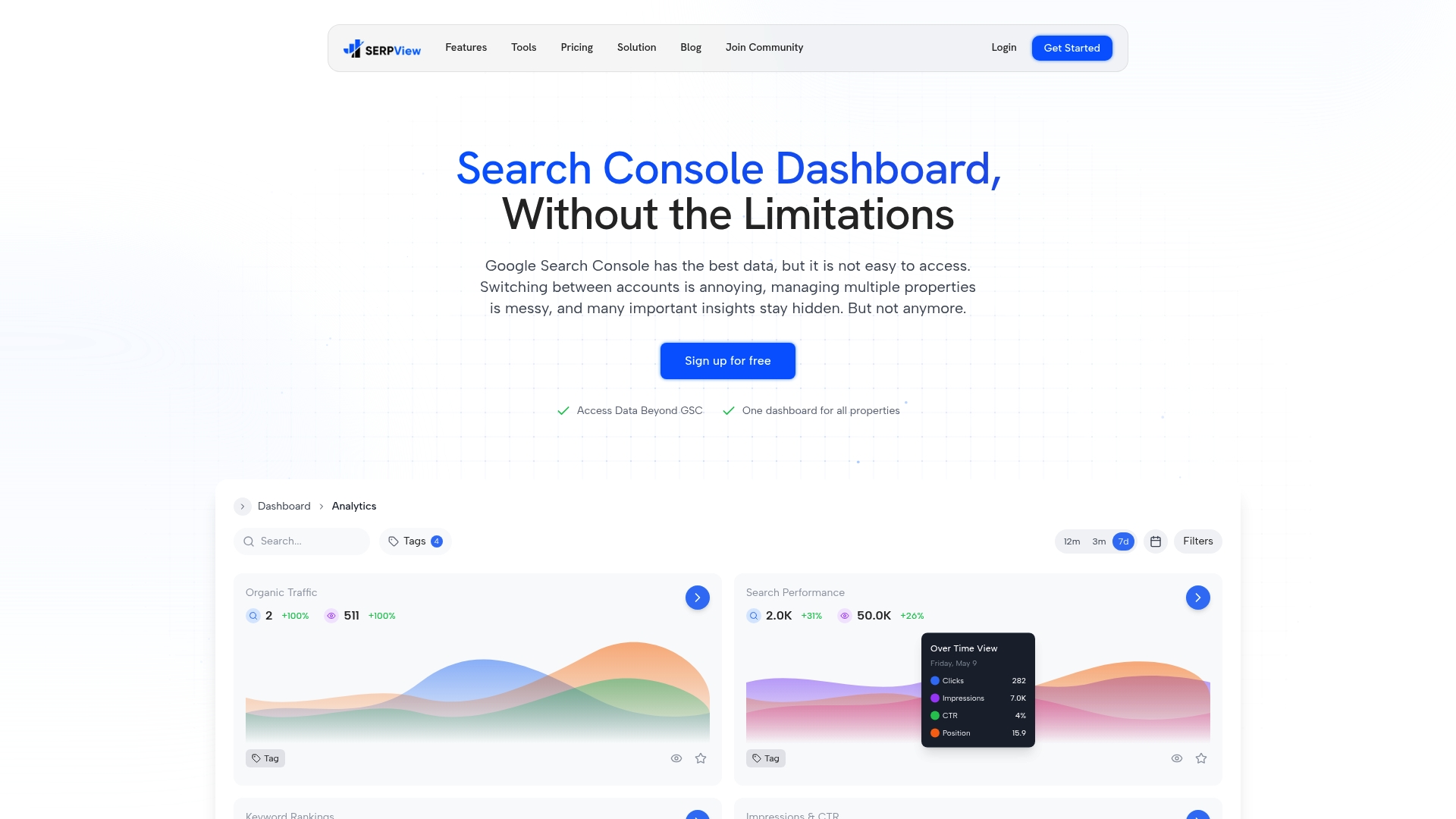
Serpview removes that ceiling. Its unified dashboard consolidates analytics across multiple properties and surfaces up to 50,000 rows of query data. You get query counting by ranking tier, customizable filters, and custom annotations that let you mark site changes directly on performance charts. For consultants building recurring intelligence reports, the shared dashboard feature lets you deliver live search data to clients without exporting a single spreadsheet. Serpview turns raw GSC data into the kind of structured intelligence that earns a seat at the strategy table.
FAQ
What is search data in the context of client strategy?
Search data is the collection of queries, clicks, impressions, and behavioral signals generated by users in search engines. In client strategy, it functions as real-time market intelligence that reveals customer intent, content gaps, and competitive dynamics.
How does search data reveal content gaps?
Queries ranking in positions 5–20 with high impressions and low CTR indicate that existing content partially meets user intent but falls short. Addressing those gaps typically improves rankings by 2–3 positions within 30 days.
Why should search data go beyond the SEO team?
Search behavior maps customer hesitation points before any sales contact, making it directly relevant to sales enablement, product development, and executive forecasting. Keeping it within SEO limits its strategic value.
What are zero-result queries and why do they matter?
Zero-result queries occur when users search a site and find no matching content. They are a direct signal of unmet demand and function as a demand forecasting tool when analyzed consistently.
How does internal site search data improve client strategy?
Internal site search converts at 4.63% compared to a site average of 2.77%. Analyzing what users search for internally reveals friction points and content gaps that external search data alone cannot surface.
Recommended
Ready to unlock your full GSC potential?
SERPView helps you access all your Google Search Console data without limitations. Start your free trial today.
Get Started Free