
The Role of Real-Time Search Data in SEO Strategy
SERPView Team
SEO Analytics

TL;DR:
Real-time search data allows SEO professionals to monitor ranking shifts, AI citations, and query trends instantaneously. It reduces feedback cycle times from weeks to hours, enabling rapid responses to changes and improving AI-driven search visibility. Streaming ingestion offers the most current data, but setting relevant thresholds is essential to prevent alert fatigue and maintain actionable insights.
Real-time search data is defined as the continuous, low-latency retrieval and indexing of search information as it happens, giving SEO professionals immediate visibility into ranking shifts, AI citation changes, and emerging query trends. Unlike traditional batch indexing, which processes data in scheduled cycles, live retrieval delivers signals within seconds. The role of real-time search data has grown sharply as AI-powered search engines now construct answers from dynamic retrieval pools rather than static indexes. Top-quartile companies with real-time data capabilities achieve over 50% higher revenue growth and net margins than bottom-quartile firms. That gap is widening in 2026 as search behavior accelerates.
How does real-time search data transform SEO feedback loops?
Traditional SEO feedback cycles run on a delay. You publish content, wait for crawling, watch rankings shift over weeks, and then adjust. Real-time search data compresses that entire cycle into hours.
Modern APIs deliver SERP data in under one second, enabling continuous monitoring of AI-generated answers and organic rankings. That speed means you can detect a ranking drop, identify the cause, and publish a corrective update before your competitors even notice the shift. For authoritative domains, the time-to-citation in AI search results can shrink from months to hours.
The practical benefits of real-time search data in feedback loops include:
-
Ranking volatility alerts: Catch position drops within minutes rather than discovering them in a weekly report.
-
AI answer monitoring: Track when your brand appears in, or disappears from, AI-generated overviews using tools like Serpview’s AI citation scanner.
-
Content freshness signals: Identify which recently published pages are entering retrieval pools and generating impressions.
-
Competitor shift detection: Spot when a rival domain gains sudden visibility on your core queries.
-
CTR anomaly tracking: Connect click-through rate changes to specific SERP feature appearances in real time.
The narrative control benefit is underappreciated. When a news event or industry development touches your brand, real-time monitoring lets you see how AI search engines are framing that story and respond with structured, factual content before a damaging narrative solidifies.
Pro Tip: Publish structured, schema-marked content on trusted domains immediately after a significant industry event. AI retrieval pools can index and cite that content within hours, giving you early narrative control before competitors react.
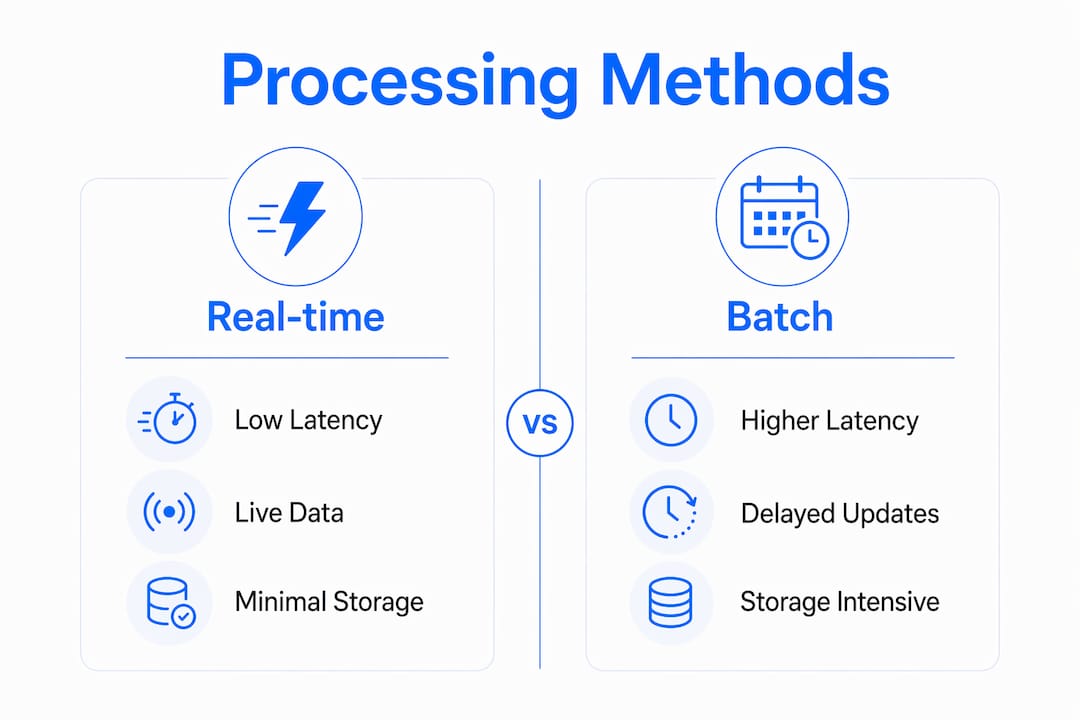
What are the technical mechanisms behind real-time search analytics?
Two distinct architectures power real-time search analytics, and understanding the difference helps you choose the right monitoring setup.

Live retrieval queries source data at request time. It avoids storage overhead but introduces query-time latency. Streaming ingestion continuously updates an index so data is always near-instant to access. Streaming ingestion maintains sub-second searchability while live retrieval trades that speed for lower infrastructure cost. For SEO monitoring at scale, streaming ingestion is the stronger architecture because it keeps your data fresh without query delays.
| Characteristic | Real-time processing | Batch processing |
|---|---|---|
| Latency | Sub-second to seconds | Hours to days |
| Data freshness | Continuous | Scheduled cycles |
| Use case | Ranking alerts, AI citation tracking | Monthly reporting, trend analysis |
| Infrastructure cost | Higher | Lower |
| Decision speed | Immediate | Delayed |
Latency budgets matter more than most SEO teams realize. Financial fraud detection systems evaluate transactions in 200 milliseconds, preventing losses that batch reporting would miss entirely. The same principle applies to search: a ranking drop detected in seconds is recoverable; one discovered in a weekly report may have already cost significant traffic.
The biggest technical challenge in real-time pipelines is not speed. It is signal quality. Alert fatigue and data bloat degrade the usefulness of real-time streams when relevance thresholds are not set correctly. Every alert that fires for a non-issue trains your team to ignore the dashboard.
Pro Tip: Set strict relevance thresholds before activating real-time alerts. Define what constitutes a genuine ranking crisis (for example, a drop of five or more positions on a top-ten query) versus normal daily fluctuation. This keeps your signal-to-noise ratio high.
Why is real-time data critical for AI-driven search visibility?
AI search engines do not rely on a single data source. AI search engines combine static model memory with live web retrieval to construct answers. Static memory reflects training data, which can be months old. Live retrieval pulls from the current web, and structured content on trusted domains can be cited within hours of publication.
This architecture changes the SEO content strategy entirely. Optimizing only for static model memory is slow and uncertain. Publishing structured, factual content on a trusted domain and monitoring its entry into AI retrieval pools is faster and more measurable.
The structural characteristics of content, including schema markup, metadata completeness, and domain trust, directly determine how quickly it enters real-time retrieval pools. A well-structured article with proper schema has a measurably better chance of appearing in an AI-generated answer than an identical article without it.
Key factors that influence AI citation through real-time retrieval:
-
Domain authority: Trusted domains enter retrieval pools faster and are cited more frequently.
-
Schema markup: Structured data signals factual reliability to AI retrieval systems. Learn more about structured data and its citation impact.
-
Content recency: Freshly published, timestamped content signals relevance for time-sensitive queries.
-
Factual density: Concise, claim-rich content is easier for AI systems to extract and cite than narrative-heavy prose.
Modern real-time APIs track millions of AI queries daily with structured metadata and citation extraction. That scale of monitoring gives SEO professionals a bird’s-eye view of how their brand appears across AI-generated answers, not just traditional SERP positions. Citation volatility is real: an AI answer that cites your content today may not cite it tomorrow if a fresher, more structured source appears.
What practical steps set up real-time search ranking monitoring?
Implementing a real-time search ranking monitoring setup does not require rebuilding your entire analytics stack. These steps create a working foundation.
-
Define your latency budget. Decide how quickly you need to know about ranking changes. For high-revenue queries, a one-hour alert window is reasonable. For informational content, daily summaries may suffice. Successful real-time retrieval depends on clear latency definitions to avoid stale reasoning in your decision process.
-
Identify your priority query set. Not every keyword needs real-time monitoring. Focus on your top revenue-driving queries, branded terms, and any queries where you currently appear in AI overviews. Use Serpview’s ranking queries report to identify which queries deserve the tightest monitoring windows.
-
Connect a real-time SERP API. Integrate an API that delivers sub-second SERP data into your monitoring dashboard. Configure it to track AI answer appearances, featured snippet ownership, and position changes for your priority query set.
-
Set relevance thresholds and alert rules. Define the conditions that trigger an alert. Position drops, AI citation losses, and competitor gains on core queries are the three most valuable alert categories. Avoid alerting on every minor fluctuation.
-
Monitor AI citation drift separately. AI-generated answers change independently of traditional rankings. Use Serpview’s AI overview checker to track when your content enters or exits AI answer pools. This is a distinct signal from organic position and requires its own monitoring layer.
-
Share data with your content team immediately. Real-time businesses empower employees with trusted data access for faster decisions. A ranking drop that only the SEO manager sees is a missed opportunity. Use shared dashboards so content writers and strategists can act without waiting for a weekly briefing.
-
Review and recalibrate monthly. Real-time monitoring setups drift. Queries that mattered six months ago may no longer be priorities. Recalibrate your thresholds and query sets monthly to keep your monitoring aligned with current business goals.
Key takeaways
Real-time search data gives SEO professionals the speed and specificity to act on ranking and AI citation changes before they compound into traffic losses.
| Point | Details |
|---|---|
| Feedback loop compression | Live data reduces time-to-citation from months to hours for authoritative domains. |
| Architecture choice matters | Streaming ingestion delivers better freshness than live retrieval for continuous SEO monitoring. |
| AI citations require structured content | Schema markup, domain trust, and content recency directly determine entry into AI retrieval pools. |
| Alert fatigue is a real risk | Set strict relevance thresholds to keep real-time alerts meaningful and prevent signal noise. |
| Team access multiplies impact | Sharing live data with content and strategy teams accelerates response without hierarchical delays. |
Real-time data will define the next SEO divide
I have watched SEO teams treat data freshness as a nice-to-have for years. That era is over. The shift to AI-generated search answers has made real-time monitoring a core competency, not an advanced feature.
What surprises most teams when they first implement live monitoring is not the volume of changes. It is how many of those changes were already happening while they were looking at weekly reports. Rankings fluctuate daily. AI citations turn over faster than most content calendars move. The teams winning in AI search right now are not necessarily producing better content. They are producing structured content faster and watching what happens to it in near real time.
The organizational shift is harder than the technical one. Real-time data only creates advantage when the people who can act on it actually see it. I have seen companies invest in excellent monitoring infrastructure and then route all alerts to a single analyst who reviews them twice a week. That is batch thinking with a real-time price tag.
The caution I would add is this: speed without quality thresholds creates noise. Teams that alert on every minor fluctuation burn out and start ignoring dashboards. The discipline is in defining what actually matters before you turn on the firehose. Set your thresholds, test them for two weeks, and adjust. The goal is fewer, better alerts, not more.
Real-time data mastery in SEO is not about watching numbers move. It is about building a system where the right person sees the right signal at the right moment and has the authority to act. That combination is rarer than the technology required to build it.
— Utsav
Serpview makes real-time SEO monitoring practical
Serpview was built to address exactly the gap between raw search data and decisions you can act on. Its unified dashboard consolidates analytics across multiple properties, removes the 1,000-row restriction that limits Google Search Console, and surfaces up to 50,000 rows of data so nothing gets cut off.
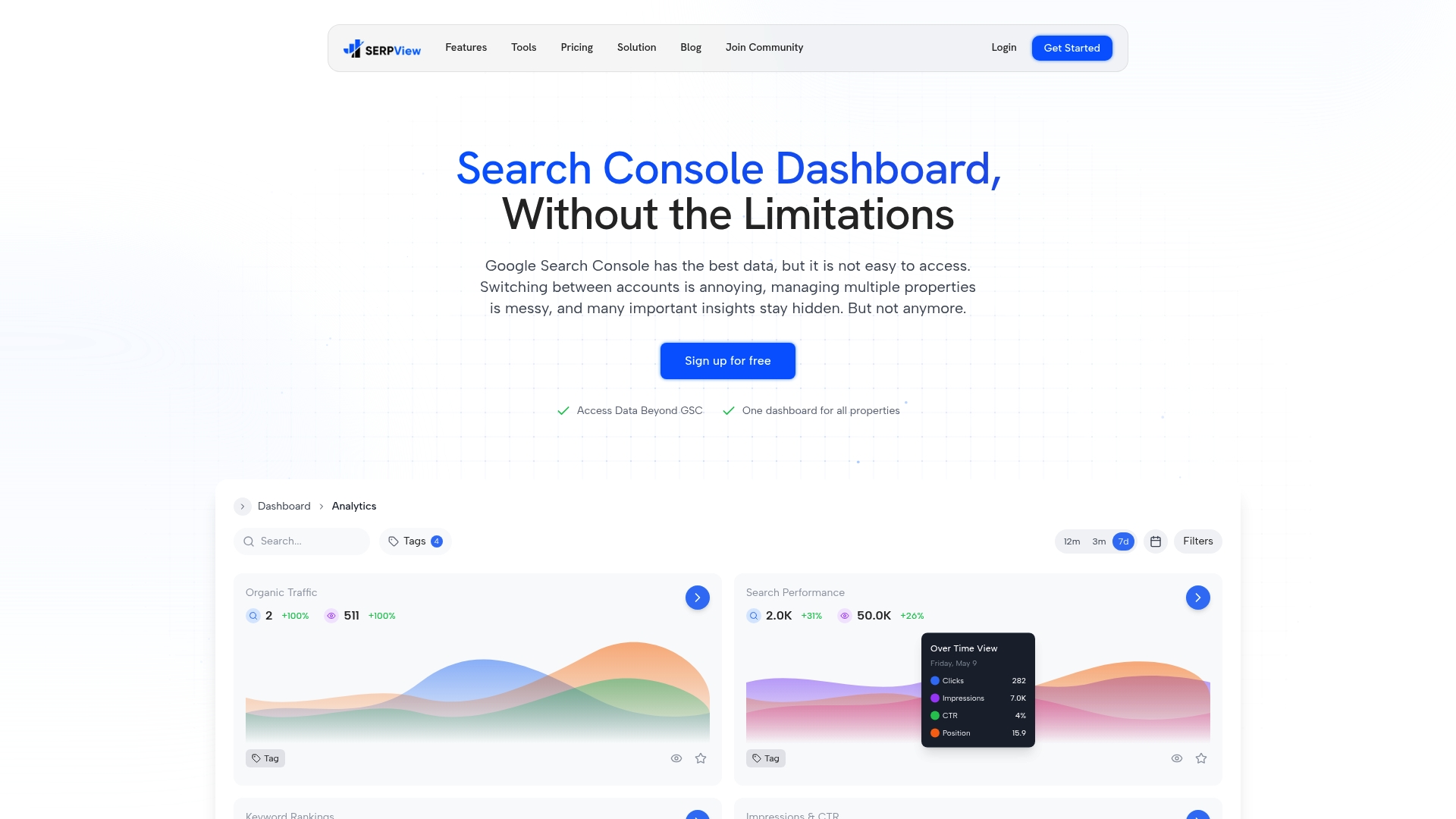
For real-time search ranking monitoring, Serpview’s live updates, customizable filters, and AI citation tracking give you the signal clarity that generic analytics tools miss. The Google Search Console integration page explains how Serpview extends GSC data into a monitoring layer built for speed and scale. If you are ready to move beyond weekly reports, Serpview gives your team the live visibility to act when it counts.
FAQ
What is real-time search data in SEO?
Real-time search data is the continuous, low-latency retrieval of search ranking signals, AI citation appearances, and query performance metrics as they occur. It contrasts with batch processing, which delivers data in scheduled cycles hours or days after the fact.
How does live search data improve SEO performance?
Live search data compresses SEO feedback loops, reducing the time between a ranking change and your response from weeks to hours. For authoritative domains, this speed advantage extends to AI citation monitoring, where structured content can be cited within hours of publication.
What is the difference between live retrieval and streaming ingestion?
Live retrieval queries data sources at request time, while streaming ingestion continuously updates an index for near-instant access. Streaming ingestion delivers better data freshness for continuous SEO monitoring, though it carries higher infrastructure cost.
How do I avoid alert fatigue in real-time monitoring?
Set strict relevance thresholds that define what constitutes a genuine ranking event, such as a drop of five or more positions on a priority query. Filtering out normal daily fluctuations keeps alerts meaningful and prevents your team from tuning out the dashboard.
Why does structured content matter for AI search citations?
AI search engines pull from live retrieval pools where schema markup, metadata completeness, and domain trust determine citation priority. Structured, factual content on trusted domains enters these pools faster and is cited more consistently than unstructured content.
Recommended
Ready to unlock your full GSC potential?
SERPView helps you access all your Google Search Console data without limitations. Start your free trial today.
Get Started Free