
Keyword Performance Tracking for SEO Pros: How to Measure and Act
SERPView Team
SEO Analytics
Keyword performance tracking is the ongoing measurement of how your target keywords rank, get seen, get clicked, and get converted, so you can prove which terms are earning their keep. If you’re starting today, do three things: pick your priority keyword set, connect Google Search Console and GA4 as your primary data sources, and record a baseline before you touch anything.
Here’s the immediate playbook:
- Pick priority keywords based on revenue potential, not just search volume.
- Connect your primary data sources (Google Search Console, GA4, and a rank tracker) so rankings, clicks, and conversions live in one view.
- Set a baseline and an alert threshold so you know what “normal” looks like before something breaks.
From here, we’ll walk through the exact KPIs to track, a step-by-step measurement workflow, the tools that actually matter, and the mistakes that quietly wreck good data.
Key Takeaways
Keyword performance tracking works when you pair ranking data with engagement and conversion metrics, using GSC and GA4 as your foundation and a weekly cadence to catch real signals before they become quarterly surprises.
| Point | Details |
|---|---|
| Track four layers, not one | Combine rank, visibility, engagement, and conversions instead of reporting position alone. |
| Use the CTR formula correctly | Calculate CTR as clicks divided by impressions, times 100, to catch title and meta problems early. |
| Set a weekly triage cadence | Daily data is noisy; weekly reviews catch real trend shifts without overreacting to volatility. |
| Watch for cannibalization | Multiple pages ranking for one query split your signal; canonicalize or merge them. |
| Consolidate your data sources | Serpview unifies GSC exports beyond the 1,000 row limit for faster diagnosis and client reporting. |
Table of Contents
- What Does Keyword Performance Tracking Actually Cover?
- Which KPIs Should You Track and How Do You Calculate Them?
- How Do You Measure Keyword Performance Step by Step?
- Which Tools and Data Sources Do You Actually Need?
- How Do You Improve Keyword Performance Once You’ve Measured It?
- What Are the Most Common Keyword Tracking Mistakes?
- Why Does a Unified Dashboard Speed Up Diagnosis?
- A Practitioner’s Take on Tracking Habits That Actually Pay Off
- How Serpview Removes the Manual Work From Tracking
- Sources
- FAQ
What Does Keyword Performance Tracking Actually Cover?
Keyword performance tracking means watching four layers over time: where a keyword ranks, how visible it is in search results, how much engagement it earns, and what outcomes it produces. A single ranking number tells you almost nothing on its own. Pairing that rank with traffic and conversion data is what turns a position report into a business signal, according to Klipfolio’s keyword performance framework.
What belongs in scope:
- Google Search Console data: impressions, clicks, and average position for organic queries.
- Rank tracker positions, ideally checked daily or every few days for volatile terms.
- GA4 sessions and conversions mapped back to the landing page a keyword drives to.
What stays out of scope: brand sentiment, generic site-wide analytics with no keyword tie-back, and social engagement metrics. Keyword-level tracking is narrower than page-level or content performance tracking, which looks at a URL’s total traffic regardless of which query sent it there.
Which KPIs Should You Track and How Do You Calculate Them?
Ten numbers matter more than the rest. Track these consistently and you’ll catch problems before they become quarter-ending surprises.
- Rank/position: your keyword’s average position in search results, pulled from GSC or a rank tracker.
- Ranking distribution: the count of keywords in top 3, top 10, and top 20. This shows momentum better than any single average.
- Impressions: how often your page appeared in search results for that query.
- Clicks: how many of those impressions turned into a visit.
- Click-through rate (CTR): clicks divided by impressions, times 100.
- Organic sessions: visits attributed to that keyword’s landing page, from GA4.
- Conversions attributed to keyword: goal completions tied back to that session.
- Conversion rate: conversions divided by sessions, times 100.
- Visibility score: a weighted composite of rankings and search volume, useful for tracking a keyword group rather than one term.
- Share of voice: your visibility relative to the total available visibility for a keyword set, a rough proxy for competitive standing.
Statistic Callout: The CTR Formula CTR = (Clicks ÷ Impressions) × 100. If yours doesn’t, your title tag or meta description has a problem, not your ranking.
Map each KPI to a goal before you report it. Rankings and impressions serve awareness. Clicks and CTR serve traffic. Conversions and conversion rate serve revenue. Reporting a rankings win without checking whether conversions moved is how teams celebrate metrics that don’t pay the bills.
One caveat worth flagging early: GSC’s own interface caps exports at 1,000 rows, and its click and impression data can be sampled or delayed for low-volume queries. Combining rank-aware metrics like nDCG or MRR with real click behavior gives a fuller picture than either alone, a point echoed in Meilisearch’s guide to search relevance metrics.
How Do You Measure Keyword Performance Step by Step?
A repeatable process beats a one-off audit every time. Here’s the sequence we recommend running for any keyword set, whether it’s five terms or five hundred.
- Select and prioritize your keyword set. Start with terms tied to revenue pages, not vanity volume. Check keyword difficulty alongside intent before committing tracking resources to a term.
- Map each keyword to a landing page and funnel step. If three keywords point to the same page, you’ve already found a potential cannibalization issue before you’ve collected a single data point.
- Connect your data sources. Link Google Search Console and GA4, and layer in a dedicated rank tracker for daily position history GSC doesn’t reliably provide.
- Set baselines and expected volatility windows. A keyword that swings three positions in a week might be normal; know that range before you panic over it.
- Establish reporting cadence. Daily checks surface noise. Weekly reviews catch real trend shifts. Monthly reports are where you present outcomes to stakeholders. Klipfolio’s guidance on keyword reporting cadence makes the same case: daily data misleads, weekly and monthly baselines reduce false positives.
Set alerts around thresholds that actually matter:
- A significant ranking drop on a high-intent, high-conversion keyword.
- A sharp CTR collapse without a rank change, often indicating a SERP feature or title tag problem.
- Multiple pages ranking closely for the same query, a cannibalization signal.
When an alert fires, check indexing status first, then SERP features, then competitor movement, before assuming your content is at fault.
Pro Tip: Annotate the exact date of any site change, algorithm update, or content edit directly on your tracking timeline. Six weeks later, “traffic dropped in March” is useless. “Traffic dropped the week we merged two blog categories” tells you exactly where to look.
Which Tools and Data Sources Do You Actually Need?
No single tool covers the full picture, and that’s the root of most tracking headaches. Each source contributes a distinct layer:
- Google Search Console: the canonical source for organic impressions, clicks, and average position, and it should anchor any keyword performance tracking stack.
Google Ads keyword reports carry their own caveat: complete daily data isn’t available until roughly 3 p.m. Pacific the following day, so same-day paid keyword analysis will always be incomplete. For large keyword sets, GSC’s row limits become a real constraint fast, and that’s where a unified export matters more than another spreadsheet.
How Do You Improve Keyword Performance Once You’ve Measured It?
Measurement without action is just a report nobody reads. Once your KPIs flag an underperformer, work through these in order:
- Match intent to content. A keyword ranking on page one with high impressions but weak clicks often signals a mismatch between what the searcher wants and what your search intent category actually delivers.
- Refresh conversion-focused pages first. Prioritize the pages closest to page one that already have a working conversion path. That’s where a small rank gain pays off fastest.
- Improve internal linking. Pages starved of internal links rarely climb, no matter how good the content is.
- Target SERP features with structured data. Featured snippets, FAQ blocks, and product rich results all pull extra visibility from the same ranking position, and structured data is how you become eligible.
Run experiments, not guesses: test title and meta description variants to lift CTR, compare a light content refresh against a full rebuild, or test a new internal linking pattern on a cluster of related pages.
Pro Tip: Rank optimization work by expected conversion impact, not by rank position alone. A page stuck at position 11 with a strong conversion rate on page one traffic is worth more effort than a page 4 term with no clear path to revenue.
What Are the Most Common Keyword Tracking Mistakes?
Bad data leads to confident wrong decisions, which is worse than no data at all. Watch for these:
- SERP volatility and personalization make single-day rank checks unreliable. Use weekly cohorts instead of daily snapshots.
- Mismatched attribution between GSC and GA4 happens because the two tools use different session and click definitions. Treat small discrepancies as expected, not broken.
- Sampling and export limits in GSC’s native interface hide the long tail of your keyword set. Raise your minimum impression threshold before drawing conclusions from thin data.
- Keyword cannibalization quietly splits your ranking signal across multiple pages. Canonicalize or merge overlapping content.
- Noise from low-volume keywords skews averages. Filter them out of your headline reports, even if you still track them separately.
Run a quick data-quality check before trusting any signal: confirm the date range matches across tools, confirm the keyword is mapped to the right URL, and confirm the sample size clears your minimum threshold.
Why Does a Unified Dashboard Speed Up Diagnosis?
Picture a typical incident: a high-value keyword drops five positions overnight. In a fragmented setup, you’d check GSC, then GA4, then your rank tracker, then indexing status, one tab at a time. In a unified view, ranking, CTR, landing page conversions, and index status sit side by side, so you form a root-cause hypothesis in minutes rather than hours.
Prioritize dashboards that offer:
- Cross-property GSC exports beyond the native 1,000 row limit.
- Long-range historical data for spotting seasonal patterns.
- Device and country filters, since mobile and desktop performance often diverge sharply.
- Landing-page mapping and annotation support for tracking changes over time.
Statistic Callout: Time-to-detect is the metric that matters for dashboard ROI: how many days pass between a real ranking change and the moment your team notices it. A dashboard that shortens that window from a week to a day is worth more than any single feature on its spec sheet.
A Practitioner’s Take on Tracking Habits That Actually Pay Off
The tracking win that stuck with me wasn’t a ranking jump. It was a CTR collapse we caught within days on a converting page, traced to a competitor stealing a featured snippet. We rewrote the intro to reclaim it and recovered the clicks in two weeks.

The habit behind that catch: a short weekly triage session reviewing keyword alerts, not a monthly deep dive. Small, consistent checks compound faster than heroic quarterly audits ever do.
How Serpview Removes the Manual Work From Tracking
Most of the friction in keyword performance tracking comes from stitching together GSC exports, GA4 pulls, and a rank tracker by hand, then hitting Search Console’s 1,000 row ceiling right when you need the full picture. Serpview removes that ceiling: it consolidates GSC data across multiple properties into one dashboard with up to 50,000 exportable rows, plus the historical range and device segmentation raw GSC never gives you.
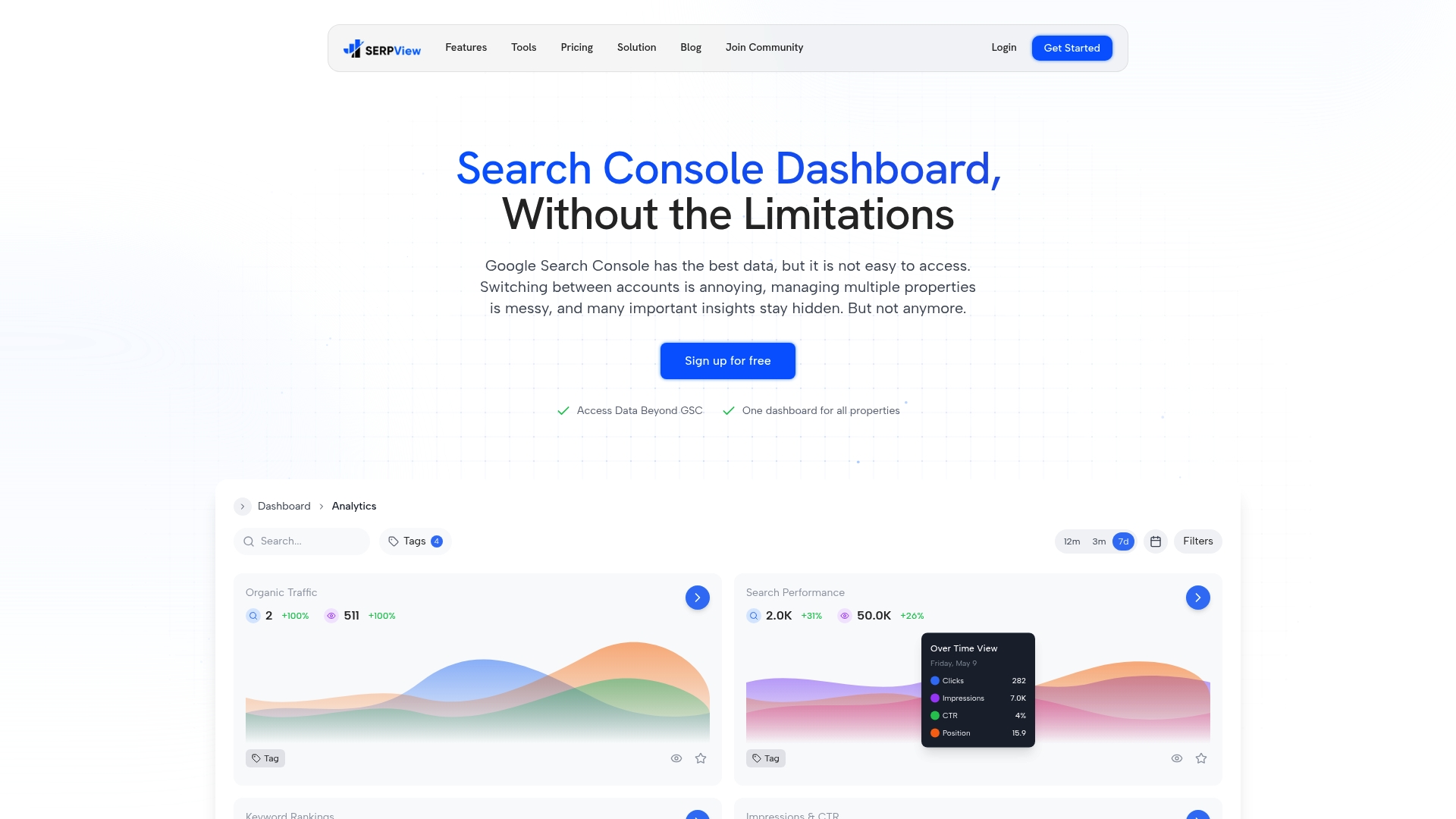
That consolidation shows up in three concrete ways:
- Faster triage, since ranking, CTR, and index status sit in one view instead of four browser tabs.
- Deeper historical analysis, so you can spot seasonal patterns GSC’s shorter retention window hides.
- Client-ready reporting, with white-label sharing for agencies managing several accounts at once.
If your team is still exporting spreadsheets to answer “why did this keyword drop,” start with the Google Search Console glossary breakdown to see exactly where native GSC falls short, then check the SERPView query counting feature to see how ranking-tier analysis works in practice.
Sources
- A practical guide to search relevance metrics and evaluation | Meilisearch
- Keyword Performance: What It Is & Best Practices | Klipfolio
- How to view your keyword performance (Google Ads help)
FAQ
How Do You Track Keyword Performance?
Connect Google Search Console for impressions, clicks, and average position, link GA4 for conversions, and add a rank tracker for precise daily position history, then review the combined data weekly.

Which Keyword Tracker Is the Best?
There’s no single best tracker for every team; the right choice depends on whether you need daily SERP granularity, GSC row limits solved, or client-ready reporting. A unified platform like Serpview matters most once your keyword set outgrows GSC’s 1,000 row export cap.
Is Keyword Ranking a KPI?
Ranking is a component KPI, but it only becomes meaningful when paired with impressions, CTR, and conversion data. Rank alone tells you position, not business impact.
What Are the Top Website Performance Metrics to Monitor?
Focus on organic CTR, conversion rate, and average ranking position for priority keywords. Together, these three show whether visibility is actually turning into revenue.
How Often Should You Report on Keyword Performance?
Review data weekly to catch real trends, and reserve monthly reports for stakeholder summaries. Daily checks tend to surface volatility rather than genuine signal.
Recommended
Ready to unlock your full GSC potential?
SERPView helps you access all your Google Search Console data without limitations. Start your free trial today.
Get Started Free