
What Is Search Performance Benchmarking? A Clear Guide
SERPView Team
SEO Analytics

Search performance benchmarking is the systematic process of measuring how well a search system delivers speed, relevance, and user satisfaction, then comparing those measurements against a defined baseline over time. It covers both technical and product metrics: latency, throughput, and recall@K on the technical side; click-through rate (CTR), conversion rate, and zero-result rate on the product side. The goal is not a one-time audit. It is a continuous, repeatable workflow that tells you, with data, whether your search system is getting better or quietly degrading.
Here is what that looks like in practice:
- Offline evaluation: You run a fixed set of test queries against your search index and score results using relevance judgments. Metrics like Mean Reciprocal Rank (MRR), Normalized Discounted Cumulative Gain (nDCG), and Mean Average Precision (MAP) tell you how accurately the system ranks results.
- Online evaluation: You track real user behavior, including CTR, bounce rate, session abandonment, and conversion rate, to see how those rankings translate into actual satisfaction.
- Infrastructure metrics: Latency (especially P95), throughput in queries per second, and indexing cost tell you whether the system can sustain its quality under real load.
Together, these three layers give you a complete picture of search health. Without all three, you are measuring a shadow of the actual system.
Why benchmarking search performance is critical for SEO success
Benchmarking is how you separate a system that feels fast from one that is effective. A search engine that is fast but inaccurate creates hidden operational debt: users get quick responses that miss what they actually need, downstream AI models receive poor-quality inputs, and support workflows slow down as a result.
The business case for regular benchmarking is direct:
- User experience: Slow or irrelevant results push users to abandon a search session. Tracking zero-result rates and abandonment rates reveals exactly where that friction lives.
- Conversion impact: Search performance drives revenue in measurable ways. A drop in CTR on high-intent queries often precedes a drop in conversions, and benchmarking catches that signal early.
- Algorithmic accountability: Search algorithms change, whether through deliberate updates or infrastructure shifts. Without a benchmark, you cannot tell whether a traffic change came from an algorithm update or a degradation in your own system.
- Data-driven decisions: Anecdotal impressions (“search feels slower lately”) are not actionable. A fixed test set with documented baselines turns vague impressions into specific, fixable problems.
The contrast between impression-based and data-driven decision-making is sharpest when something goes wrong. Teams without benchmarks spend days debating whether a problem exists. Teams with benchmarks spend that time fixing it.
What types of benchmarking apply to search systems?

Search benchmarking does not follow a single template. The right approach depends on what you are measuring and why. Three main types apply here, and most mature teams use a combination.
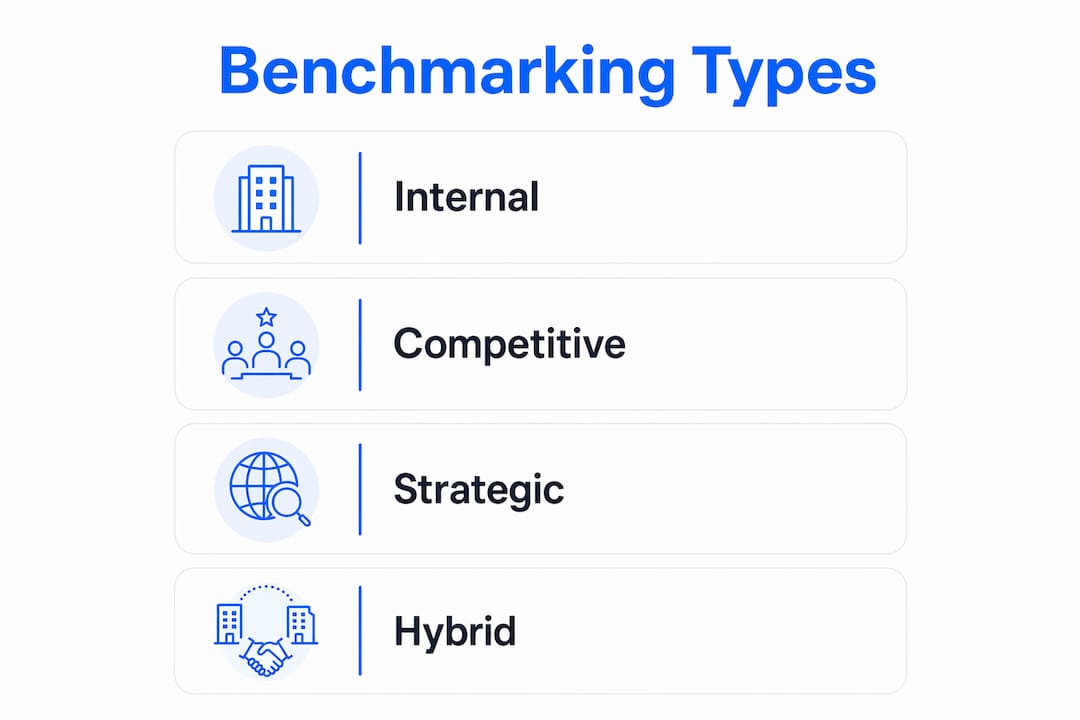
Internal (baseline) benchmarking compares your system against its own historical performance. You run the same fixed query set at each review cycle and track whether latency, recall, or CTR has shifted. This type is the foundation. Without a fixed, repeatable test set, performance discussions stay vague and comparisons across time become unreliable.
Competitive benchmarking measures your search quality against an external reference point, such as an industry standard or a published benchmark corpus. This is common in information retrieval research, where shared datasets like MS MARCO or BEIR provide a common yardstick. For SEO practitioners, it often means comparing your organic search metrics against category averages or published CTR benchmarks by industry.
Strategic benchmarking focuses on aligning search performance with specific business objectives. Rather than asking “is our recall better than last month?” it asks “does our search system support the conversion goals we set for Q3?” SLOs (Service Level Objectives) are the formal expression of this type: you define what “good enough” means for your business before testing begins.
Hybrid approaches combine offline and online evaluation. You use a curated test set to measure ranking quality, then validate those findings against real user signals like CTR and session depth. This combination is the most reliable method because offline metrics measure accuracy while online metrics measure impact.
The classification matters because it shapes how you design your test set, which metrics you prioritize, and how you interpret results. A team running only internal benchmarks may miss that their “improved” recall still lags behind what users actually expect.
How to benchmark search performance step by step
A structured process prevents the two most common failures: measuring the wrong things and measuring them inconsistently. Here is a practical workflow you can apply to an SEO program, a site search system, or a retrieval pipeline.
Step 1: Define scope and objectives. Decide what you are benchmarking and why. Are you evaluating a site search upgrade? Tracking organic search performance after a content update? Measuring the impact of a reranking layer? Clear objectives determine which metrics matter and which are noise.

Step 2: Build a representative query set. Select queries that reflect real user behavior, covering high-volume head terms, mid-tail navigational queries, and edge cases that stress the system. This set becomes your golden test set. Protect it. Do not modify it between cycles unless you version the change explicitly.
Step 3: Establish a baseline. Run your test set against the current system and record all target metrics. This baseline is your reference point for every future comparison. Document the environment: index size, algorithm version, infrastructure configuration, and any recent content changes.
Step 4: Collect data across both evaluation modes. Run offline evaluation using your fixed query set and score results with relevance judgments. Simultaneously, pull online data from your analytics platform covering CTR, bounce rate, zero-result rate, and conversion metrics for the same query categories.
Step 5: Apply your KPIs systematically. Track latency (P95 in particular), throughput, recall@K, CTR, bounce rate, and conversion rate. Record each metric at the same point in the test cycle so comparisons stay valid.
Step 6: Document contextual variables. Note every change that could affect results: algorithm updates, infrastructure migrations, index rebuilds, content volume shifts, or frontend changes. Without this log, you cannot distinguish a genuine performance change from an environmental artifact.
Step 7: Iterate and monitor continuously. Benchmarking is not a quarterly event. Set up a recurring review cadence and, where possible, a real-time dashboard that flags anomalies between formal review cycles.
Pro Tip: Never modify your golden query set between benchmark cycles without creating a new versioned baseline. Changing the test set mid-stream is the fastest way to introduce benchmark drift, where your metrics appear to improve simply because you removed the hard queries.
Key metrics and tools for measuring search performance
Choosing the right metrics is where most benchmarking programs either gain traction or stall. The metrics below cover the full stack from infrastructure to user behavior.
Technical metrics:
- Latency (P95): The response time at the 95th percentile of all queries. Average latency hides spikes; P95 captures the tail behavior that users actually experience as slowness or instability.
- Throughput: Sustainable queries per second at a defined SLO. A synthetic maximum throughput number is misleading; what matters is how many queries the system handles before P95 degrades.
- Recall@K: The fraction of relevant results that appear in the top K positions. A system with high recall at K=10 retrieves most of the right answers in the first page of results.
- Indexing cost: Compute, storage, and rebuild time. Systems that are fast at query time but expensive to rebuild are a poor fit for frequently updated catalogs or knowledge bases.
Relevance metrics:
- MAP (Mean Average Precision): Averages precision across all recall levels, giving a single score for ranking quality across a query set.
- MRR (Mean Reciprocal Rank): Measures how high the first relevant result appears. Useful when users typically click the first good result and stop.
- nDCG (Normalized Discounted Cumulative Gain): Weights results by position, so a relevant result at rank 1 scores higher than the same result at rank 5. Offline metrics like nDCG give a quantitative view of ranking quality that simpler precision scores miss.
User engagement metrics:
- CTR: The percentage of impressions that result in a click. Low CTR on high-ranking results often signals a relevance or title/description mismatch.
- Zero-result rate: The percentage of queries that return no results. A rising zero-result rate points to index gaps or query understanding failures.
- Bounce rate and abandonment: Users who leave immediately after a search result suggest the result did not match their intent.
- Conversion rate: The downstream business metric that ties search quality to revenue.
Tools and frameworks: Google Search Console provides organic search data including impressions, clicks, CTR, and average position, though its default 1,000-row export limit restricts deep analysis. Custom logging pipelines capture query-level latency and error rates. A/B testing frameworks let you compare algorithm variants on live traffic. For search performance aggregation across multiple properties, a unified analytics platform removes the row-limit constraint and surfaces patterns that property-level views obscure. OpenSearch Benchmark is a purpose-built macrobenchmark utility for measuring cluster-level throughput, latency, and indexing performance under realistic workloads.
Pro Tip: Combine offline relevance metrics with online engagement signals before drawing conclusions. A high nDCG score alongside a low CTR usually means your ranking is accurate but your result presentation (titles, snippets, structured data) is not matching user expectations.
Best practices for effective SEO search performance benchmarking
Getting benchmarking right comes down to a few disciplines that separate teams with reliable data from teams with noise.
Use a curated golden query set. Your test set should include common queries, navigational queries, and edge cases that stress the system. The mix matters. A set that only covers head terms will miss the recall failures that happen on long-tail queries, where user intent is often more specific and harder to satisfy. You can read more about how SEO performance benchmarks are structured across query types in Serpview’s benchmarking guide.
Run multiple trials per query. Search systems are stochastic: API variability, caching effects, and load fluctuations mean a single run can be misleading. For retrieval tasks, 8–16 trials per query produce reliable measurements; complex reasoning tasks benefit from 32 or more. Single-run benchmarks are not benchmarks. They are snapshots.
Set formal SLOs before testing. Define what “good enough” means before you run a single query. A P95 latency target, a minimum recall threshold, a floor on CTR for priority query categories. Without these targets, benchmark results become discussion material rather than decision material.
Use a layered measurement approach. Measure each system component separately: retrieval engine, reranker, embedding generator, and application gateway. Then measure the end-to-end path. A fast vector database can still deliver a slow product if embedding generation or network overhead dominates. Knowing which layer is the bottleneck tells you exactly where to focus.
Integrate human relevance judgments. Quantitative metrics alone do not capture nuanced relevance. A graded rubric reviewed by multiple raters, with inter-rater agreement validated using Cohen’s Kappa or Intraclass Correlation Coefficient, adds a qualitative layer that pure metrics miss. This is especially important for queries where relevance is subjective or context-dependent.
Build a continuous monitoring pipeline. Point-in-time benchmarks catch problems after the fact. A real-time dashboard that tracks CTR, zero-result rate, and P95 latency catches degradation as it happens. Serpview’s custom annotations feature lets you mark algorithm updates and infrastructure changes directly on your performance timeline, so you can correlate metric shifts with specific events rather than guessing.
Avoid common pitfalls:
- Relying on ad-hoc impressions instead of fixed test sets.
- Measuring only average latency and missing tail behavior.
- Treating a one-time benchmark as a permanent baseline without re-running after major changes.
- Optimizing a single metric (say, latency) at the expense of recall, which produces a fast system that fails users.
- Benchmarking only under ideal conditions rather than under realistic or peak load.
For teams that want a practical reference on how benchmarking applies across different value contexts, the same core principles of fixed reference points, repeatable measurement, and documented context apply regardless of the domain.
Key Takeaways
Search performance benchmarking requires a fixed query set, layered metrics covering both technical performance and user engagement, and a continuous monitoring cadence to produce decisions rather than debates.
| Point | Details |
|---|---|
| Combine offline and online evaluation | Offline metrics measure ranking accuracy; online signals like CTR and bounce rate show real user impact. |
| P95 latency over average latency | Average latency hides spikes; P95 captures the tail behavior users experience as instability. |
| Run multiple trials per query | For retrieval tasks, 8–16 trials per query reduce noise from API variability and caching effects. |
| Set SLOs before testing | Define P95 targets and minimum recall thresholds before running benchmarks so results drive decisions. |
| Protect your golden query set | Never modify the test set between cycles without versioning the change, or benchmark drift invalidates comparisons. |
FAQ
What is performance benchmarking in search?
Performance benchmarking in search is the process of measuring a search system’s speed, relevance, and user engagement against a defined baseline using fixed test queries and real user data. It covers both technical metrics like latency and recall and product metrics like CTR and conversion rate.
What are the key metrics for search performance?
The core metrics are P95 latency, throughput, recall@K, CTR, zero-result rate, bounce rate, MAP, MRR, and nDCG. Technical metrics measure infrastructure health; relevance metrics assess ranking quality; engagement metrics reflect actual user satisfaction.
How do you benchmark SEO performance?
Build a fixed query set covering head terms and edge cases, establish a baseline using both offline relevance scoring and online analytics data, then run the same test set at each review cycle while documenting all system changes between cycles.
What are the four stages of benchmarking?
The four stages are: define scope and select a representative query set, establish a baseline by measuring current performance, run comparative evaluations across cycles or system variants, and act on findings by targeting the specific layer or metric that shows the largest gap against your SLOs.
Recommended
Ready to unlock your full GSC potential?
SERPView helps you access all your Google Search Console data without limitations. Start your free trial today.
Get Started Free