
How Search Analytics Measures ROI for Marketers
SERPView Team
SEO Analytics

TL;DR:
- Search analytics measures ROI by comparing revenue from organic search to the costs involved. It uses multiple attribution models and extended data to accurately reflect SEO’s contribution, especially considering AI and dark social influences. Applying this data helps optimize marketing budgets and improve decision-making, resulting in better ROI insights for 2026.
Search analytics measures ROI by comparing the revenue generated from organic search activity against the costs invested to produce it. This process goes well beyond counting clicks. It maps conversion paths, assigns financial value to keyword performance, and reveals which content drives real business outcomes. Understanding how search analytics measures ROI is the difference between guessing at your marketing budget and defending it with data. SEO delivers an average ROI of 748% across industries, making it one of the highest-returning channels available to marketing analysts and business owners today.
How search analytics measures ROI: core methods and formulas
The standard SEO ROI formula is straightforward: ((Revenue from SEO minus Cost of SEO) / Cost of SEO) × 100. That formula gives you a percentage return on every dollar spent on organic search. The challenge is feeding it accurate inputs, which is where most teams fall short.
Three calculation approaches give you progressively deeper insight:
-
Direct revenue attribution ties specific transactions to organic search sessions. You track a user who found you through a search query, completed a purchase, and assign that revenue to SEO. This works well for e-commerce but misses longer B2B sales cycles.
-
Assisted conversion value captures the contribution of organic search in multi-step journeys. A user might find your site through a blog post, leave, return via a branded search, and then convert. Direct attribution credits the branded search. Assisted attribution credits the blog post too. Both matter.
-
Media equivalency value compares what you would have paid in paid search (PPC) to acquire the same traffic organically. Effective SEO strategies produce a cost per lead between $30 and $60, compared to $150 to $300 for PPC. That gap is a measurable financial advantage.
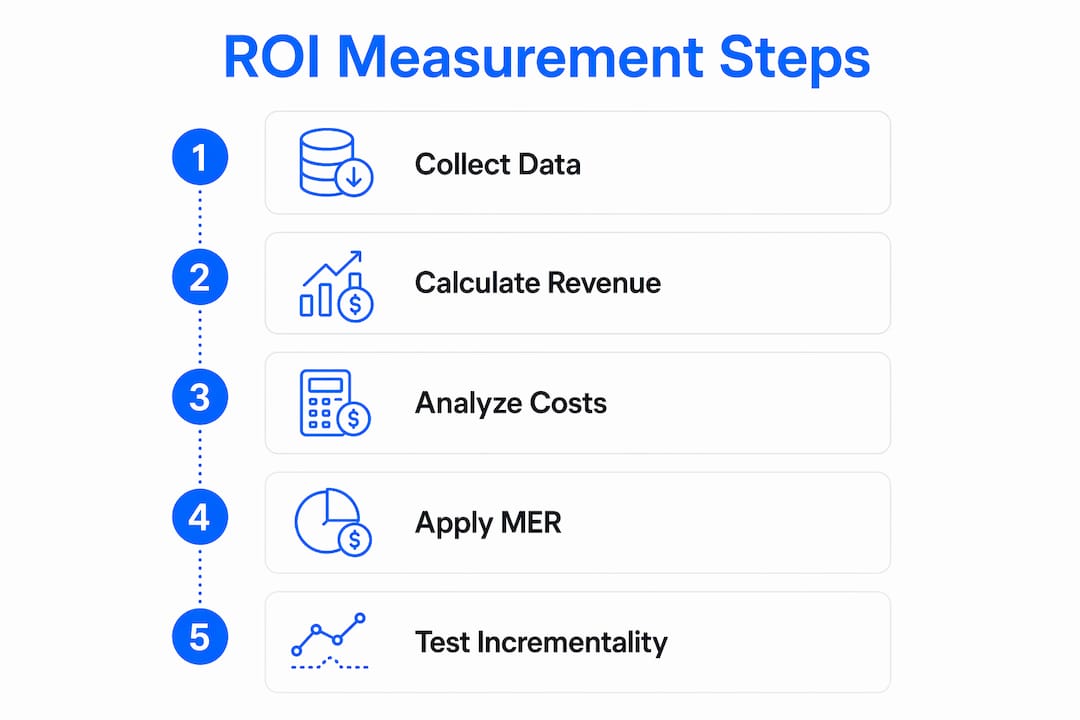
For a system-level view, the Marketing Efficiency Ratio (MER) equals total revenue divided by total marketing spend. MER gives you a blended performance number across all channels. It is especially useful when attribution across channels is messy or incomplete.
Advanced teams also use incrementality testing. This involves running holdout groups or geo experiments to isolate the revenue lift that SEO actually caused, separate from organic growth that would have happened anyway. Without incrementality testing, your ROI figures can be inflated by trends you did not create.

Pro Tip: Apply the “So What?” test to every metric in your ROI report. Ask “So what?” three times in a row. If you cannot connect a data point to a financial outcome by the third answer, that metric lacks decision-grade value and should be cut from your executive reporting.
What challenges arise when measuring search analytics ROI?
ROI measurement in search analytics fails most often because of three structural problems: time lag, attribution errors, and incomplete cost accounting.
Time lag is the most underestimated issue. SEO investments typically take 6 to 12 months before producing measurable returns. Teams that evaluate SEO performance on a 30-day or 90-day window will consistently conclude it is not working, even when it is. Rolling averages over longer windows prevent false conclusions.
Attribution errors are the second major problem. Last-click attribution misattributes 58 to 65% of conversions. The actual organic search contribution, when measured with multi-touch attribution, is closer to 22 to 24%. That gap means businesses using last-click models are systematically undercounting SEO’s value and overpaying for channels that appear at the end of the funnel.
The third problem is incomplete cost accounting. Most teams track content creation costs but omit technical SEO work, tool subscriptions, and internal staff time. An ROI figure built on partial costs is not an ROI figure. It is a best-case estimate.
Additional challenges in 2026 include:
-
AI-generated answer visibility: When your content appears in AI overviews or cited responses, it drives brand awareness and indirect traffic that standard analytics does not capture directly.
-
Dark social influence: Users who discover your content through AI tools, private messaging, or voice search often arrive later through direct or branded search, making the original touchpoint invisible.
-
Branded search volume as a proxy: Growth in branded search queries is a reliable indirect signal that your organic content is building authority and recall, even when direct attribution is not possible.
Pro Tip: Use extended historical data storage to track rolling 12-month averages. Short data windows are the single most common reason SEO ROI looks worse than it actually is.
What key SEO metrics and KPIs drive ROI from search campaigns?
The metrics that connect search performance to business outcomes fall into four categories: traffic quality, conversion efficiency, cost comparison, and visibility signals.
| Metric | What it measures | Why it matters for ROI |
|---|---|---|
| Organic conversion rate | Percentage of organic visitors who complete a goal | Directly links traffic to revenue |
| Cost per lead (CPL) | Cost to acquire one lead through organic search | Benchmarks SEO efficiency against PPC |
| Assisted conversion value | Revenue influenced by organic search across multi-step journeys | Captures full-funnel contribution |
| Branded search volume | Growth in searches for your brand name | Signals brand authority and recall |
| AI share of voice | Frequency of brand mentions in AI-generated answers | Emerging visibility metric for 2026 |
Content freshness and structured data now play a direct role in search visibility. Traditional metrics like backlinks predict only 4 to 7% of AI citation behavior. Content published or updated within 13 weeks and marked up with schema drives significantly more AI-based visibility. That shift changes how you should weight your KPIs.
Tracking click-through rate by ranking position tells you whether your titles and meta descriptions are earning their impressions. A page ranking in position 3 with a below-average CTR is leaving revenue on the table. Fixing the title tag costs almost nothing and can materially increase organic revenue without changing your ranking.
The most effective ROI dashboards combine these metrics into a single view that connects search performance to pipeline or revenue data. Serpview’s unified dashboard pulls up to 50,000 rows of search data, giving you the granularity to identify which specific queries are driving conversions rather than just traffic.
How can businesses apply ROI data to optimize marketing investment?
ROI data from search analytics is only useful if it changes decisions. Here is how to apply it systematically:
-
Prioritize high-converting keyword clusters. Sort your organic traffic by conversion rate, not just volume. A keyword driving 200 visits and 20 conversions outperforms one driving 2,000 visits and 5 conversions. Shift content investment toward the clusters with proven conversion records.
-
Reallocate budget from lower-performing channels. When your SEO CPL is $40 and your paid search CPL is $220 for the same audience, the data makes the budget decision for you. Use multi-touch attribution reports to build the case for reallocation with full-funnel evidence, not just last-click numbers.
-
Use assisted conversion data to protect top-of-funnel content. Blog posts and informational pages rarely get direct conversion credit. Assisted conversion reports show their actual contribution to closed revenue. Without this data, teams cut the content that is doing the most work.
-
Apply incrementality testing before scaling. Before doubling your SEO budget, run a geo experiment. Measure organic revenue in test markets versus control markets over 90 days. Organizations using structured analytics frameworks achieve 300% to 4,600% ROI within 90 days when they connect data outputs to specific business outcomes. Incrementality testing is how you confirm you are in that range, not just assuming it.
-
Track decision velocity, not just dashboard metrics. Analytics ROI maps to changes in behavior and decision speed. If your team is making faster, more confident budget decisions because of your search data, that is a measurable business outcome. Document it.
The Serpview N-gram report identifies recurring query patterns across your search data, which helps you spot content gaps and keyword clusters that are driving assisted conversions you might otherwise miss.
Key takeaways
Search analytics measures ROI most accurately when you combine multi-touch attribution, rolling time windows, and full cost accounting rather than relying on last-click data alone.
| Point | Details |
|---|---|
| Use the standard ROI formula | Apply ((Revenue from SEO minus Cost of SEO) / Cost of SEO) × 100 with complete cost inputs. |
| Extend your measurement window | SEO returns take 6 to 12 months; use rolling averages to avoid false conclusions. |
| Replace last-click attribution | Multi-touch models reveal the true 22 to 24% organic search contribution to conversions. |
| Track AI visibility signals | Content freshness under 13 weeks and schema markup now drive AI-based search ROI. |
| Apply the “So What?” test | Every metric in your report must connect to a financial outcome or it should be removed. |
Search analytics ROI in 2026: what I’ve learned the hard way
The biggest mistake I see marketing analysts make is treating ROI measurement as a reporting exercise rather than a decision-making tool. They build dashboards that look impressive in quarterly reviews but do not change a single budget line. That is not measurement. That is theater.
The shift that actually matters is moving from last-click attribution to system-level thinking. Last-click attribution is comfortable because it is simple. But it systematically rewards the final touchpoint and punishes the content that did the real work of building awareness and intent. When you switch to MER and multi-touch models, the picture changes dramatically, and so do the budget conversations.
The AI dimension in 2026 adds a layer most teams are not ready for. When your content gets cited in an AI-generated answer, you get brand exposure without a click. Standard analytics shows nothing. But branded search volume goes up weeks later. Tracking that signal, and connecting it to eventual conversions, is the new frontier of search ROI measurement. Teams that ignore it are undercounting their SEO returns by a meaningful margin.
My practical advice: start with one clean ROI number per quarter using the standard formula, then layer in assisted conversions and branded search trends. Do not try to build the perfect attribution model on day one. Build a directionally accurate one that your leadership team trusts, then refine it. A good decision made on solid data beats a perfect model that nobody acts on.
— Utsav
How Serpview supports search analytics ROI measurement
Measuring search analytics ROI requires data depth that standard tools often cannot provide. Serpview addresses this directly by removing the 1,000-row restriction from Google Search Console data, giving you access to up to 50,000 rows per report.
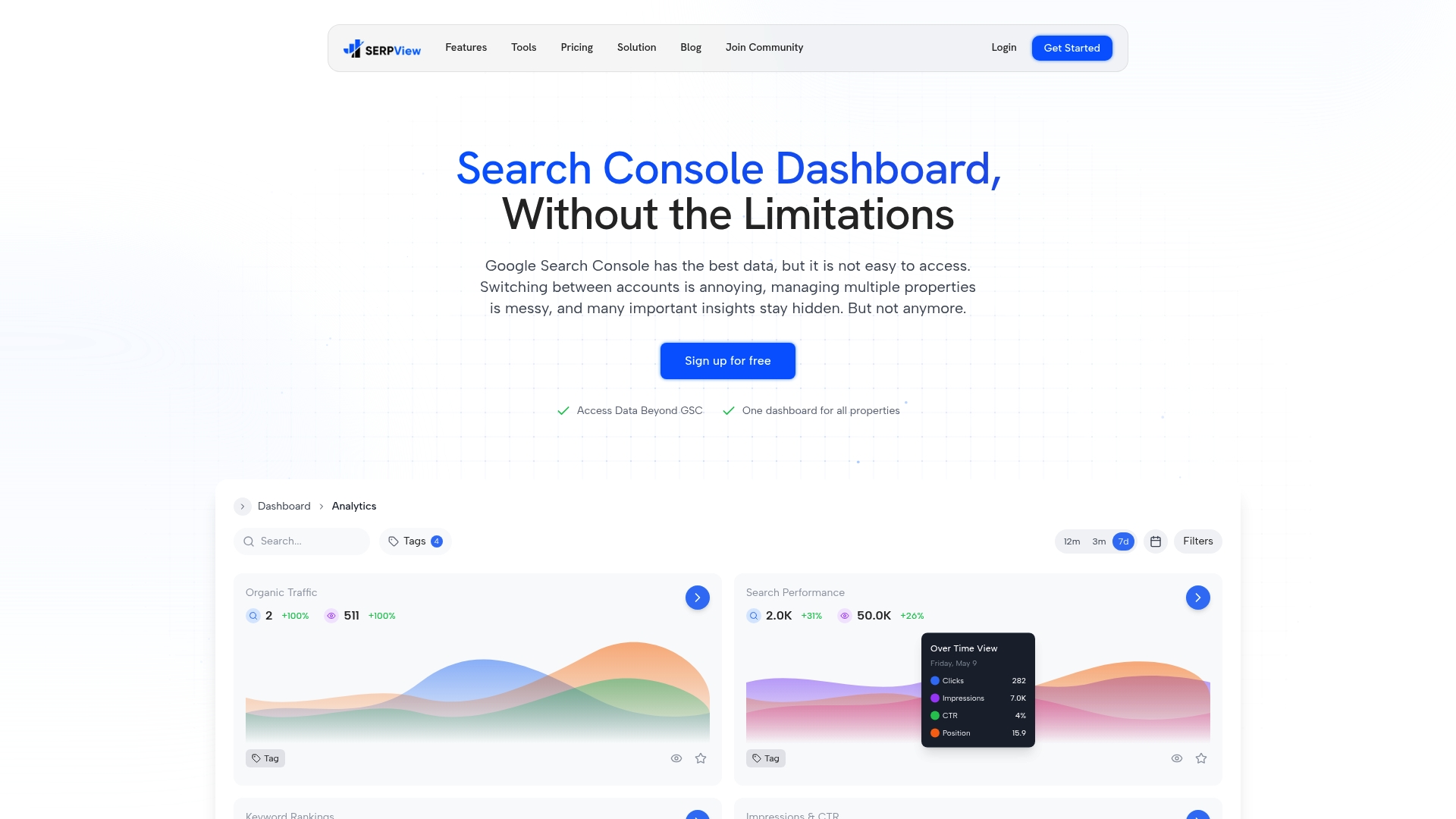
The Serpview shared dashboard lets your team and clients view live SEO performance data in one place, which keeps ROI conversations grounded in the same numbers. The schema markup generator helps you implement structured data quickly, which directly improves AI citation visibility. For analysts who need to understand the full scope of their Google Search Console data, Serpview’s extended storage and query counting by ranking tier give you the granular view needed to connect search performance to real revenue outcomes.
FAQ
What is the standard formula for SEO ROI?
SEO ROI equals ((Revenue from SEO minus Cost of SEO) divided by Cost of SEO) multiplied by 100. Accurate results require including all costs: content, technical work, tools, and staff time.
How long does SEO take to show ROI?
SEO investments typically take 6 to 12 months before producing measurable returns. Using rolling averages over that window prevents premature conclusions about campaign performance.
Why does last-click attribution undercount SEO value?
Last-click models misattribute 58 to 65% of conversions by ignoring earlier touchpoints. Multi-touch attribution shows organic search contributes to 22 to 24% of conversions when the full path is measured.
What metrics best connect search performance to revenue?
Organic conversion rate, cost per lead, assisted conversion value, and branded search volume are the four metrics that most directly link search analytics to business outcomes.
How does AI search change ROI measurement in 2026?
AI-generated answers create brand visibility without clicks, making standard traffic metrics incomplete. Content freshness under 13 weeks and schema markup now drive AI citation behavior, which means tracking branded search volume growth becomes a critical indirect ROI signal.
Recommended
Ready to unlock your full GSC potential?
SERPView helps you access all your Google Search Console data without limitations. Start your free trial today.
Get Started Free