
Search Visibility Improvement Strategies for 2026
SERPView Team
SEO Analytics
The single most important shift in 2026 is this: optimize for citations, not just clicks. AI Overviews, ChatGPT, and Perplexity now surface answers without requiring a user to visit your page, so your content must be structured to be extracted and cited, not merely ranked.
Here are the six actions to start this week:
- Audit bot access (owner: dev): review your robots.txt and add or validate an llms.txt file to control which LLM crawlers can access citation-eligible content.
- Add TL;DR blocks and FAQ schema (owner: content): place a one-sentence direct answer at the top of each priority page’s H2 sections, then mark up FAQ content with JSON-LD.
- Build or tighten topic clusters (owner: content/SEO): connect pillar pages to supporting Q&A pages with consistent internal links to signal topical authority.
- Run a digital PR sprint (owner: PR): package one original data asset and pitch it to three to five relevant publications this month to earn editorial mentions.
- Set up AI-citation tracking (owner: analytics): begin manually sampling AI answers for your top 20 queries weekly; log which domains are cited instead of yours.
- Consolidate GSC data in Serpview (owner: SEO lead): use Serpview’s search visibility metrics dashboard to get a baseline across all properties before implementing changes.
Key Takeaways
The most effective search visibility improvement strategy in 2026 combines AI citation optimization, technical bot controls, answer-first content structure, and off-site authority building, measured with metrics that go beyond clicks.
| Point | Details |
|---|---|
| Optimize for citations first | Structure every priority page with a TL;DR and answer-first H2s so AI systems can extract and cite your content. |
| Deploy llms.txt and schema | Control LLM crawler access and add FAQPage, Article, and Organization schema to maximize AI extraction eligibility. |
| Build topical clusters | Connect pillar pages to supporting Q&A pages with consistent internal links to signal authority to both Google and AI systems. |
| Measure AI citation rate | Track AI citation rate and branded search growth alongside organic traffic; a click drop is not alarming when citations are rising. |
| Serpview for multi-property tracking | Serpview’s 50,000-row exports, custom annotations, and AI Copilot accelerate the 90-day roadmap from baseline to measurable lift. |
Table of Contents
- Why 2026 redefines what “search visibility” actually means
- What technical foundations does AI-aware visibility require?
- How should you structure content to earn AI citations?
- How do you earn the off-site citations AI systems trust?
- What metrics and tools should you use to track visibility in 2026?
- How do you keep content cite-ready with a maintenance cadence?
- What does a practical 90-day visibility roadmap look like?
- How do you diagnose visibility gaps and prove improvement with Serpview?
- How does multimodal search change your optimization approach?
- How does privacy compliance affect your SEO performance?
- How do localization and hyperlocal signals improve your search visibility?
- Stop chasing clicks and start building visibility
- Serpview gives you the data to run this playbook from day one
- Sources
- FAQ
Why 2026 redefines what “search visibility” actually means
Search visibility used to mean one thing: ranking on page one. In 2026, that definition is obsolete. A page can rank in position three and still lose to a competitor whose content is cited in an AI overview above all organic results. HubSpot’s analysis of the evolution of search makes the distinction explicit: visibility builds awareness and trust even when users never click through.
The practical implication is that you now need to operate across three complementary disciplines:
- SEO (rankings): traditional on-page, technical, and link signals that determine where you appear in organic results.
- GEO (Generative Engine Optimization): structuring content so that AI systems like Google’s AI Overviews and Perplexity can extract and attribute passages to your domain.
- AEO (Answer Engine Optimization): earning the single direct-answer position in featured snippets, People Also Ask boxes, and voice results.
According to BlackPropeller’s complete organic visibility guide, a single well-built piece of content can serve all three when it combines answer-first structure, schema markup, and genuine authority signals. That convergence is the core of every search visibility improvement strategy worth running in 2026.
The discovery surface has also expanded. Your audience is searching on Google, asking ChatGPT and Perplexity, watching YouTube tutorials, browsing Reddit threads, and scrolling TikTok. Each platform has its own ranking and citation logic. A brand that appears only in Google’s organic results is invisible to a growing share of its potential audience.
Search Engine Land’s 2026 SEO landscape report confirms that technical fundamentals like HTTPS and title tags are near-universally adopted, so the new competitive layer is bot management and how sites decide which LLM crawlers to permit. That decision now directly affects whether your content is eligible for AI citation at all.
What technical foundations does AI-aware visibility require?
Technical SEO in 2026 has a new control layer: bot policy. Getting this right is a prerequisite for everything else.
Core technical checklist
- Verify robots.txt allows Googlebot, Bingbot, and the LLM crawlers you want to permit (GPTBot, ClaudeBot, PerplexityBot).
- Add an llms.txt file to declare which content sections are available for AI training and citation. Use Serpview’s free llms.txt generator to create and validate the file.
- Confirm indexing in Google Search Console for all priority pages; fix any “Discovered — currently not indexed” or “Crawled — currently not indexed” errors first.
- Check Core Web Vitals: Largest Contentful Paint under 2.5 seconds, Interaction to Next Paint under 200 milliseconds, and Cumulative Layout Shift under 0.1.
- Run a crawl to catch broken internal links, redirect chains longer than two hops, and duplicate content without canonical tags.
Schema types that increase AI extraction
Structured data adoption is rising specifically because AI systems parse labeled markup to select citable passages. The types with the highest citation impact are:
| Schema type | What it signals to AI | Where to place it |
|---|---|---|
| FAQPage | Direct Q&A pairs ready for extraction | Bottom of answer-focused pages |
| Article / Report | Author, publish date, methodology | Every editorial and research page |
| Organization | Brand identity, logo, contact | Homepage and About page |
| HowTo | Step-by-step process | Tutorial and guide pages |
| Product | Specs, pricing, availability | Product and comparison pages |
A minimal Article schema with named author and publish date looks like this in JSON-LD:
{
  "@context": "https://schema.org",
  "@type": "Article",
  "headline": "Your page title",
  "author": {"@type": "Person", "name": "Author Name"},
  "datePublished": "2026-01-15",
  "dateModified": "2026-06-01"
}
Place this in the <head> or immediately before </body>. AI crawlers read it to confirm authorship and freshness, both of which affect citation probability.
Canonicalization and pagination
Paginated content dilutes the extractable answer. Use rel="canonical" to consolidate authority to the primary URL, and avoid splitting a single authoritative answer across multiple pages. If you paginate a long guide, ensure the canonical points to the full-page version.
Pro Tip: Before enabling LLM crawler access in robots.txt or llms.txt, coordinate with your security and legal teams. Some proprietary data, client case studies, or unpublished research may need to be excluded from AI training access even if it is publicly visible to human readers.
How should you structure content to earn AI citations?
Content structure is the highest-leverage variable in AI citation eligibility. Retrieval-Augmented Generation systems extract short, direct passages, so front-loading the answer is not a style preference — it is a functional requirement.
The answer-first template
Every H2 and H3 section on a priority page should open with a one-to-two sentence direct answer, then expand. Here is a reusable template:
TL;DR: [One sentence that directly answers the section’s question.] [Two to three sentences of supporting context, data, or nuance.] [Optional: a numbered list or table for scannability.]
This structure serves human readers who skim and AI systems that extract the first complete sentence after a heading.
Topical clusters and pillar architecture
A cluster strategy signals topical authority to both Google and AI systems. The architecture works like this: one pillar page covers the broad topic comprehensively, while five to ten supporting pages each answer a specific long-tail question in depth. Every supporting page links back to the pillar, and the pillar links out to each supporting page. Research tools using LLM-based clustering methods can help you identify the knowledge components and subtopics worth building into your cluster map. For a practical walkthrough of building this structure, the content cluster strategy guide from BabyLoveGrowth covers the pillar-and-cluster build process step by step.
EEAT in practice
Named author profiles with credentials, a visible methodology section, original data or visualizations, and a visible “last updated” date all increase citation probability. The 30% rule applies here: an update only counts as meaningful if at least 30% of the content changes substantively. Refreshing a date without updating the substance does not reset freshness signals.
FAQ schema placement and validation
Place FAQPage schema on any page where you have three or more explicit Q&A pairs. Use Serpview’s FAQ schema validator to check your JSON-LD before deployment. The FAQ ideas generator can surface question variants your audience is actually searching for, which increases the chance your FAQ pairs match the exact phrasing AI systems encounter in queries.
For internal linking, route citation value toward your pillar pages. Every supporting cluster page should include at least two contextual links to the pillar, and the pillar should link to each cluster page using descriptive anchor text that matches the cluster page’s primary question.
Using AI content tools responsibly
AI writing tools can accelerate drafts, but the output needs a clear information-gain layer to be cite-worthy. A responsible workflow: use the AI tool to generate a structural draft, then add original data, named expert input, or a proprietary case example that the AI could not have produced. That added layer is what differentiates your content from the thousands of AI-generated pages covering the same topic.
How do you earn the off-site citations AI systems trust?
Off-site signals have always mattered for SEO, but in 2026 they carry a second function: they are the training and retrieval signals that AI systems use to decide which sources to cite. Brands that earn mentions across reputable sources and publish original data are materially more likely to be cited in AI-generated answers.
Digital PR action plan
- Create a data asset: a proprietary survey, benchmark report, or original analysis. Even a small dataset (200+ responses) gives journalists something to cite.
- Write a press release and a data brief: the press release is for editors; the data brief (methodology, key findings, downloadable CSV) is for journalists who want to verify and cite the numbers.
- Pitch to three tiers: tier-one publications in your vertical, relevant newsletters with 10,000+ subscribers, and niche community moderators (subreddits, Slack groups, LinkedIn newsletters).
- Use HARO and Qwoted: respond to journalist queries in your area of expertise with a concise, quotable answer plus your credentials. A single placed quote in a high-authority publication can trigger a chain of secondary citations.
- Follow up once: a single follow-up email five business days after the initial pitch is standard practice. More than that reduces response rates.
Community and social mentions
YouTube videos, Reddit answers, and LinkedIn posts that cite your content create a distributed mention graph that AI systems increasingly use as a trust signal. Post your original data findings as a LinkedIn article, create a short YouTube explainer that references the full report, and answer relevant Reddit questions with a link to the supporting page. These mentions compound: one editorial citation often triggers three to five secondary mentions within two weeks.
Measuring off-site mentions as AI trust signals
A citation in an AI answer is not always preceded by a traditional backlink. Monitor brand mentions using Google Alerts, and manually sample AI answers for your top 20 queries weekly. Log which domains appear in those answers. When a competitor appears and you do not, trace back to what content or PR asset they published that earned the citation, then build a comparable or better asset.
What metrics and tools should you use to track visibility in 2026?
Clicks are a lagging indicator. The 2026 Search Visibility Playbook from Trustworthy Digital recommends tracking AI citation rate, AI share-of-voice, branded search trends, and pipeline velocity alongside traditional organic metrics.
Priority metrics
- AI citation rate: the percentage of sampled AI answers (across Google AI Overviews, ChatGPT, Perplexity) that cite your domain for a defined query set.
- AI share-of-voice: your domain’s citation count divided by total citations across your tracked query set.
- Branded search volume: month-over-month trend in searches for your brand name, which reflects awareness built through citations.
- Pipeline velocity: how quickly leads move through the funnel, segmented by organic-entry source, to detect whether AI-referred visitors convert differently.
Tools and what each measures
| Tool | What it measures | How to use it |
|---|---|---|
| Google Search Console | Impressions, clicks, CTR, position by query and page | Baseline performance; identify pages with high impressions but low CTR |
| Serpview | Multi-property GSC data (up to 50,000 rows), CTR benchmarks, content decay, cannibalization, annotations | Aggregate and compare across sites; track pre/post changes with custom annotations |
| Manual AI sampling | AI citation rate and share-of-voice across ChatGPT, Perplexity, AI Overviews | Weekly 20-query sample; log cited domains in a shared spreadsheet |
| Google Alerts / mention tools | Brand mentions across the web | Daily digest; flag new editorial citations for the PR team |
Pro Tip: Automate a daily AI-citation sample export for a rotating set of high-value queries using Serpview’s AI Copilot to query your aggregated data and surface which pages are gaining or losing citation eligibility based on impressions and CTR trends.
Serpview’s common search data blind spots guide covers the most frequent gaps teams miss when relying solely on standard GSC exports, including the 1,000-row limit that hides long-tail query performance.
Interpreting signals correctly
A drop in clicks is not automatically alarming. If AI citation rate is rising and branded search is growing, the drop likely reflects zero-click behavior, not a loss of visibility. Treat a click drop as a problem only when it coincides with falling impressions, declining branded search, and no increase in AI citations. That combination signals a genuine visibility loss requiring diagnosis.
How do you keep content cite-ready with a maintenance cadence?
Content decay is one of the most common reasons pages lose AI citation eligibility. A page that was authoritative six months ago may now be outdated relative to newer sources, and AI systems tend to prefer fresher, more recently updated content.
Triage checklist
- Pull your top 50 pages by impressions from Serpview.
- Flag any page where impressions or CTR has dropped more than 15% over 90 days.
- Check whether a competitor’s newer page now ranks above yours for the same query cluster.
- Identify pages where the “last updated” date is more than 12 months ago and the topic has changed.
- Prioritize pages by the combination of business value (conversion rate, revenue attribution) and AI citation potential (question-based queries, informational intent).
The 30% rule and versioning
A meaningful update changes at least 30% of the content substantively: new data, revised recommendations, added sections, or removed outdated claims. Log every update with a version note in your CMS or a Serpview custom annotation, recording what changed and why. This creates a traceable record that lets you correlate specific updates with performance changes.
Suggested cadences
- High-priority pages (top 10 by business value): review and update every three months.
- Mid-priority pages (positions 11–30 by business value): review every six months.
- Evergreen reference pages (stable topics, low decay risk): review annually or when a major algorithm update occurs.
Decision trigger: if a page drops out of the top three positions for its primary query, treat it as high-priority regardless of its business value tier.
Pro Tip: Pair each high-priority content refresh with a technical audit: revalidate schema, check llms.txt inclusion, and re-run Core Web Vitals. A content update that ships with broken schema or a slow LCP score loses much of its citation-eligibility gain.
What does a practical 90-day visibility roadmap look like?
Three parallel workstreams run simultaneously across the first 90 days. The sequencing below reflects impact-to-effort ratio: technical controls first because they are fast and unlock everything else, content second because it compounds over time, and authority third because PR cycles take four to eight weeks to produce results.
Workstream overview
| Workstream | Weeks 1–2 | — | — |
|---|---|---|---|
| Technical | robots.txt audit, llms.txt deploy, schema on top 5 pages | CWV fixes, canonicalization, crawl error resolution | Schema expansion to full site, structured data QA |
| Content | TL;DR + FAQ schema on top 10 pages | Pillar page build or refresh, 5 cluster pages | Long-tail Q&A expansion, content decay triage |
| Authority | Google Alerts setup, HARO registration | Original data asset creation, first PR pitch batch | Follow-up outreach, community seeding, YouTube/LinkedIn posts |
Week 1–2 quick wins
Start with robots.txt and llms.txt because they require no content work and immediately affect which crawlers can access your pages. Add TL;DR blocks and FAQ schema to your three highest-traffic informational pages. These two tasks together can shift citation eligibility within two to three weeks of AI crawler re-indexing.
Months 2–3 investments
Pillar content and original research take longer to produce but have the highest long-term citation value. Stage experiments by treating five pages as “control” (no changes) and five as “treated” (full AEO refresh + schema + PR outreach). Measure the difference in impressions, CTR, and AI citation rate after 60 days. That comparison gives you a defensible internal case for scaling the approach.
How do you diagnose visibility gaps and prove improvement with Serpview?
A concrete workflow keeps diagnosis and measurement honest. Here is the step-by-step process:
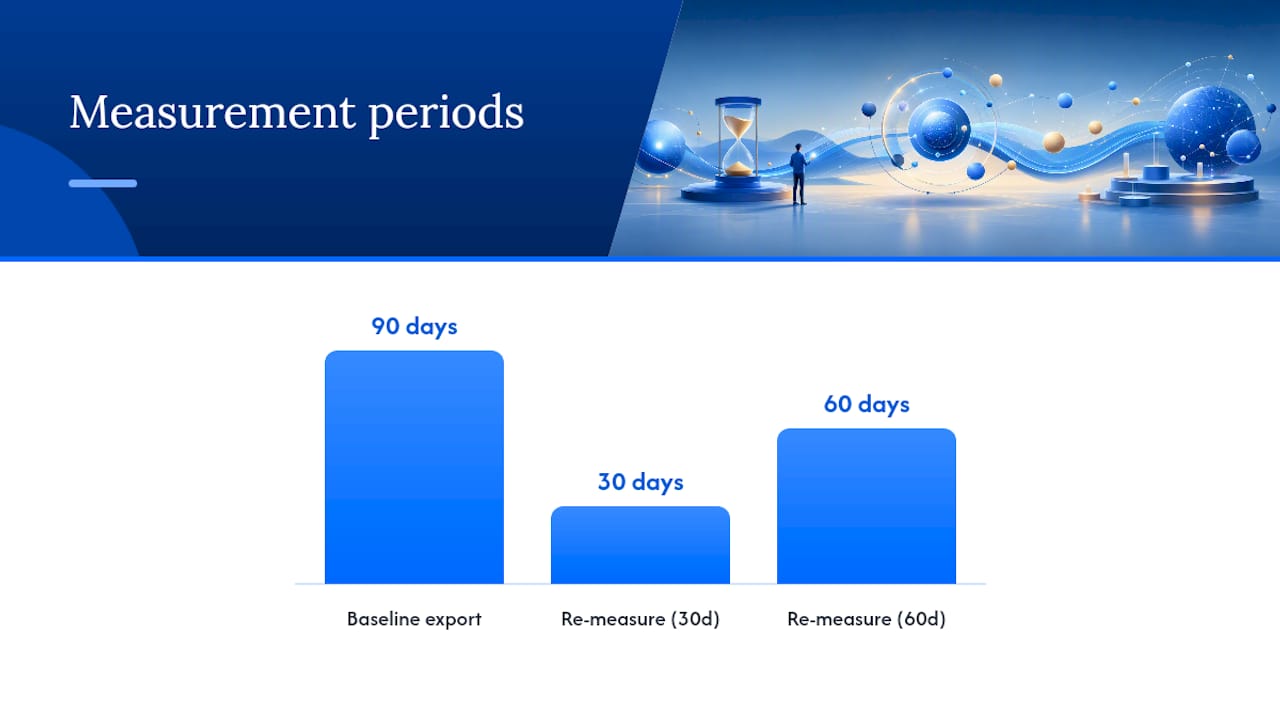
- Step 1 — Baseline export: pull the last 90 days of GSC data through Serpview for all properties. Export up to 50,000 rows to capture long-tail queries that standard GSC hides. Note current impressions, CTR, and average position for your top 50 pages.
- Step 2 — Identify citation gaps: for your top 20 informational queries, manually check Google AI Overviews, ChatGPT, and Perplexity. Log which domains are cited. Compare against your Serpview impression data to find pages with high impressions but zero AI citations.
- Step 3 — Implement fixes: apply the AEO refresh (TL;DR, answer-first H2s, FAQ schema) to the gap pages. Submit updated sitemaps. Update llms.txt to include the refreshed pages.
- Step 4 — Re-measure at 30 and 60 days: pull a new Serpview export and compare impressions, CTR, and position against the baseline. Re-run the manual AI citation sample for the same 20 queries.
For client reporting, include: baseline vs. current impressions by page, CTR trend, AI citation rate change (manual sample), and a Serpview annotation timeline showing when each change was deployed. Serpview’s shared dashboard lets you share a live view with stakeholders without exporting static files.
Pro Tip: Use Serpview’s long historical exports and custom annotations to overlay update commits on the performance timeline. When a client asks “did the refresh work?”, you can point to the exact date the change went live and the impression curve that followed.
For a broader AI search readiness check before you start, the AI Search Audit tool from BabyLoveGrowth provides a free diagnostic that surfaces AI-specific gaps alongside technical issues.
How does multimodal search change your optimization approach?
Text is no longer the only retrieval medium. Google Lens, voice assistants, and video search each have distinct ranking signals, and ignoring them means missing a growing share of discovery queries.
Image search: every image needs a descriptive file name, an alt attribute that answers the likely query, and surrounding text that provides context. For product images, add Product schema with image properties. Google Lens queries tend to be visual-first, so image quality and contextual relevance matter as much as alt text.
Video search: YouTube is the second-largest search engine in the United States. A video that answers a question your pillar page covers creates a second citation surface. Include a transcript, add chapter markers with keyword-aligned titles, and link back to the written pillar page in the description. This cross-format linking reinforces topical authority across both Google and YouTube’s algorithms.
Voice search: voice queries are conversational and question-based. Pages optimized with FAQ schema and answer-first H2 sections are naturally well-positioned for voice results, since voice assistants typically read the featured snippet or the first direct answer they find. Keep answers under 40 words for the best voice extraction rate.
How does privacy compliance affect your SEO performance?
Privacy regulations directly affect the data you can collect, the signals you can send to ad platforms, and the user experience signals Google measures. The California Consumer Privacy Act (CCPA) and its amendment (CPRA) set the baseline for U.S. compliance, and several other states have enacted similar laws.
Cookie consent banners, when implemented poorly, slow page load times and increase bounce rates, both of which affect Core Web Vitals and engagement signals. A consent management platform (CMP) that loads asynchronously and does not block the main thread keeps LCP scores clean while staying compliant.
Server-side tagging is the most durable solution for analytics continuity under privacy constraints. By moving tag execution to your server rather than the browser, you reduce third-party script load on the page and maintain measurement accuracy even when users decline cookies. Google Analytics 4’s server-side configuration supports this natively.
First-party data collection, such as email sign-ups, gated content downloads, and logged-in user behavior, becomes more valuable as third-party cookie deprecation continues. Pages that convert visitors into known users give you measurement continuity that cookie-dependent analytics cannot provide.
How do localization and hyperlocal signals improve your search visibility?
Local and hyperlocal search visibility depends on a combination of Google Business Profile signals, locally relevant content, and consistent NAP (name, address, phone) data across directories.
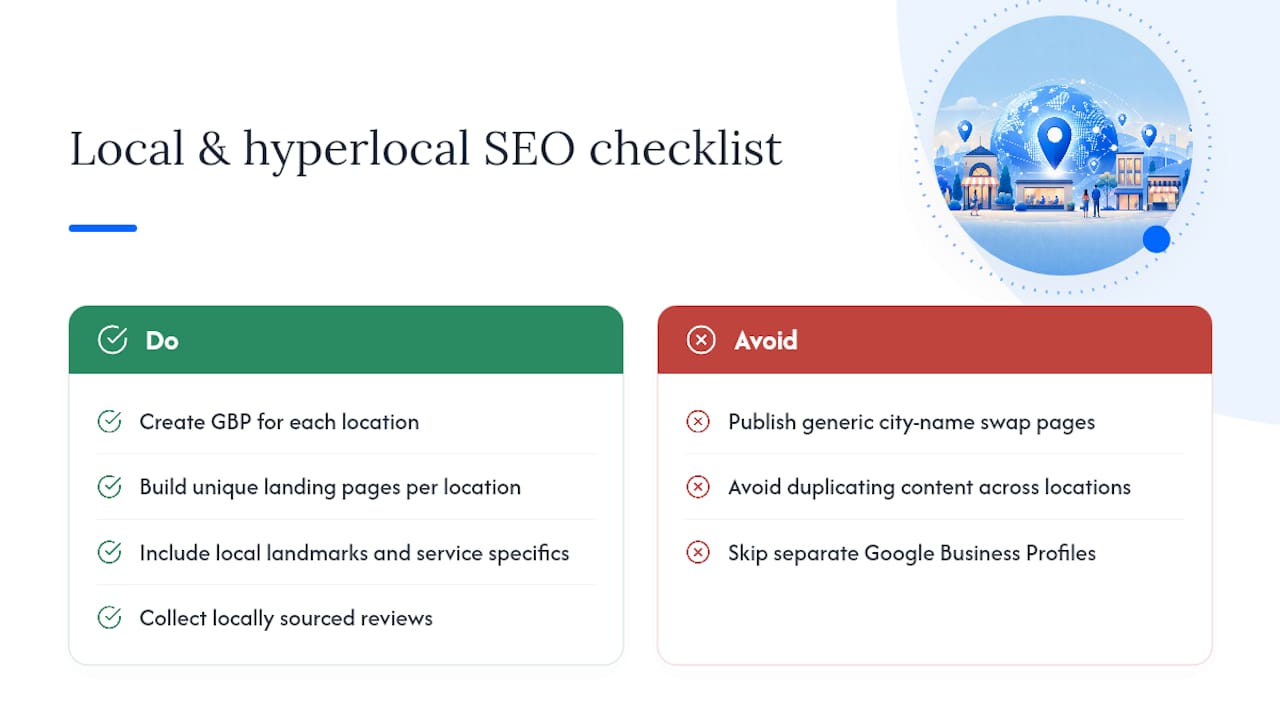
For multi-location businesses, each location needs its own Google Business Profile, its own landing page with locally specific content, and its own schema using LocalBusiness markup with the correct address and service area. Generic location pages that swap only the city name rarely rank well; pages that include local landmarks, service-area specifics, and locally sourced reviews perform significantly better.
Hyperlocal content targets neighborhood-level or ZIP code-level queries. A service business covering a metro area benefits from pages targeting specific neighborhoods, each with unique content about local context, not just a city-name swap. Wordstream’s analysis of Google ranking factors identifies topical relevance and engagement as two of the top signals, and hyperlocal pages tend to have higher engagement rates because they match the searcher’s precise intent.
For voice and AI-driven local search, structured data with GeoCoordinates and areaServed properties helps AI systems confirm that your business is relevant to a location-specific query. Pair this with locally earned citations in regional publications and directories to reinforce the geographic authority signal.
Stop chasing clicks and start building visibility
The teams winning in AI-first search are not the ones with the highest traffic. They are the ones whose content appears in AI answers, earns editorial mentions, and shows up across multiple discovery surfaces simultaneously. That shift requires a different set of KPIs and a different internal conversation.
The most common organizational failure is that traffic remains the primary success metric long after the strategy has shifted to visibility. Executives see a flat or declining sessions chart and conclude the SEO program is not working, even as AI citation rate and branded search are growing. The fix is to set an AI-citation KPI alongside organic traffic from the start, so the measurement framework reflects the actual goal.
Who needs to be involved: SEO owns the technical and content workstreams, PR owns the off-site citation strategy, analytics owns the measurement framework, and leadership needs a monthly one-page summary that shows visibility trends, not just traffic. The incentive structure matters too. If the content team is rewarded only for pageviews, they will not prioritize answer-first structures that reduce clicks. Tie at least one team KPI to AI citation rate or branded search growth.
The teams that will look back at 2026 as a turning point are the ones that made this measurement shift now, before their competitors did.
Serpview gives you the data to run this playbook from day one
Most teams running the 90-day roadmap above hit the same bottleneck: fragmented data across multiple GSC properties, a 1,000-row export limit that hides long-tail performance, and no way to annotate changes against the performance timeline. Serpview solves all three.
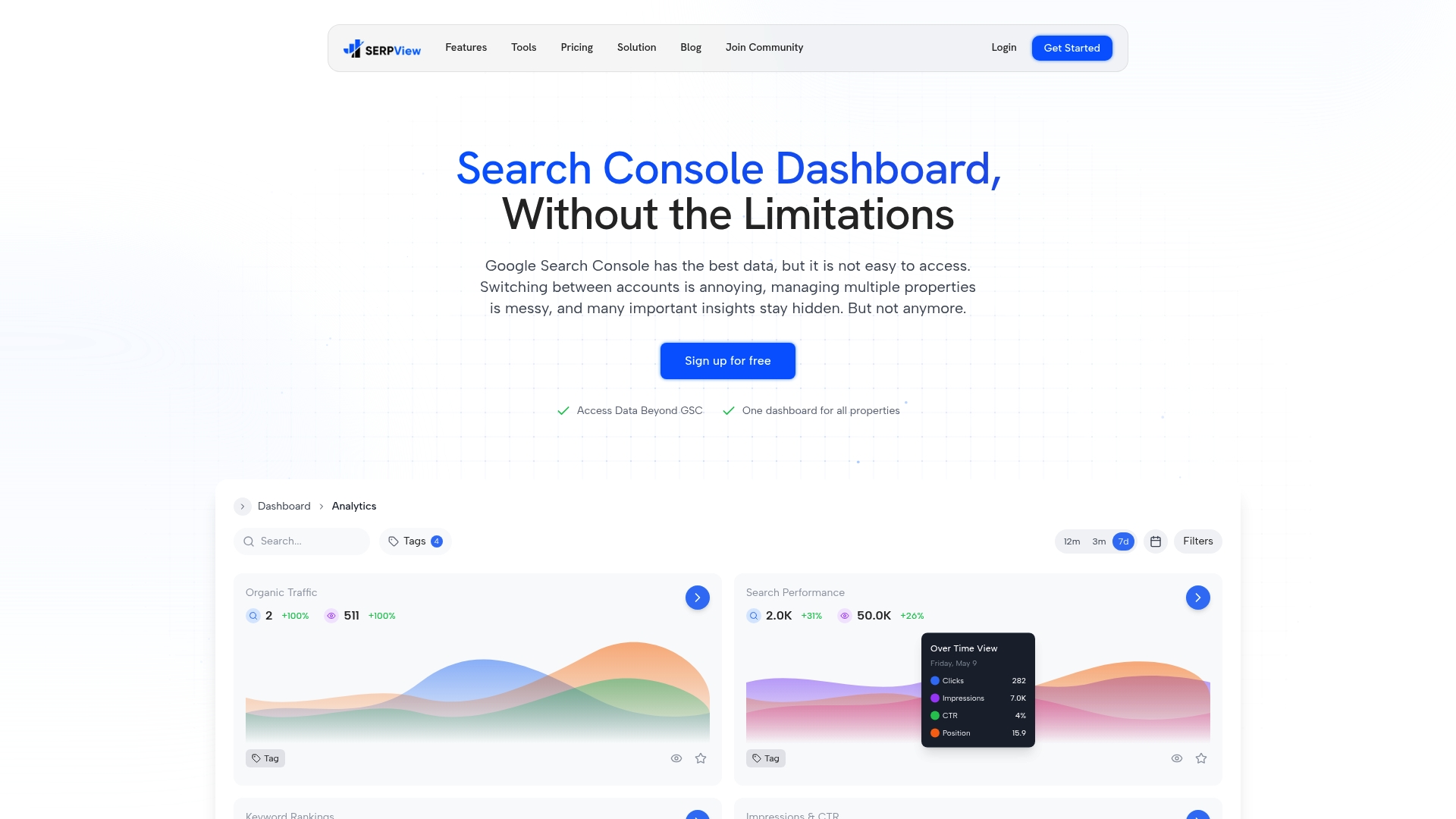
Serpview consolidates Google Search Console data across all your properties into a single dashboard, with exports up to 50,000 rows. You get CTR benchmarking, content decay heatmaps, algorithm update overlays, and a keyword cannibalization checker built in. The AI Copilot lets you query your aggregated data in plain language, so diagnosing a citation gap takes minutes instead of hours. For agencies, white-label sharing and team invitations mean client reporting is built into the same workflow.
Start a free trial at Serpview and run your first multi-property baseline export today.
Sources
The sources below cover the four main workstreams in this guide:
Technical and AI-specific:
- Evolution of search
- SEO, GEO & AEO: Complete Organic Visibility Guide 2026
- Brand Visibility Strategy: How to Get Found Across Google, AI, and Social in 2026 - First Movers
- 2026 Search Visibility Playbook | Trustworthy Digital
- The most important Google ranking factors in 2026
- Scale
Content strategy and PR:
Measurement and ranking factors:
Tools:
FAQ
What is the fastest way to improve AI citation eligibility?
Add a TL;DR block and FAQ schema to your top informational pages. AI systems extract the first direct answer after a heading, so answer-first structure combined with FAQPage JSON-LD is the highest-leverage change you can make in under a week.
How is GEO different from traditional SEO?
Traditional SEO targets Google’s ranking algorithm; GEO (Generative Engine Optimization) targets AI retrieval systems like Google AI Overviews, ChatGPT, and Perplexity. GEO prioritizes extractable passages, named authorship, and off-site mentions over link count alone.
What metrics should replace clicks as the primary KPI?
Track AI citation rate (share of sampled AI answers citing your domain), AI share-of-voice, branded search volume trends, and pipeline velocity. These metrics reveal visibility influence even when sessions are flat or declining.
How does Serpview help with the 90-day roadmap?
Serpview consolidates GSC data across multiple properties with exports up to 50,000 rows, custom annotations to mark update dates, and an AI Copilot for query-level diagnosis. This lets you set a clean baseline, track changes, and report pre/post lift to stakeholders from a single dashboard.
How often should you update priority pages for citation eligibility?
High-priority pages benefit from a review every three months. An update counts as meaningful only when at least 30% of the content changes substantively, such as new data, revised recommendations, or added sections. Refreshing a date without updating the substance does not improve freshness signals.
Recommended
Ready to unlock your full GSC potential?
SERPView helps you access all your Google Search Console data without limitations. Start your free trial today.
Get Started Free