
Common Search Data Blind Spots for SEO Pros in 2026
SERPView Team
SEO Analytics
TL;DR:
- Search data blind spots in 2026 include platform-specific vocabularies, AI zero-click attribution issues, and hidden query data in paid reports. These gaps cause marketers to underestimate demand, misattribute traffic, and overlook valuable insights from unrecorded or suppressed data sources. Addressing these challenges requires diversified data collection, schema markup, and continuous cross-platform analysis.
Search data blind spots are defined as gaps in your analytics where real user behavior goes unrecorded, misclassified, or completely invisible. These gaps are not minor inconveniences. They distort keyword strategy, skew attribution models, and cause marketers to allocate budget based on incomplete pictures of actual demand. The most critical common search data blind spots in 2026 stem from three sources: platform-exclusive keyword vocabularies, AI-driven zero-click search behavior, and broken query reporting in paid search. Each one compounds the others, and together they create a measurement environment where what you see represents only a fraction of what is actually happening.
1. Why multi-platform vocabularies create search data blind spots
The single biggest hidden search data issue most SEO professionals miss is this: 73% of AI search terms on platforms like Perplexity are absent from Google’s keyword data entirely. That finding comes from an analysis of 356,619 keywords across 17 platforms, which showed platform exclusivity rates ranging from 60% to 88%. If your keyword research starts and ends with Google, you are missing the majority of how users actually phrase their needs elsewhere.

Platforms like TikTok, Amazon, and Perplexity each carry their own search vocabulary. A user searching for skincare on TikTok types conversational, trend-driven phrases that never appear in Google Keyword Planner. An Amazon shopper uses product-specific language shaped by listing conventions. These vocabularies do not overlap cleanly, and treating Google as the universal source of keyword intelligence produces a systematically distorted view of demand.
AI-powered search compounds this further. Natural language queries submitted to AI assistants are longer, more conversational, and structurally different from traditional keyword formats. They rarely match the short-tail or even long-tail patterns that SEO tools are built to capture. The result is a growing pool of long-tail keyword demand that standard research methods never surface.
| Platform | Keyword exclusivity rate | Primary query format |
|---|---|---|
| Google Search | Baseline reference | Short to medium keyword phrases |
| Perplexity AI | 73%+ exclusive | Full natural language questions |
| TikTok Search | High exclusivity | Trend-driven, conversational |
| Amazon | High exclusivity | Product-specific, feature-focused |
Pro Tip: Run parallel keyword research across at least three platforms monthly. Pull on-site search logs, customer service transcripts, and community forums to surface vocabulary that no keyword tool captures.
2. How AI zero-click search creates attribution blind spots
Zero-click AI search is now the dominant hidden search data issue for traffic attribution. Up to 70% of AI-referred traffic is miscategorized in standard analytics tools, appearing as direct or organic traffic rather than as AI referral. Forrester formalized this problem in march 2026 under the term “visibility vacuum,” describing the loss of buyer intent signals that occurs when AI answers a query without sending the user to any website.
The visibility vacuum means you cannot see who found your brand through an AI engine, what they were looking for, or whether they converted. Traditional attribution models assign credit based on last-click or session-based rules. Neither model accounts for a user who reads an AI-generated summary, forms a purchase intent, and then types your URL directly into a browser. That conversion appears as direct traffic, with no connection to the AI interaction that drove it.
The measurement gap carries real financial weight. AI-sourced visitors convert at 11x the rate of standard organic visitors, according to Microsoft Clarity data, and Adobe finds AI retail referrals convert 31% higher than other channels. These are your highest-value visitors, and your analytics are largely blind to them.
Addressing this requires a shift in how you think about measurement:
- Track entity mention frequency across AI platforms, not just keyword rankings
- Monitor branded search volume as a proxy for AI-driven awareness
- Use UTM parameters on all owned links to capture any AI referral that does include a click
- Combine qualitative signals like customer surveys with quantitative analytics to estimate AI influence
- Treat direct traffic spikes as a signal worth investigating for AI attribution
Pro Tip: Set up a blended analytics view that combines AI search visibility metrics, branded query trends, and direct traffic patterns. No single metric tells the full story, but the combination gives you directional clarity.
3. Blind spots inside search advertising query reports
Paid search professionals face a specific and growing set of overlooked search metrics inside their own platforms. Google suppresses AI-influenced search queries from Ads reports, meaning e-commerce businesses see clicks and conversions tied to AI-powered searches but cannot view the associated search terms. You are paying for traffic you cannot analyze.
The problem extends beyond AI suppression. Marketing strategist Adnan Agic identifies the Search Terms report as broken due to increasingly masked queries and a growing “other” bucket that hides a significant share of actual search activity. The “other” bucket often signals match type bloat, where broad match keywords trigger irrelevant or untraceable queries that inflate spend without providing usable data. Tightening match types is the most direct way to regain query auditability.
The practical consequences are serious:
- Negative keyword lists become harder to build without full query visibility
- New keyword discovery from search terms data slows significantly
- Budget allocation decisions rest on an incomplete view of what is actually triggering ads
- Performance shifts become harder to diagnose when the underlying query data is masked
Diversifying your intelligence sources is not optional at this point. On-site search logs, customer service queries, and sales call transcripts all reveal the language your buyers use. These sources supplement what the Search Terms report no longer shows. Serpview’s paid campaign data integration approach addresses this structural disconnect directly by combining organic and paid signals in one view.
Pro Tip: Monitor campaign-level metrics like impression share, conversion rate, and cost per acquisition on a weekly basis. Shifts in these numbers often signal query-level changes you cannot see directly in the Search Terms report.
4. How Google Search Console underreports your actual search visibility
Google Search Console omits rare, unique, or potentially personal queries from its reports for privacy reasons. Privacy-driven filtering anonymizes or drops low-volume queries, and this disproportionately affects niche and long-tail sites. If your content targets specific, narrow audiences, GSC data systematically understates your actual search visibility.
The 1,000-row export limit compounds this problem. GSC shows you the top 1,000 queries by default, which means any site with broad keyword coverage loses visibility into the long tail entirely. Serpview addresses this directly by providing access to up to 50,000 rows of data across multiple properties in a unified dashboard. That scale reveals patterns that the standard GSC interface buries.
The combination of privacy filtering and row limits means your GSC data is always a sample, not a census. Treating it as a complete picture of your search presence leads to underinvestment in content areas that are actually generating impressions and clicks you cannot see.
5. Vocabulary blind spots where no search terms exist yet
The Ignorance Graph framework identifies a specific category of search analytics gaps called “vocabulary blind spots.” These occur when no existing search terms exist for a concept your content covers. AI search engines rely on entity clarity to surface content, and if your topic lacks recognized terminology, AI systems cannot confidently cite or recommend it.
The solution is proactive entity definition. Using schema.org markup to define novel concepts gives AI engines the structured signals they need to understand and surface your content. This is not a future-proofing exercise. It is a current requirement for any brand operating in a space where terminology is still forming, such as emerging technology, new regulatory categories, or niche professional fields.
Creating named, schema-marked entities is the most direct way to overcome vocabulary blind spots. AI search engines do not guess at meaning. They surface what is clearly defined and structured.
6. Strategies to identify and address search analytics gaps in 2026
Closing search data blind spots requires a multi-method approach. No single tool or platform provides complete visibility. The goal is to triangulate across multiple data sources until the gaps between them become small enough to manage.
- Audit your data sources. List every platform contributing to your keyword and traffic data. Identify which user segments or query types each source misses.
- Pull on-site search logs. Your own site’s search bar captures the exact language your visitors use. This data is unfiltered and platform-independent.
- Mine customer service transcripts. Support tickets and chat logs reveal the questions buyers ask before converting. These questions rarely appear in keyword tools.
- Use schema markup for entity clarity. Apply structured data to define your brand, products, and key concepts. This improves AI citation frequency and search engine understanding.
- Monitor AI citation frequency. Track how often AI engines mention your brand or content in responses. This is a leading indicator of AI-driven awareness that precedes measurable traffic.
- Combine analytics layers. Blend hard data from GSC and Ads with directional estimates from branded search trends and direct traffic patterns. Layered analytics produce better decisions than any single source.
- Diversify competitive intelligence. Use community forums, Reddit, and industry publications to surface emerging vocabulary before it appears in keyword tools.
| Data source | Strength | Limitation |
|---|---|---|
| Google Search Console | Owned, free, reliable for top queries | Row limits, privacy filtering, no AI query data |
| On-site search logs | Captures real visitor language | Requires sufficient site traffic to be meaningful |
| Customer service transcripts | Reveals pre-purchase intent language | Manual to process, not scalable without tooling |
| Schema markup signals | Improves AI discoverability | Indirect effect, results take time to appear |
| Branded search trend monitoring | Proxy for AI-driven awareness | Correlation only, not direct attribution |
Understanding search intent at the query level remains the foundation of all of this. Without knowing why a user searched, you cannot evaluate whether your content or ads actually served their need. AI search makes this harder, not easier, which is why diversified data collection is now a core SEO competency rather than an advanced tactic. For a broader view of how these data sources connect to client-facing strategy, Serpview’s client strategy guide covers the integration in practical terms.
Key takeaways
The most damaging search data blind spots in 2026 are platform vocabulary gaps, AI attribution failures, and suppressed query data in paid search reports, and each one requires a different measurement fix.
| Point | Details |
|---|---|
| Platform vocabulary gaps | 60–88% of keywords are platform-exclusive; research across multiple platforms, not just Google. |
| AI attribution failure | Up to 70% of AI-referred traffic is miscategorized; use branded search trends and direct traffic as proxies. |
| Paid query suppression | Google hides AI-influenced search terms in Ads reports; tighten match types and diversify data sources. |
| GSC underreporting | Privacy filtering and row limits make GSC a sample, not a complete record; expand data access where possible. |
| Entity and schema clarity | AI engines surface clearly defined entities; use schema markup to define novel concepts proactively. |
The fragmentation problem is bigger than most teams realize
The search environment has fractured faster than measurement frameworks have adapted. I have watched teams spend months refining their Google-centric keyword strategies while their actual audience was forming opinions and purchase intent through AI assistants, TikTok search, and platform-specific queries that never showed up in any report. The data looked clean. The strategy looked sound. The results told a different story.
What I find most underappreciated is the compounding effect. A vocabulary blind spot means you never create the right content. An attribution blind spot means you never credit the right channel. A query suppression blind spot means you never refine the right ad. Each gap feeds the next, and the cumulative effect is a strategy built on a fraction of real user behavior.
The teams that adapt fastest are not the ones with the most sophisticated tools. They are the ones willing to treat their analytics as a hypothesis rather than a fact. They ask “what is this data not showing me?” before they ask “what does this data mean?” That mental shift is the actual unlock for optimizing in an AI search environment.
Structured data and named entity strategy are not technical SEO tasks anymore. They are the primary way you communicate with AI search engines. If your content is not clearly defined and marked up, AI systems will either ignore it or misrepresent it. That is not a ranking problem. It is a visibility problem at a more fundamental level.
— Utsav Chopra
Serpview gives you the data layer most tools skip
Search data blind spots shrink when you have access to more of your own data. Serpview’s combined analytics feature consolidates performance data across multiple properties into one dashboard, removing the row limits and fragmentation that make GSC analysis incomplete. You get up to 50,000 rows of query data, mobile versus desktop breakdowns, and historical performance tracking that standard tools cap or omit entirely.
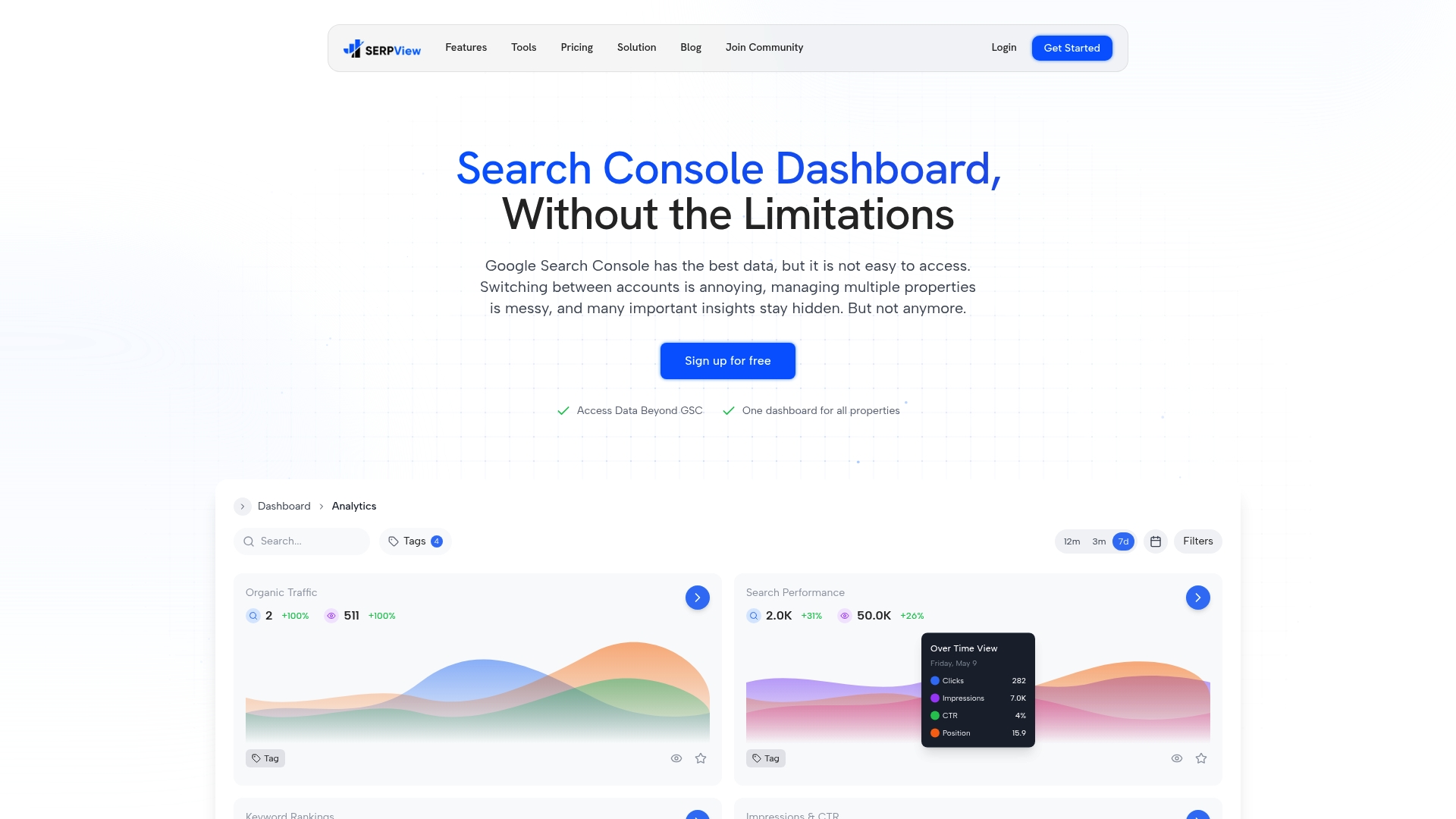
Serpview’s SEO glossary covers the core concepts behind search intent, keyword strategy, and structured data, giving your team a shared reference point for the measurement frameworks this article describes. The shared dashboard feature makes it straightforward to present unified search data to clients or stakeholders without exporting and reformatting reports manually. If your current analytics setup leaves you guessing at what your data is not showing, Serpview is the place to start closing those gaps.
FAQ
What are the most common search data blind spots in 2026?
The most common search data blind spots are platform-exclusive keyword vocabularies, AI-driven zero-click attribution gaps, and suppressed query data in paid search reports. Each one causes marketers to make decisions based on incomplete data.
Why does Google Search Console miss so many queries?
Google Search Console filters out rare, low-volume, and potentially personal queries for privacy reasons. This disproportionately affects niche and long-tail sites, causing GSC to undercount actual search visibility.
How do I track traffic from AI search engines?
AI-referred traffic is largely miscategorized as direct or organic in standard analytics tools. Track branded search volume trends, monitor direct traffic spikes, and use entity mention frequency as a proxy for AI-driven awareness.
Why is the Google Ads Search Terms report unreliable?
Google suppresses AI-influenced queries from the Search Terms report, and a growing “other” bucket hides additional query data. Tightening match types and supplementing with on-site search logs and customer feedback restores some of the lost visibility.
What is a vocabulary blind spot in SEO?
A vocabulary blind spot occurs when no recognized search terms exist for a concept your content covers. Using schema.org markup to define and name those concepts gives AI search engines the structured signals they need to surface your content accurately.
Recommended
Ready to unlock your full GSC potential?
SERPView helps you access all your Google Search Console data without limitations. Start your free trial today.
Get Started Free