
How Search Visibility Metrics Work for SEO Pros
SERPView Team
SEO Analytics
TL;DR:
- Search visibility metrics quantify a website’s potential to attract organic traffic by combining search rankings, click-through rates, and search volumes. Tracking both traditional and AI-generated answer citations helps prevent unseen declines in search presence, especially as AI overhauls search results. Consistent monitoring and benchmarking enable SEO teams to detect issues early and optimize across multiple visibility dimensions.
Search visibility metrics are quantitative indicators that measure how prominently a website appears in search engine results, reflecting its potential to attract organic traffic based on ranked keywords and their search demand. Understanding how search visibility metrics work separates reactive SEOs from those who catch problems weeks before traffic drops. This metric combines ranking positions, estimated click-through rates, and keyword search volumes into a single weighted score. That score gives you a bird’s-eye view of your site’s potential exposure across a tracked keyword set. In 2026, with AI-generated answers reshaping the SERP, visibility has split into two distinct measurements that every digital marketer needs to track.
How search visibility scores are calculated
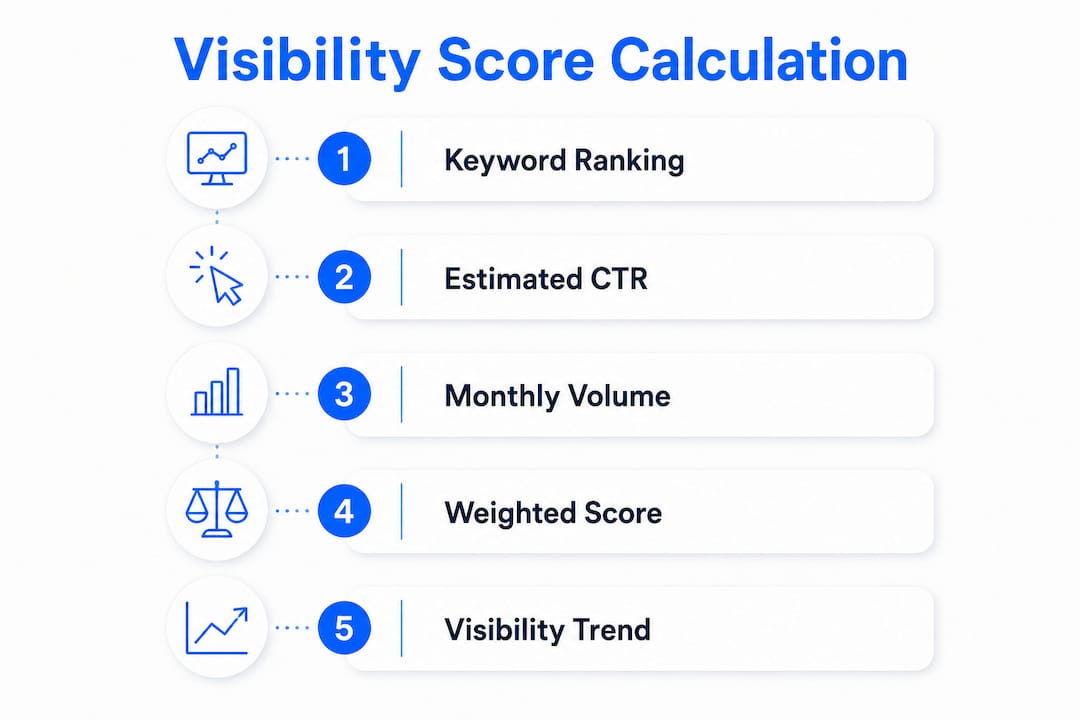
Search visibility is calculated as a weighted percentage: each keyword’s ranking position is multiplied by an estimated CTR for that position, then multiplied by the keyword’s monthly search volume. That product is divided by the theoretical maximum score, which assumes a #1 ranking for every tracked keyword. The result is a percentage from 0% to 100%, where 100% represents perfect dominance across your entire keyword set.

CTR by position drives most of the weight in the formula. Top rankings capture 30–40% of available clicks, while position 10 drops below 1%. That steep curve means a single keyword jumping from position 8 to position 3 can move your visibility score more than ten keywords moving from position 15 to position 12.
The formula looks like this in practice:
| Keyword | Monthly Volume | Position | Est. CTR | Weighted Score |
|---|---|---|---|---|
| “project management software” | 40,500 | 2 | 15% | 6,075 |
| “task tracking tool” | 8,100 | 5 | 6% | 486 |
| “team collaboration app” | 22,200 | 11 | 0.5% | 111 |
The sum of weighted scores is divided by the maximum possible score to produce your visibility percentage. Small changes at the top of the SERP produce outsized results.
Two additional factors complicate the calculation:
- Keyword set composition. Tracking only branded keywords inflates your score and hides real market exposure. A representative mix of branded, non-branded, and long-tail terms gives an accurate picture.
- Tool methodology. Each SEO tool uses a proprietary CTR curve, so raw visibility percentages are not comparable across platforms. A 22% score in one tool may equal a 14% score in another. Track trends within one tool, not absolute numbers across many.
How does search visibility differ from rankings and traffic?
Rankings, organic traffic, and search visibility each measure something different. Rankings tell you where a specific keyword sits in the SERP. Organic traffic counts the actual visits your site receives. Search visibility measures your potential exposure across all tracked keywords at once.
The critical distinction is that visibility reflects potential exposure, not confirmed clicks. A site can gain visibility while losing traffic if SERP features like featured snippets, knowledge panels, or AI overviews absorb clicks before users reach organic results. That divergence is accelerating in 2026.
Visibility also functions as a leading indicator. Visibility often declines before organic traffic does, giving you a 2–4 week window to diagnose algorithm changes, lost backlinks, or technical regressions before they show up in your analytics. Traffic data confirms damage. Visibility data warns you in advance.
- Rankings are keyword-specific and granular.
- Organic traffic is the real-world outcome of rankings and CTR combined.
- Visibility is the composite signal that sits between the two.
Pro Tip: Set a weekly visibility alert in your tracking tool. A drop of more than 5 percentage points in seven days almost always signals a crawl issue, a penalty, or a significant algorithm update. Catching it early cuts recovery time in half.
How is AI changing search visibility measurement?
The rise of generative AI has created two complementary visibility metrics. Classic search visibility measures rank-based presence in traditional SERPs. AI visibility measures your brand’s citation share inside AI-generated answers from tools like ChatGPT, Perplexity, and Google’s AI Overviews.
AI visibility factors in over 250 signals, including EEAT content quality, structured data completeness, topical authority, and explicit crawl permissions. That is a fundamentally different scoring model from the position-times-CTR formula used in classic visibility.
The signals that drive AI visibility fall into distinct categories:
- EEAT content. AI engines favor content with named authors, verifiable credentials, and cited sources. Anonymous content scores poorly regardless of its ranking position.
- Structured data. Schema markup helps AI crawlers parse your content accurately. Missing schema is one of the most common reasons sites fail to appear in AI-generated answers.
- Crawl permissions. Blocking AI crawlers via robots.txt or the absence of an llms.txt file removes your site from AI training and retrieval pipelines entirely.
- Brand authority signals. Wikipedia presence, Wikidata entries, and consistent brand mentions across authoritative domains all contribute to AI citation likelihood.
- Topical depth. AI engines reward sites that cover a subject comprehensively, not just sites that rank for individual keywords.
“Most websites score below 55 out of 100 on AI visibility audits because they block AI crawlers, lack schema markup, and have no Wikipedia or Wikidata presence. Fixing those three issues alone moves the majority of sites into a competitive range.”
Source: SearchScore AI Visibility Methodology
Adapting SEO strategies to include AI visibility is no longer optional. Classic SEO content optimized purely for keyword density and backlinks does not automatically translate into AI citation presence. The two metrics require parallel optimization tracks.
How to use visibility metrics to sharpen your SEO strategy
Search visibility becomes most useful when you treat it as a monitoring and benchmarking tool, not just a vanity score. The following practices turn raw visibility data into decisions.
Monitor trends, not snapshots. A single visibility score tells you little. A downward trend over three weeks tells you something is wrong. Use custom annotations to log site changes, content updates, and algorithm dates alongside your visibility data. That context turns a confusing dip into a diagnosable event.
Benchmark against direct competitors. Benchmark visibility scores against direct competitors rather than chasing an absolute target. If your competitor holds 18% visibility and you hold 11%, closing that gap is a realistic and meaningful goal. Absolute scores without competitive context are hard to act on.
Use a representative keyword set. A 75% score on 10 obscure keywords does not reflect strong market positioning. Your tracked keyword set should include high-volume non-branded terms, mid-tier informational queries, and a sample of long-tail keywords that reflect real buyer intent. Review and refresh that set at least quarterly.
Combine classic and AI visibility tracking. Your classic visibility score may hold steady while your AI citation share collapses, or vice versa. Tracking both gives you a complete picture of your total search presence. Sites that ignore AI visibility are flying blind on a growing share of search traffic.
Practical optimization steps that move both metrics:
- Fix crawl errors and ensure AI crawlers are explicitly permitted in your robots.txt and llms.txt files.
- Add comprehensive schema markup to all key page types, including articles, products, FAQs, and author profiles. Learn more about content optimization tactics that support both classic and AI visibility.
- Build named authorship into your content. Every article should carry a byline with verifiable credentials.
- Pursue Wikipedia and Wikidata entries for your brand if your domain authority supports it.
- Audit your keyword tracking setup twice a year to remove branded-only bias.
Pro Tip: Visibility scores vary by industry. Dominant brands rarely exceed 30–40% visibility for non-branded keywords. If your score sits above 20% in a competitive vertical, you are outperforming most of the market.
Key Takeaways
Search visibility metrics work by combining ranking positions, estimated CTRs, and keyword search volumes into a weighted score that signals potential organic exposure, not confirmed traffic.
| Point | Details |
|---|---|
| Visibility score formula | Multiply ranking position by estimated CTR and keyword volume, then normalize against a perfect #1 ranking for every keyword. |
| Visibility as a leading indicator | Visibility drops 2–4 weeks before traffic declines, giving you time to diagnose and fix issues early. |
| Classic vs. AI visibility | Classic visibility tracks rank-based exposure; AI visibility tracks citation share in AI-generated answers using 250+ signals. |
| Keyword set quality matters | Tracking only branded keywords inflates your score; include non-branded and long-tail terms for an accurate read. |
| Benchmark against competitors | Compare your visibility score to direct competitors, not an abstract ideal, to set goals that reflect real market conditions. |
Why visibility metrics deserve more respect than they get
The SEO industry has a habit of chasing traffic numbers and ignoring the signals that predict them. I have watched teams celebrate a flat traffic month while their visibility score quietly dropped 8 points over the same period. Three weeks later, the traffic fell off a cliff. The visibility data was right the whole time.
The more uncomfortable truth is that the gap between visibility and traffic is widening, and most teams are not measuring it. AI overviews and zero-click results are absorbing an increasing share of impressions. Your classic visibility score can look healthy while your actual click volume erodes. That is why tracking AI visibility alongside traditional metrics is no longer a nice-to-have. It is the only way to see the full picture.
My practical advice: pick one tool, build a consistent keyword set, and track both visibility types weekly. Do not switch platforms every quarter chasing a higher score. Consistency in measurement is what makes trend data meaningful. The SEO professionals who will win in 2026 are the ones who treat visibility as a diagnostic instrument, not a report card.
— Utsav Chopra
Serpview gives you the visibility data that matters
Serpview goes beyond what Google Search Console provides by consolidating analytics across multiple properties in a single dashboard, with up to 50,000 rows of data instead of the standard 1,000-row limit. That scale matters when you are tracking a comprehensive keyword set across branded and non-branded terms.
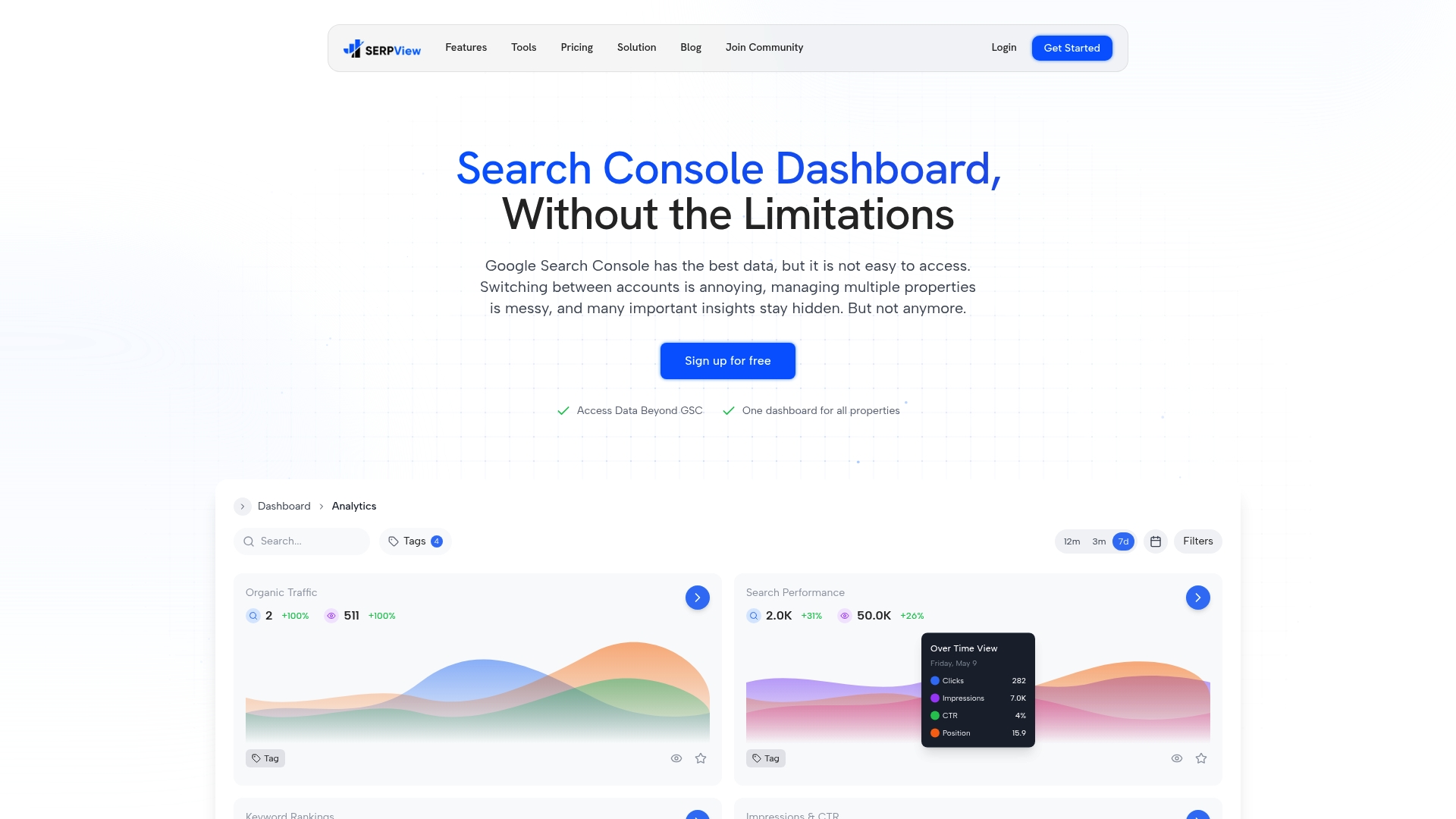
Serpview’s customizable keyword tracking, competitor benchmarking, and performance history tools give you the trend data you need to catch visibility drops before they become traffic problems. The platform’s structured data analysis and real-time alerts keep your classic and AI visibility optimization on track. If you are serious about query-level performance insights, Serpview turns raw search data into decisions you can act on today.
FAQ
What is online search visibility?
Online search visibility is a weighted percentage score that measures how prominently a website appears across a set of tracked keywords in search engine results. It combines ranking positions, estimated CTRs, and keyword search volumes into a single composite metric.
How does a search visibility score work?
A search visibility score multiplies each keyword’s ranking position by its estimated CTR and monthly search volume, then divides the total by the maximum possible score if every keyword ranked first. The result is a percentage from 0% to 100%.
What does a search visibility trend mean?
A search visibility trend shows how your composite visibility score changes over time. A declining trend often signals algorithm updates, lost backlinks, or technical issues, and typically appears 2–4 weeks before organic traffic drops.
What are the types of search visibility metrics?
The two main types are classic search visibility, which tracks rank-based exposure in traditional SERPs, and AI visibility, which measures your brand’s citation share in AI-generated answers. Both require separate tracking and optimization approaches.
Why do visibility scores differ across SEO tools?
Each tool uses a proprietary CTR curve to weight ranking positions, so raw percentages are not comparable across platforms. Consistent use of a single tool over time is the only way to produce reliable trend data.
Recommended
Ready to unlock your full GSC potential?
SERPView helps you access all your Google Search Console data without limitations. Start your free trial today.
Get Started Free