
Agency SEO Dashboard: What It Is and How to Use It
SERPView Team
SEO Analytics
An agency SEO dashboard is a centralized platform that pulls data from multiple sources — Google Search Console, GA4, Google Business Profile, and paid search accounts — into a single visual interface that your team and clients can act on. It consolidates complex analytics into clear visual reports, giving account managers a bird’s-eye view of every client’s search performance without toggling between a dozen tabs. For agencies managing five, fifteen, or fifty clients, that consolidation is the difference between reporting that takes days and reporting that runs on a schedule.
Three reasons agencies adopt an agency-grade SEO dashboard immediately:
- Client proof: Converts raw GSC and GA4 data into white-label reports clients can read without an SEO background.
- Time saved: Automated report delivery eliminates manual data pulls and slide-deck assembly every month.
- Scale: Multi-client workspaces and role-based permissions let one analyst manage dozens of accounts without data bleed between clients.
Verdict: If your agency delivers SEO services to more than two clients, you need a dashboard that supports white-label reports, multi-client management, and automated delivery. Anything less is a spreadsheet with extra steps.
Key Takeaways
An agency SEO dashboard is the operational foundation of scalable client reporting: without white-label delivery, multi-client workspaces, and deep data exports, your reporting process will not hold up as your client roster grows.
| Point | Details |
|---|---|
| Definition and core value | An agency SEO dashboard consolidates multi-source data into white-label, client-ready reports that prove SEO performance at scale. |
| Three must-have features | Insist on white-label reporting, multi-client workspaces, and export row limits above 1,000 before committing to any platform. |
| KPIs vary by service type | Local, e-commerce, content, and enterprise clients each need a distinct KPI set; one generic report template serves none of them well. |
| Data constraints are real | GSC’s 1,000-row default hides large portions of client performance; platforms offering up to 50,000 rows give you the full picture. |
| Serpview for agencies | Serpview consolidates multiple GSC properties, exports up to 50,000 rows, and delivers live shared dashboards with white-label branding. |
Table of Contents
- What does an agency SEO dashboard actually include?
- Which KPIs should you track for each service type?
- Integrations, data limits, and refresh cadence you need to plan for
- How dashboards fit into your agency service packages
- How to evaluate and choose an agency SEO dashboard
- How Serpview addresses agency dashboard requirements
- What do agency SEO dashboards typically cost?
- Security and data privacy when managing multiple clients
- The part of dashboard rollouts most agencies get wrong
- Serpview gives agencies a faster path to client-ready reporting
- Sources
- FAQ
What does an agency SEO dashboard actually include?
An SEO dashboard should track keyword rankings, traffic, technical health, backlinks, content performance, and conversions — and surface each metric in a format tailored to the audience reading it. For agencies, that means two distinct views: an internal analyst view with full data depth, and a client-facing view that answers “Is this working?” without overwhelming a non-technical stakeholder.
The table below maps the core feature categories to their agency use case and why each one earns its place in a paid platform.
| Feature | Agency Use Case | Why It Matters |
|---|---|---|
| GSC + GA4 integration | Unified search and traffic data per client | Eliminates manual data stitching across properties |
| Rank tracker | Daily keyword position monitoring | Surfaces wins and drops before clients notice them |
| Site audit | Technical health scoring | Flags crawl errors, Core Web Vitals issues, and indexing gaps |
| White-label reports | Branded PDF or live dashboard for clients | Reinforces agency value and professionalism |
| Multi-client workspaces | Separate environments per account | Prevents data cross-contamination across clients |
| Roles and permissions | Analyst, manager, and client access tiers | Controls what each user sees and edits |
| Export and API access | Raw data for custom analysis or BI tools | Supports deeper reporting beyond the dashboard UI |
| Pre-built templates | Standardized monthly or quarterly reports | Cuts setup time for new client onboarding |
Must-have features for any agency serving multiple clients at scale: GSC and GA4 integration, white-label reporting, multi-client workspaces, and role-based permissions. Everything else — backlink monitoring, AI visibility tracking, custom annotations — is a high-value differentiator that separates good platforms from great ones.
Pro Tip: Before committing to any platform, request a demo using a real client dataset. Pre-built templates look polished in screenshots; they reveal their limitations the moment you load actual client data with edge-case URL structures or multi-language properties.
Which KPIs should you track for each service type?
The metrics that matter for a local restaurant client are not the same ones that matter for a B2B SaaS company running a content-led growth program. Structuring reports around client questions rather than raw metrics is what separates a report that gets read from one that gets filed.
Local SEO clients care about visibility in their market and calls or directions from search:
- Google Business Profile impressions and actions (calls, direction requests, website clicks)
- Local pack rankings for target city + service queries
- Organic sessions from local geographic segments
- Review count and average rating trend
- Citation consistency score
E-commerce clients need a direct line from search to revenue:
- Organic revenue and transactions (GA4 e-commerce events)
- Category and product page rankings for commercial-intent queries
- Crawl coverage of product catalog (indexed vs. submitted)
- Click-through rate by product category
- Conversion rate from organic vs. paid traffic
Content and organic growth clients track authority and pipeline contribution:
- Organic sessions by content cluster or topic
- Long-tail keyword visibility and ranking distribution
- Pages entering and exiting top-10 positions
- Average CTR vs. industry benchmark
- Content decay signals (pages losing impressions month over month)
Enterprise clients add governance and competitive layers:
- Share of voice across branded and non-branded queries
- Index coverage by site section or subdomain
- Core Web Vitals scores by page template
- AI search visibility (an emerging differentiator worth tracking now)
- Competitor ranking overlap and gap analysis
For executive audiences, surface delta-vs-last-period widgets and goal-vs-actual gauges at the top of every report. Operators and analysts want the trend chart and the raw data table underneath. The same dashboard can serve both if your platform supports audience-specific views.
| Service Type | Priority KPIs | Recommended Widget |
|---|---|---|
| Local SEO | GBP actions, local pack rankings, local sessions | Map widget, trend line, delta badge |
| E-commerce | Organic revenue, product rankings, crawl coverage | Conversion funnel, rank table, index chart |
| Content/Organic | Cluster sessions, CTR benchmark, content decay | Topic heatmap, CTR comparison, decay alert |
| Enterprise | Share of voice, Core Web Vitals, AI visibility | SOV gauge, CWV scorecard, visibility trend |
Integrations, data limits, and refresh cadence you need to plan for
Google Search Console is the backbone of most agency dashboards, but it carries a hard constraint: the standard API returns a maximum of 1,000 rows per query. For clients with large sites or broad keyword footprints, that ceiling means you are seeing a fraction of actual search performance. Platforms that consolidate multiple GSC properties and increase exportable rows materially reduce the manual data stitching that otherwise eats analyst hours.
The critical integrations every agency dashboard needs, and what each one contributes:
- Google Search Console: Impressions, clicks, CTR, average position by query and page. The primary source for organic search performance.
- GA4: Sessions, conversions, revenue, and user behavior. Connects search visibility to business outcomes.
- Google Business Profile: Local pack impressions, direction requests, calls, and photo views for local SEO clients.
- Google Ads: Paid search data for agencies running blended organic and paid campaigns, enabling side-by-side comparison.
Beyond the GSC row limit, agencies face a few other data realities worth planning for. GA4 applies sampling to large date ranges in the standard interface, which can skew trend data. API rate limits mean dashboards with dozens of clients may queue data pulls rather than refresh simultaneously. Historical data retention varies by platform: GSC itself retains 16 months of data, but some dashboard tools cap their own storage shorter.
Refresh cadence matters for client trust. Real-time or daily refresh is appropriate for rank tracking and GBP data. Weekly refresh is usually sufficient for site audit scores and backlink counts. Monthly is the floor for content decay analysis. Never promise a client “live data” if your platform refreshes weekly.
Pro Tip: If you are onboarding a new client whose historical GSC data predates your dashboard setup, export the full available date range immediately and store it. Many platforms only begin capturing data from the connection date, leaving a permanent gap in historical context. A platform that exports up to 50,000 rows gives you the coverage to do this properly.
How dashboards fit into your agency service packages
Dashboards are not just a reporting tool. They are a service delivery mechanism that signals to clients what they are paying for and why it is working. The way you package dashboard access directly affects retention, upsell potential, and the perceived value of your retainer.
A practical three-tier model:
- Starter tier: Monthly white-label PDF report covering organic sessions, top-ranking keywords, and one technical health summary. Delivered automatically, no client login required. Appropriate for clients spending under $2,000/month.
- Growth tier: Monthly PDF plus a live shared dashboard the client can check between calls. Includes rank tracking, GBP performance, and a content decay alert. Supports quarterly strategy reviews with trend data. Appropriate for clients at $2,000–$5,000/month.
- Enterprise tier: Full dashboard access with custom views per stakeholder (executive summary for the CMO, detailed keyword table for the in-house content team). Weekly internal KPI review, monthly client-facing report, and a quarterly business review deck pulled directly from dashboard exports. Appropriate for clients above $5,000/month.
Consolidated client analytics reduce reporting time and improve the clarity of client deliverables, which means your team spends less time assembling data and more time on the narrative layer: what changed, why it changed, and what you are doing about it. That narrative is what justifies the retainer in a client’s mind, not the dashboard itself.
Automate the data delivery. Narrate the strategy. The types of agency search performance reports you deliver at each tier should map directly to the client’s decision-making cadence, not your internal convenience.
How to evaluate and choose an agency SEO dashboard
Buying a dashboard on a demo alone is how agencies end up locked into platforms that look good in screenshots but break down at scale. Use this checklist during every vendor evaluation.
Questions to ask every vendor:
- How many rows does your GSC export return per query, and is that limit per property or per workspace?
- Can clients log in with their own credentials, and what can they see or edit?
- Does white-labeling extend to the client login URL, email reports, and PDF exports?
- What is your historical data retention policy, and what happens to my data if I cancel?
- Do you offer an API or CSV export, and at what pricing tier does that unlock?
- What is your data refresh SLA, and how do you communicate outages?
Red flags that should end a demo early:
- No API or CSV export at any tier
- White-label limited to a logo swap on PDF only (no custom domain, no branded client login)
- No role or permission granularity beyond “admin” and “viewer”
- Historical data capped at less than 12 months
- Opaque answers about row limits or data sampling
Agencies that rely on platforms with hard-coded reports and no export access are building client relationships on data they do not control. When the vendor changes pricing or discontinues a feature, the agency has no fallback. Own your data pipeline from day one.
A simple scoring rubric for vendor demos:
| Criterion | Pass | Fail |
|---|---|---|
| Export row limit | Up to 50,000 rows per query | Under 1,000 rows (GSC default) |
| White-label depth | Custom domain + branded login | Logo on PDF only |
| Role granularity | Role-based permissions | Binary admin/viewer only |
| Historical retention | 12+ months | Under a year or unclear |
| API access | Available on growth tier or below | Enterprise-only or absent |
How Serpview addresses agency dashboard requirements
Serpview is built specifically around the constraints that make agency reporting hard. The most common one is the GSC 1,000-row ceiling: Serpview lifts that to up to 50,000 exportable rows per query, giving agencies full keyword and page coverage for large client sites rather than a truncated sample.
Key capabilities that map directly to agency requirements:
- Multi-property GSC consolidation: Connect and manage multiple client properties in a single workspace without switching accounts.
- Shared dashboards: Share live SEO data with clients via a branded link, giving them real-time visibility without requiring a platform login.
- Pre-built report templates: Cannibalization reports, CTR benchmarking, content decay heatmaps, and algorithm update overlays are available out of the box, not custom-built per client.
- Historical search performance: Track performance trends over extended date ranges, not just the 16-month GSC window.
- Custom annotations: Add context directly to the timeline — a site migration, a content publish, a Google core update — so clients understand why a metric moved.
- AI-powered features: Chat with your SEO data and automated workspace setup reduce the time from data connection to first insight.
Agencies using consolidated dashboards report spending significantly less time on manual data assembly and more time on the strategic narrative that clients actually pay for.
Serpview’s team invitation and permission controls let you assign analyst, manager, and client-view roles per workspace, so a client never accidentally sees another client’s data. For agencies that need to prove SEO ROI at scale, the combination of consolidated analytics and deep export capability is what makes the platform worth evaluating seriously.
What do agency SEO dashboards typically cost?
Pricing for agency SEO dashboards generally follows one of three models: per-seat subscription, per-client-property subscription, or a flat-tier model with usage caps. Understanding which model applies to a platform tells you a lot about how costs will scale as your client roster grows.
Per-seat pricing works well for small teams but becomes expensive when you need to give multiple clients read-only access. Per-property pricing is predictable but can spike when you onboard a client with multiple subdomains or international versions of a site. Flat-tier models with usage caps (number of properties, keywords tracked, or export rows) are the most common for agency-focused platforms and the easiest to budget.
Watch for fees that are not visible in the headline price: white-label features locked behind a higher tier, API access as a paid add-on, historical data export charged per pull, or client seats billed separately from analyst seats. These add-ons can double the effective cost of a platform that looks affordable at the entry tier.
Serpview offers tiered subscription pricing and a lifetime access option, which is unusual in the SaaS space and worth evaluating for agencies that want to eliminate recurring tool costs. The lifetime model is particularly attractive for agencies with a stable client base that does not fluctuate dramatically month to month.
Security and data privacy when managing multiple clients
Handling SEO data for multiple clients in one platform creates a real data governance responsibility. Each client’s search performance data, keyword strategy, and conversion metrics are commercially sensitive. A breach or accidental data exposure between client workspaces is not just a technical problem; it is a contractual and reputational one.

The minimum security standard for any multi-client dashboard: workspace-level data isolation (one client’s data is never accessible from another client’s workspace), role-based access controls with audit logging, and encrypted data transmission. Single sign-on (SSO) support and two-factor authentication are worth requiring for enterprise-tier clients.
From a privacy standpoint, agencies connecting client Google accounts to a third-party platform are acting as data processors under frameworks like GDPR for European clients and CCPA for California-based clients. Your service agreement with the client should specify what data the platform accesses, how long it retains it, and what happens to it on contract termination. Ask every vendor for their data processing agreement (DPA) before signing.
Lightweight browser extensions and community-hosted tools typically lack the access controls and audit trails that enterprise clients require. For agencies managing clients in regulated industries — healthcare, finance, legal — the platform’s security certifications (SOC 2 Type II is the relevant standard in the US) should be a hard requirement, not a nice-to-have.
The part of dashboard rollouts most agencies get wrong
There is a gap between what a dashboard shows and what a client understands. Most agencies close that gap by adding more data. The right move is the opposite.
When you give a client full access to a live dashboard on day one, you often create more questions than you answer. A client who sees a ranking drop on a Tuesday morning, without context, will email before you have had coffee. The better approach is to stage transparency: start with a curated shared view that surfaces the three or four metrics the client cares about most, add context through custom annotations that explain why metrics moved, and expand access as the client builds familiarity with the data.
The dashboard is the evidence. Your narrative is the value. Clients do not pay retainers for data they could pull themselves; they pay for the interpretation and the plan. A well-configured dashboard makes that interpretation faster to deliver and easier for the client to trust.
Serpview gives agencies a faster path to client-ready reporting
Most agency reporting workflows involve too many manual steps between raw GSC data and a client-ready deliverable. Serpview cuts that path short. With up to 50,000 exportable rows, pre-built report templates, and live shared dashboards your clients can access with a branded link, you can move from data connection to first report in a fraction of the time a manual workflow requires.
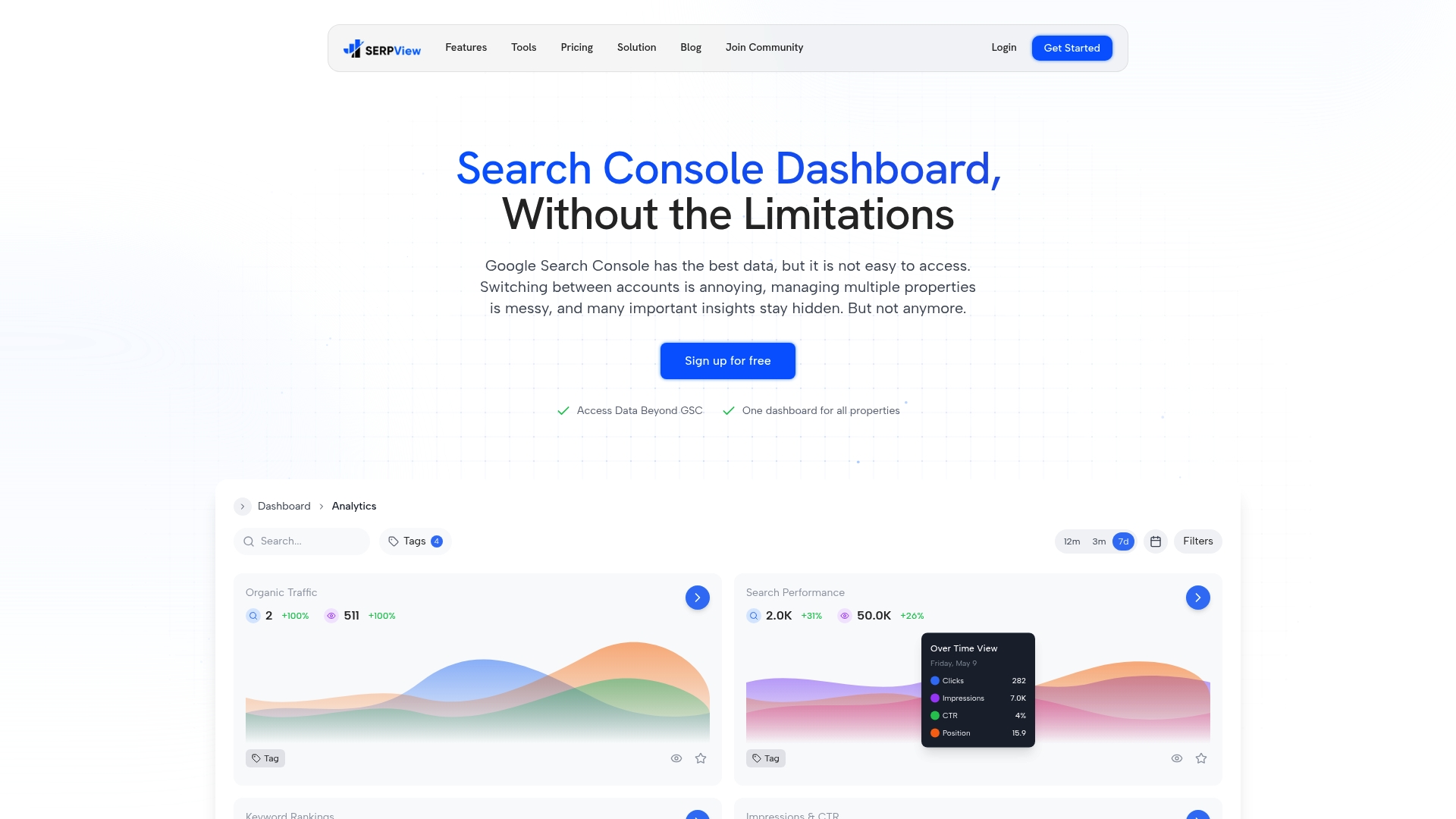
White-label sharing means the client sees your agency’s branding, not a third-party tool. Multi-property GSC consolidation means one workspace covers every client site you manage. Start a trial at Serpview and connect your first client property today.
Sources
- SEO Client Report Template for Agencies (Free Download) | CrawlRaven
- How to Build the Perfect SEO Agency Dashboard For Clients Today - VH Info
FAQ
What is an agency SEO dashboard?
An agency SEO dashboard is a platform that consolidates SEO data from sources like Google Search Console and GA4 into visual reports agencies can share with clients. It typically supports multiple client workspaces, white-label branding, and automated report delivery.
What does an SEO agency do with a dashboard?
An SEO agency uses a dashboard to track keyword rankings, organic traffic, technical health, and conversions across all client accounts, then delivers those findings as branded reports that demonstrate campaign progress.
What are the most important features in an agency SEO dashboard?
White-label reporting, multi-client workspaces, role-based permissions, and high export row limits are the features agencies should prioritize. Platforms capped at 1,000 GSC rows will miss significant portions of performance data for larger client sites.
What is the best agency SEO dashboard for multi-client reporting?
Serpview is built for exactly this use case: it consolidates multiple GSC properties, exports up to 50,000 rows per query, and delivers live shared dashboards with white-label branding, making it a strong fit for agencies managing several client accounts simultaneously.
How often should an agency SEO dashboard refresh data?
Rank tracking and Google Business Profile data should refresh daily; site audit scores and backlink counts weekly; content decay analysis monthly. Always confirm a platform’s actual refresh SLA before promising clients “live” data.
Recommended
Ready to unlock your full GSC potential?
SERPView helps you access all your Google Search Console data without limitations. Start your free trial today.
Get Started Free