
Why Businesses Need SEO Analytics to Prove Organic ROI
SERPView Team
SEO Analytics
SEO analytics is the measurement practice that proves and improves search-driven revenue. Without it, you are spending on content and technical work with no way to confirm what is generating pipeline, what is wasting budget, or what to prioritize next. Zero-click searches have risen sharply: from 56% in May 2024 to 69% in May 2025, which means impressions and AI citation signals now matter as much as clicks when you report organic visibility to leadership.
Three reasons to invest in SEO analytics right now:
- Prove revenue. Connect organic sessions to conversions and actual deal value so you can answer “is SEO working?” with a number, not a feeling.
- Prioritize high-ROI content. Identify which pages drive assisted conversions and organic revenue, then double down on those topics and formats.
- Reduce wasted spend. Spot underperforming pages and reallocate budget from paid channels when organic attribution data shows organic is already covering that demand.
Table of Contents
- What SEO analytics actually covers (and how it differs from general web analytics)
- Core SEO KPIs and the ones that move the revenue needle
- How SEO analytics creates tangible business outcomes
- Common measurement mistakes and vanity metrics to avoid
- A simple SEO analytics framework you can adopt this week
- Which tools reliably collect SEO analytics data
- How long SEO analytics takes to show measurable impact
- Advanced platform capabilities that close real measurement gaps
- Key Takeaways
- The measurement gap most teams are not talking about
- Serpview gives you the row depth and consolidation GSC cannot
- Useful sources and further reading
- FAQ
What SEO analytics actually covers (and how it differs from general web analytics)
SEO analytics is the practice of collecting, interpreting, and acting on data about how a site performs in organic search, then connecting that performance to on-site behavior and business outcomes. General web analytics tells you what happened on your site. SEO analytics tells you why people arrived from search and whether those visits produced value.
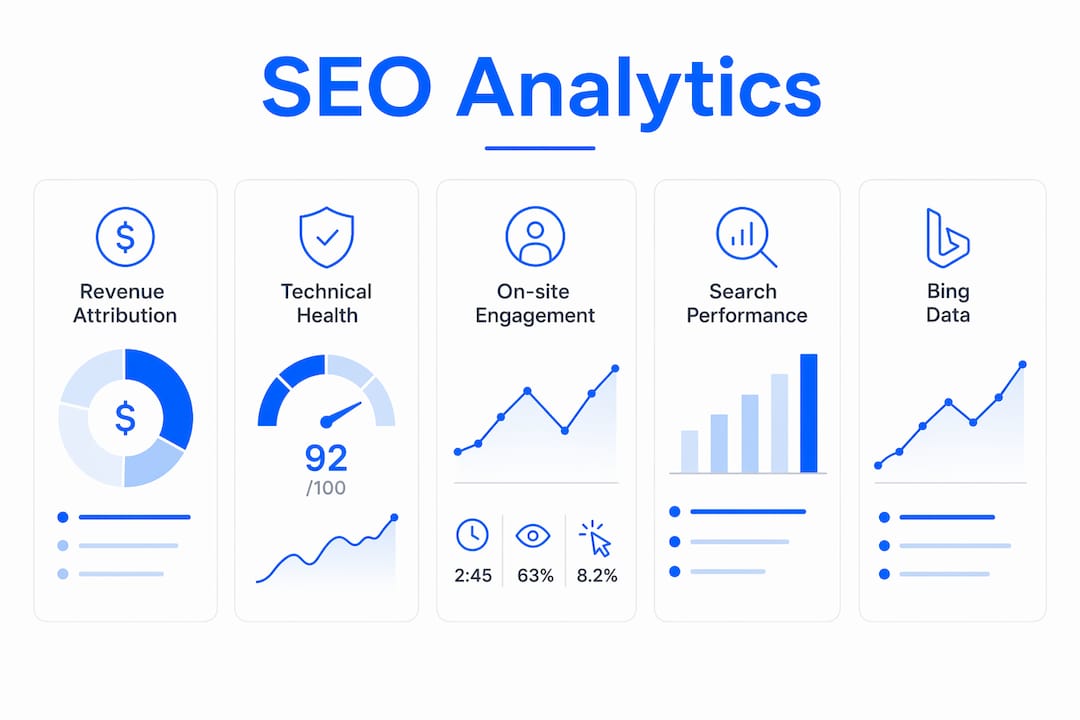
The scope covers four areas:
Search performance tracks impressions, clicks, CTR, and average position from Google Search Console and Bing Webmaster Tools. These signals show how visible you are before a user ever reaches your site.
On-site engagement lives in GA4: session depth, engagement rate, scroll behavior, and goal completions segmented by organic traffic. Google Search Console and GA4 together cover most practical SEO analytics needs before you need any paid tooling.

Technical health covers Core Web Vitals, crawl coverage, indexation ratios, and page experience signals. These are the structural inputs that determine whether your content can rank at all.
Revenue attribution ties organic sessions to pipeline, customer acquisition cost (CAC), and lifetime value. This is where SEO analytics separates itself from a simple traffic report and becomes a business argument.
Bing Webmaster Tools adds a meaningful layer for US businesses: it surfaces additional impression and query data that Google Search Console does not capture, particularly for audiences using Microsoft Edge and Bing as defaults. Ignoring it leaves a real slice of search performance unmeasured.
Core SEO KPIs and the ones that move the revenue needle
A three-tier KPI approach maps metrics to the business outcomes executives actually care about: business results at the top, engagement signals in the middle, and technical health at the base.
Foundation-stage metrics (new or small sites, under 50 indexed pages):
- Impressions — how often your pages appear in search results; the earliest signal of visibility before clicks accumulate
- Index coverage ratio — the percentage of submitted URLs that are indexed and eligible to rank
- Core Web Vitals — Largest Contentful Paint, Interaction to Next Paint, and Cumulative Layout Shift; technical prerequisites for ranking
Growth-stage metrics (sites with consistent traffic, 50–500 pages):
- Organic clicks and sessions — the volume of search-driven visits; track monthly, not weekly, to avoid algorithm-update noise
- Average position — useful as a trend indicator, not a standalone KPI
- CTR — clicks divided by impressions; a declining CTR at a stable position signals AI Overviews or featured snippet displacement
- Organic conversions — form fills, calls, bookings, or purchases attributed to organic sessions in GA4
Optimization-stage metrics (mature programs with reliable conversion data):
- Organic revenue and organic-attributed pipeline — the dollar value tied directly to organic sessions
- CAC from organic — compare this against paid CAC to make the budget reallocation argument
- Assisted conversions — organic’s role in multi-touch paths where another channel gets last-click credit
- AI citation share — how often your content appears in AI Overviews or AI-generated answers; a new but critical visibility signal as only about 16% of teams currently track AI search impact
The KPI → business metric mapping is direct: increasing organic conversions reduces CAC from organic proportionally, assuming consistent close rates. That is the number your CFO wants to see, not a ranking screenshot.
How SEO analytics creates tangible business outcomes
The conversion path looks like this: a user searches a commercial query, your page appears in an AI Overview or organic result, the user clicks through, engages with the content, and eventually completes a conversion. In GA4, that session is tagged as organic. If you have connected Search Console to GA4 and GA4 to your CRM, you can trace that conversion back to the specific query and page that started the journey.
Multi-touch attribution materially increases organic’s credited value compared with last-click models, particularly in B2B sales cycles where a prospect may touch organic content three or four times before converting through a paid retargeting ad. Without multi-touch attribution, the paid channel gets full credit and organic looks like it is not contributing. That misread directly causes budget misallocation.
The decision triggers analytics enables are concrete. When you see a page with strong impressions but a CTR well below its position benchmark, the fix is a title and meta description update. When organic conversions are climbing but revenue per session is flat, the issue is likely landing page experience or offer clarity, not SEO. When Core Web Vitals scores drop after a site update, you have a technical regression to fix before rankings follow. Analytics does not just measure outcomes; it tells you which lever to pull next.

Teams that adopt measurement-first practices can reallocate spend from underperforming paid channels to organic content once attribution data confirms organic is already covering that demand. That reallocation is a direct, measurable business benefit of having the right analytics in place.
Common measurement mistakes and vanity metrics to avoid
The most common reason SEO teams lose executive support is reporting metrics that do not connect to business outcomes. Leadership requires organic revenue and CAC data, not a list of keywords you rank for.
Vanity metrics to stop leading with:
- Raw impressions without context — impressions alone say nothing about whether you are visible for queries that convert
- Total keyword count — ranking for 10,000 keywords means nothing if none of them drive conversions
- Surface CTR without intent segmentation — blending informational and transactional queries into one CTR number hides where the real opportunity or problem lies
- Rankings as the primary KPI — a first-place ranking with declining CTR due to AI Overviews can still mean flat revenue
Replace them with:
- Organic conversions and organic-attributed revenue
- AI share-of-voice (how often you appear in AI-generated results)
- Assisted conversions showing organic’s role in multi-touch paths
- Revenue per organic session, segmented by page type
SEO analytics is a diagnostic discipline that requires resolving conflicts between data sources before claiming ROI. When Google Search Console and GA4 disagree on session counts, the gap is usually sampling, cross-domain tracking issues, or bot traffic inflating one source. Act on the reconciled number, not whichever platform shows the better result.
Pro Tip: Build a one-page executive report that leads with three business KPIs: organic revenue, organic CAC, and assisted conversion count. Put rankings and impressions in an appendix. Executives who see business numbers first ask better questions and approve budgets more readily.
Common data quality problems include broken tracking after site migrations, spam conversions inflating goal completions, and misattributed sessions from UTM parameter stripping. Run a QA audit before every major reporting cycle, not just when numbers look wrong.
A simple SEO analytics framework you can adopt this week
Setting up measurement correctly takes a few focused steps. Here is a checklist your team can work through:
- Define business outcomes first. What does a conversion mean for your business? A form fill, a phone call, a purchase? Write it down before touching any analytics tool.
- Map conversions in GA4. Create GA4 events and key events for every conversion type, segmented so you can filter by organic traffic specifically.
- Connect Search Console to GA4. This link surfaces query-level data inside GA4 and lets you see which searches drive which on-site behaviors.
- Validate your data. Cross-reference GA4 session counts against Search Console clicks. A gap larger than 10–15% usually signals a tracking issue worth investigating.
- Implement attribution. For B2B or long sales cycles, configure multi-touch attribution or connect GA4 to your CRM so organic’s assisted role is visible.
- QA your conversion flows. Test every goal completion path monthly to catch tracking breaks before they corrupt a reporting period.
Dashboard components by audience:
| Audience | Metrics to show | Purpose |
|---|---|---|
| Executive | Organic revenue, organic CAC, assisted conversions | Prove business value and justify budget |
| Marketing manager | Organic sessions, conversions by page, CTR by intent | Prioritize content and optimization work |
| SEO analyst | Impressions, average position, Core Web Vitals, index coverage | Diagnose technical and visibility issues |
Reporting cadence:
| Frequency | What to review |
|---|---|
| Weekly | Core Web Vitals alerts, crawl errors, indexation drops |
| Monthly | Organic sessions, conversions, CTR trends, top-page performance |
| Quarterly | Organic revenue vs. CAC, assisted conversion analysis, technical SEO audit |
A staged measurement hierarchy reduces dashboard paralysis: add metrics only when earlier tiers are stable and interpretable. Tracking too many metrics before your conversion data is reliable produces noise, not insight.
Which tools reliably collect SEO analytics data
Google Search Console is the non-negotiable starting point. It shows impressions, clicks, CTR, average position, index coverage, and Core Web Vitals directly from Google’s index. The standard interface limits exports to 1,000 rows, which means large sites miss the long tail entirely without a supplemental tool.
GA4 handles on-site behavior and conversion tracking. Connect it to Search Console to bring query data into the same interface where you measure goal completions. Set up organic traffic segments from day one so you are never blending channels in your conversion reports.
Bing Webmaster Tools adds search performance data from Bing and Microsoft Edge. For US-based businesses, Bing typically accounts for a smaller share of organic traffic than Google, but ignoring it means missing a measurable portion of your audience, particularly in B2B and enterprise segments where Microsoft products are common.
Rank trackers monitor SERP feature capture (featured snippets, AI Overviews, People Also Ask boxes) and track keyword visibility as a trend rather than a snapshot. Pair rank data with CTR from Search Console to understand whether a position change is actually moving traffic.
Crawl tools and Core Web Vitals monitors surface technical issues before they affect rankings. Run crawls after every significant site change and monitor Web Vitals continuously, not just at audit time.
Integration matters as much as the tools themselves. The Search Console → GA4 → CRM chain is where organic’s true business contribution becomes visible. Multi-touch attribution for long B2B sales cycles often reveals that organic deserves significantly more credit than last-click models assign. Common pitfalls: UTM parameters stripped by redirects, cross-domain tracking gaps, and CRM deals not tagged with original source data.
When to add paid tools: once your free stack is validated and you need historical data beyond 16 months, multi-property consolidation, or row depth beyond Search Console’s 1,000-row limit, paid platforms close those gaps. Organic search insight tools that expand row depth and historical range are worth evaluating when your program scales past a few hundred indexed pages.
How long SEO analytics takes to show measurable impact
Newly published content typically needs several months before ROI is measurable. Search engines need time to crawl, index, and rank new pages, and conversion data needs volume before it is statistically reliable. Analysts should focus on diagnostic trends during this window rather than declaring success or failure on early numbers.
Rough timeline expectations:
- Months 1–2: Tracking setup, baseline data collection, QA of conversion flows. No reliable performance signal yet.
- Months 3–4: Impressions and click trends become readable. CTR and position data stabilize enough for initial optimization decisions.
- Months 5–6: Organic conversion data accumulates. You can begin comparing organic CAC against paid benchmarks.
- Month 6 and beyond: Multi-touch attribution data is meaningful. Organic revenue attribution becomes defensible in executive reporting.
Cost and resourcing by team size:
Small sites running DIY measurement with Google Search Console, GA4, and Bing Webmaster Tools can operate at no direct tool cost. The investment is primarily time to maintain dashboards and run monthly reviews.
Mid-market teams with managed reporting typically add a rank tracker and a consolidated dashboard tool, incurring moderate monthly tool costs. A part-time SEO analyst or a marketing manager with analytics training can own this stack.
Enterprise programs with multi-touch attribution, BI integration, and cross-property reporting require dedicated analyst resources and tool budgets that scale with site complexity. At this level, the analytics investment is justified by the budget reallocation decisions it enables.
Ownership recommendation: analytics should be owned by someone who sits at the intersection of SEO and business reporting, not siloed in a technical team. Cross-functional reviews with marketing, sales, and finance quarterly keep the data connected to the decisions that matter.
Advanced platform capabilities that close real measurement gaps
The 2025–2026 search environment has created specific measurement gaps that standard Search Console setups do not address. Zero-click searches rose from 56% in May 2024 to 69% in May 2025, and only about 16% of teams track AI search impact despite AI Overviews reducing CTR in many query categories. Platforms that close these gaps give business stakeholders a more accurate picture of organic’s contribution.
Feature checklist for evaluating an analytics platform:
- Multi-touch attribution support (not just last-click)
- AI Overview and zero-click visibility tracking
- Schema and structured data monitoring for AI citation eligibility
- Historical data depth beyond 16 months
- Cross-device comparison (mobile vs. desktop performance splits)
- Row depth beyond 1,000 for large-site long-tail analysis
- Custom annotations to correlate site changes with performance shifts
Capability gaps by measurement need:
| Measurement need | Standard GSC limitation | Platform feature that closes the gap |
|---|---|---|
| Long-tail keyword analysis | 1,000-row export cap | Up to 50,000 rows of query data |
| Historical trend analysis | 16-month data window | Extended historical performance tracking |
| Cross-property reporting | Single-property view | Unified multi-property dashboard |
| AI citation monitoring | No native AI visibility signal | AI share-of-voice and snippet tracking |
| Cross-device comparison | Limited device segmentation | Mobile vs. desktop KPI splits |
When tools disagree, use a diagnostic matrix: verify tracking implementation, check for GA4 sampling, cross-reference impressions between Search Console and rank trackers, and reconcile with CRM data before making strategic decisions. Acting on unvalidated metric conflicts is one of the fastest ways to misallocate SEO budget. For a deeper look at how search data blind spots affect measurement accuracy, the zero-click and AI citation gaps deserve specific attention in your platform evaluation.
Key Takeaways
SEO analytics connects organic search visibility directly to revenue, CAC, and pipeline, making it the measurement layer that justifies and guides every SEO investment decision.
| Point | Details |
|---|---|
| Revenue attribution is the goal | Connect organic sessions to conversions and deal value; organic CAC vs. paid CAC is the executive argument. |
| Avoid vanity metrics | Replace raw impressions and keyword counts with organic revenue, assisted conversions, and AI share-of-voice. |
| Use a staged KPI hierarchy | Start with foundation metrics, add growth KPIs when traffic stabilizes, then layer in revenue attribution. |
| Expect a 5–6 month signal window | Reliable organic conversion data and defensible ROI attribution typically require at least five to six months of clean data. |
| Serpview closes GSC row limits | Serpview expands Search Console data to up to 50,000 rows and consolidates multi-property views for deeper long-tail and historical analysis. |
The measurement gap most teams are not talking about
The conventional wisdom says “just set up Google Search Console and GA4 and you are covered.” That advice was accurate three years ago. Today it leaves a significant blind spot.
The shift to AI-generated search results means a growing share of your organic visibility never produces a click. Your content may be cited in an AI Overview, influencing a purchase decision, without generating a session that GA4 can attribute. If your reporting framework only counts clicks and sessions, you are systematically undercounting organic’s contribution to pipeline. That undercounting leads directly to budget cuts in the channel that is actually working.
The second gap is row depth. Google Search Console’s 1,000-row export limit is not a minor inconvenience for large sites; it is a structural blind spot. The queries that drive long-tail conversions, often the highest-intent, lowest-competition terms, are invisible in a standard export. Teams that never see those rows make content and prioritization decisions based on an incomplete picture of their own performance.
The third mistake is treating analytics as a reporting function rather than a decision-making function. The teams that get the most value from SEO data are the ones who use it to answer a specific question every week: which page should we update, which cluster should we expand, which technical issue is suppressing a high-value page? Analytics that lives in a monthly PDF and never informs a content or engineering decision is overhead, not investment.
Start small. Pick three business KPIs, get the tracking right, and build from there. The teams that try to measure everything from day one usually end up trusting nothing.
Serpview gives you the row depth and consolidation GSC cannot
Google Search Console is the right foundation, but its 1,000-row cap and single-property view create real gaps once your program scales. Serpview addresses both directly: it expands query data to up to 50,000 rows, consolidates analytics across multiple properties into one dashboard, and adds historical performance tracking well beyond GSC’s 16-month window.
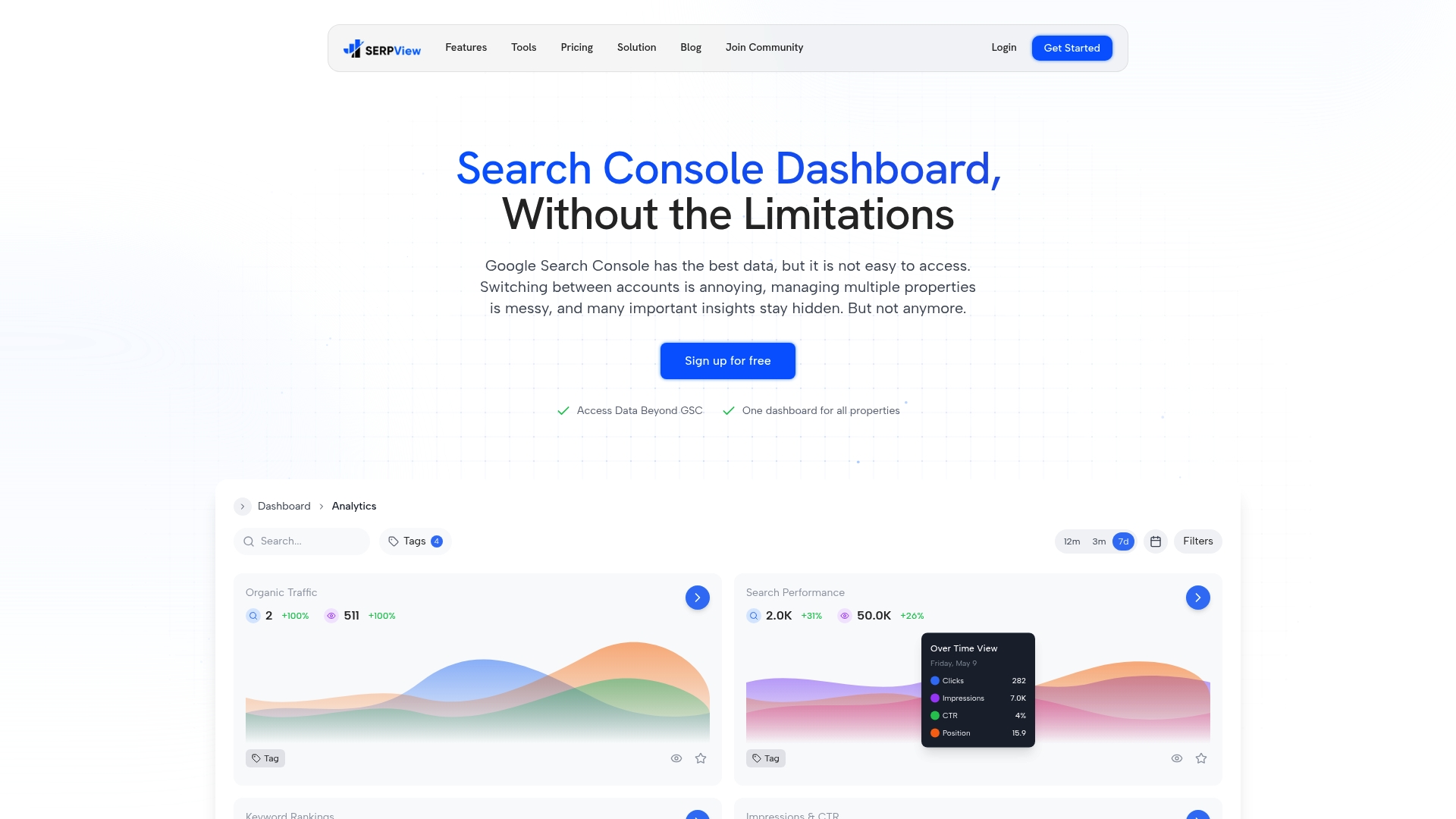
For teams building the executive reporting layer described in this article, Serpview’s shared dashboard lets you surface business KPIs to stakeholders without giving them raw data access. Custom annotations let you log site changes and content updates directly on your performance charts, so you can correlate actions with outcomes rather than guessing what caused a traffic shift. If you are ready to move beyond standard Search Console limits, explore Serpview’s Google Search Console guidance and see how a consolidated view changes what you can measure.
Useful sources and further reading
- ObserviX: SEO Analytics Guide 2026 — Covers 2025–2026 metric shifts including zero-click growth, AI citation tracking, and ROI benchmarks by industry.
- Improvado: SEO Analytics Diagnostics & Metrics for 2026 — Detailed diagnostic protocols for resolving data conflicts between Search Console, GA4, and CRM systems.
- Firestarter SEO: How to Measure SEO Success — Practical KPI framework organized by business results, engagement signals, and technical health tiers.
- The Seo Engine: SEO Analytics Measurement Hierarchy — Explains staged metric adoption based on content maturity and indexed page volume.
- Hive Digital: Benefits of Measuring Key SEO Metrics — Practical overview of the five core metrics every US-focused site should track in Search Console and GA4.
- MavenJ SEO: SEO KPIs Every Business Should Track — Comprehensive KPI guide covering organic sessions, CTR, conversions, and technical health with business-goal mapping.
- Serpview Blog: How Search Analytics Measures ROI for Marketers — Explains how to connect organic metrics to executive-level outcomes and build a defensible ROI case.
- Serpview Blog: SEO Performance Benchmarks 2026 Guide — Practical guidance for setting benchmarks across content maturity levels and KPI tiers.
FAQ
What is SEO analytics and why does it matter for business?
SEO analytics is the practice of measuring organic search performance and connecting it to business outcomes like conversions, revenue, and customer acquisition cost. It matters because it turns SEO from an activity into a measurable business investment.
Why is SEO still important for businesses in 2026?
SEO remains a high-ROI channel, but the measurement has changed: zero-click searches rose from 56% in May 2024 to 69% in May 2025, so visibility now includes AI citations and impressions, not just clicks. Businesses that measure only clicks are undercounting organic’s contribution to pipeline.
What are the 3 C’s of SEO?
Definitions vary across sources, but a widely used version covers content (relevance and quality), code (technical health and crawlability), and credibility (authority signals like backlinks and structured data). These map directly to the three KPI tiers: engagement, technical health, and business results.
Is SEO analytics only useful for large businesses?
No. Small businesses using Google Search Console and GA4 at no cost can track the metrics that matter most: organic sessions, conversions, and CTR by page. The search analytics for small business approach starts with three KPIs and scales from there as the program matures.
Recommended
Ready to unlock your full GSC potential?
SERPView helps you access all your Google Search Console data without limitations. Start your free trial today.
Get Started Free