
Why Consolidate Search Analytics Properties in 2026
SERPView Team
SEO Analytics

TL;DR:
- Consolidating search analytics unifies data from multiple sources into a single framework, enabling full-funnel visibility. This process improves decision-making by linking search queries directly to conversions and revenue, while reducing manual work, costs, and operational risks. Challenges include grain mismatch, URL normalization, data limits, and maintaining data pipelines; successful implementation relies on structured audits, API use, data modeling, and ongoing management.
Search analytics property consolidation is the practice of unifying fragmented query, session, and conversion data from multiple sources into a single reporting framework. Digital analysts who skip this step make decisions from incomplete pictures. Google Search Console shows you what queries drove clicks. Google Analytics 4 shows you what users did after they clicked. Neither tool alone tells you which search queries actually generate revenue. Understanding why consolidate search analytics properties matters is the first step toward building an analytics setup that drives real decisions.
Why consolidate search analytics properties: the core benefits
The primary reason to consolidate is full-funnel visibility. Integrating Google Search Console with GA4 transforms basic traffic reporting into performance analysis that maps search queries directly to conversions. That connection is what separates teams that guess from teams that know.
The benefits extend well beyond visibility:
- Unified KPI definitions. When your team uses one source of truth, CPA and ROAS mean the same thing in every report. Fragmented properties produce fragmented definitions, and fragmented definitions produce arguments instead of decisions.
- Reduced manual work. Managing 10 or more properties through individual interfaces is unsustainable. Analysts waste hours toggling between dashboards instead of interpreting data.
- Operational maturity. Domains without unified analytics governance score low on maturity scales and carry high operational risk. Consolidation signals that your organization treats data as infrastructure, not an afterthought.
- Cost reduction. Unified reporting eliminates redundancy by standardizing KPIs across channels. Fewer tools, fewer licenses, and fewer reconciliation hours all reduce overhead.
- Compliance and governance. A single data pipeline is easier to audit, document, and secure than a patchwork of disconnected property exports.
The efficiency gains are real and measurable. Teams that consolidate spend less time explaining data variance and more time acting on it.
What are the key challenges when consolidating search analytics data?

The biggest technical obstacle in any consolidation project is grain mismatch. GSC records data at the query-page-date grain, while GA4 records data at the session-event grain. These two structures do not join cleanly in a spreadsheet. Trying to reconcile them without a data warehouse produces misleading numbers.
Other challenges analysts regularly encounter include:
- URL normalization. GSC and GA4 often record the same page with different URL formats, such as trailing slashes, UTM parameters, or protocol variations. Without normalization logic, your join keys fail silently.
- UI data limits. The GSC interface caps exports at 1,000 rows. Analysts managing large sites or agencies with many clients hit this ceiling immediately. API access is required for any serious consolidation work.
- Historical data loss. The GSC UI retains only 16 months of data. Preserving historical trends beyond this limit requires exporting data to a warehouse on a recurring schedule before the window closes. Miss that window and the data is gone permanently.
- Cross-property deduplication. GA4’s standard configuration cannot compare multiple properties side-by-side without premium features or custom setups. Cross-domain user deduplication requires a specific User ID tracking configuration, which adds complexity to any consolidation project.
- Mismatched property structures. Analysts often discover that GSC properties were set up as URL-prefix properties while GA4 tracks a domain property. Reconciling these requires careful remapping before any data joins are reliable.
Pro Tip: Set up a recurring BigQuery export for your GSC API data from day one of any consolidation project. Waiting until you need historical data is too late. The 16-month window moves forward every day.
A simple dashboard integration is not sufficient. Consolidation requires data modeling to join disparate datasets accurately. Teams that treat it as a UI exercise consistently produce reports with unexplained discrepancies.
How do digital teams implement search analytics consolidation?
Successful consolidation follows a structured process. Skipping steps creates the same fragmentation you were trying to fix.
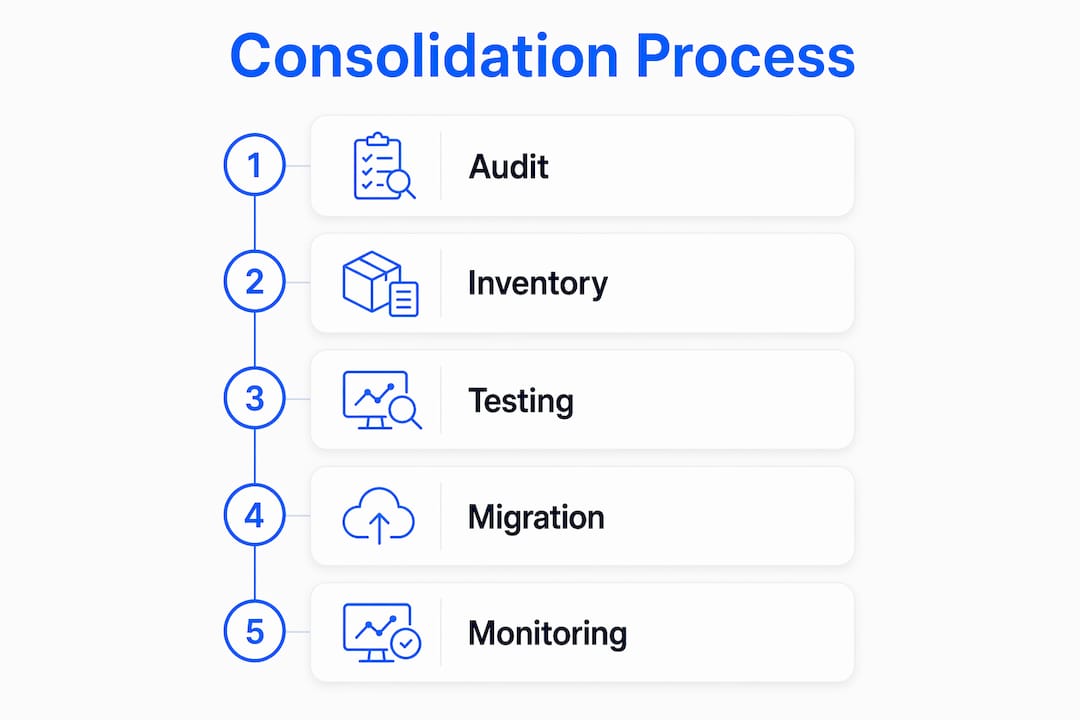
- Audit your existing properties. List every GSC property and every GA4 property your organization owns. Note the property type (domain vs. URL-prefix), the tracking status, and the owner. This inventory is your baseline.
- Link GSC properties to GA4. Connect each GSC property to its corresponding GA4 property through the Google Search Console linking feature in GA4. Verify that the linked property covers the same URLs as the GA4 data stream.
- Configure API data pulls. Use the GSC API and GA4 Data API to extract data programmatically. Manual exports do not scale. For agencies managing dozens of clients, this step is non-negotiable.
- Centralize data in a warehouse. Route both data streams into a warehouse such as BigQuery. BigQuery enables ranking search queries by conversion value rather than impression volume alone. That shift in ranking logic changes which keywords your team prioritizes.
- Build unified dashboards. Connect your warehouse to a visualization layer such as Looker Studio or a custom reporting environment. Define your KPIs at the warehouse level, not the dashboard level, so every report pulls from the same definitions.
- Document your measurement plan. A missing data dictionary signals low operational maturity and creates reconciliation problems later. Document every metric definition, every join key, and every transformation rule before you go live.
Effective consolidation projects follow a clear timeline. Audit all data sources within 45 days, complete migration testing by day 60, and achieve live unified reporting by day 90. That 90-day structure keeps projects from drifting into indefinite “almost done” status.
| Phase | Timeline | Key deliverable |
|---|---|---|
| Audit and inventory | Days 1–45 | Full property map and gap analysis |
| Migration and testing | Days 46–60 | Validated data joins and KPI definitions |
| Live reporting | Days 61–90 | Unified dashboard with documented measurement plan |
For teams managing GSC data limitations at scale, the API-first approach is the only path that holds up under real workloads.
How does consolidating search data improve strategic decisions?
Consolidated search analytics changes the quality of decisions your team makes. The improvement is not marginal. It is structural.
- Accurate revenue attribution. Consolidated reporting enables clear revenue attribution, showing which search queries generate conversions rather than just clicks. Your team stops optimizing for impressions and starts optimizing for outcomes.
- Keyword prioritization by value. When you can rank keywords by conversion value instead of search volume, your content and SEO investment goes to the queries that actually matter. This is the core advantage of joining GSC query data with GA4 conversion data in a warehouse.
- Faster SEO adjustments. Unified data pipelines reduce the time between observation and action. When a keyword drops in ranking and you can immediately see the revenue impact, the business case for fixing it writes itself.
- Cleaner cross-functional reporting. Analysts spend less time explaining why the marketing dashboard shows different numbers than the SEO report. One source of truth removes that friction entirely.
- AI and advanced analytics readiness. Unified data pipelines are the prerequisite for any machine learning or AI application. You cannot train a model on fragmented, inconsistently defined data. Consolidation is the foundation that makes advanced search data insights possible.
Organizations that move to unified reporting also improve board-level KPI clarity. Executives stop receiving conflicting numbers from different teams and start receiving one version of performance reality. That shift builds trust in the analytics function itself.
For teams thinking about how search data informs client strategy, consolidation is the prerequisite, not the end goal. The end goal is better decisions made faster.
Key Takeaways
Consolidating search analytics properties is the single most effective step a digital team can take to move from fragmented reporting to revenue-driven decision-making.
| Point | Details |
|---|---|
| Full-funnel visibility | Joining GSC query data with GA4 conversion data reveals which searches drive revenue. |
| Grain mismatch is the core challenge | GSC and GA4 use different data structures; a warehouse like BigQuery is required to join them accurately. |
| Historical data requires proactive export | GSC retains only 16 months of data in the UI; recurring API exports to a warehouse preserve the full record. |
| A 90-day timeline works | Audit by day 45, complete migration testing by day 60, and go live with unified reporting by day 90. |
| Documentation prevents failure | A data dictionary and measurement plan are required to maintain data consistency after consolidation. |
The case for treating consolidation as infrastructure, not a project
I have watched teams spend months building beautiful dashboards that collapse the moment someone asks a question the dashboard was not designed to answer. The problem is almost never the visualization tool. The problem is that the underlying data was never properly modeled.
The most common mistake I see is treating consolidation as a one-time project rather than ongoing infrastructure. You audit, you migrate, you build the dashboard, and then you stop. Six months later, a new GSC property gets added, a new GA4 data stream goes live, and nobody updates the warehouse schema. The unified reporting slowly becomes as fragmented as what you replaced.
The teams that get this right treat their data pipeline the same way they treat their website. It needs maintenance, documentation, and ownership. The measurement plan is not a deliverable you hand off. It is a living document that someone owns.
The future of this work involves AI search data integration and automated anomaly detection. But those capabilities require clean, unified data as their foundation. Investing in analytics maturity now is not about chasing the next trend. It is about building the infrastructure that makes every future capability possible. The analysts who understand this are the ones who will still be relevant when the tools change again.
— Utsav Chopra
Serpview makes unified search reporting practical
Managing multiple GSC and GA4 properties in a single reporting environment is exactly the problem Serpview was built to solve.
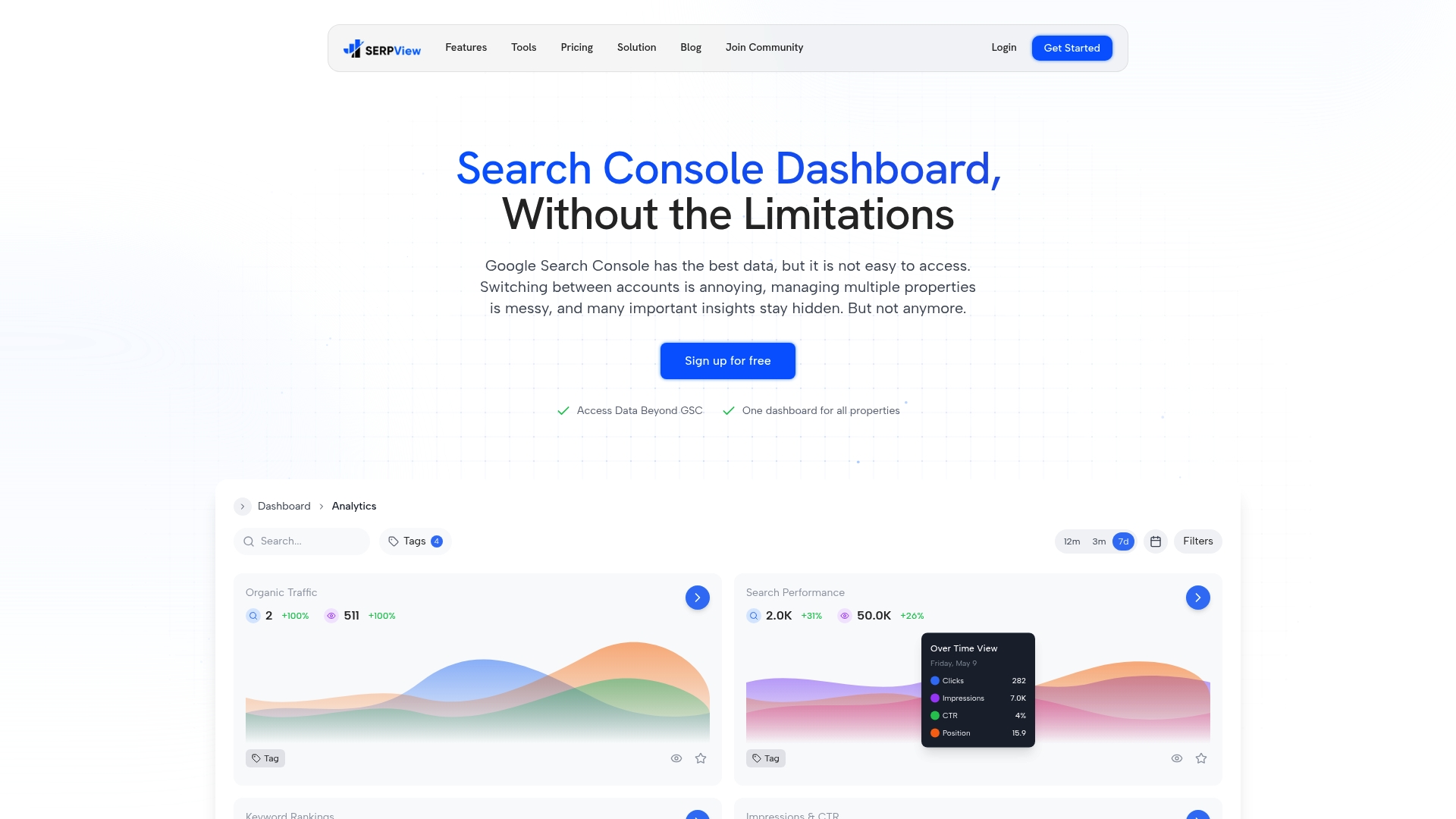
Serpview provides a unified search analytics dashboard that removes the 1,000-row restriction and surfaces up to 50,000 rows of data per query. That means you see the full picture across all your properties, not a truncated sample. The platform supports keyword analysis and performance tracking with customizable filters, mobile versus desktop comparisons, and historical data access that goes well beyond the standard GSC UI window. For agencies and enterprise teams managing dozens of properties, Serpview centralizes reporting in one place and standardizes the KPI definitions your team needs to make consistent decisions.
FAQ
What does search analytics property consolidation mean?
Search analytics property consolidation means unifying data from multiple Google Search Console and Google Analytics 4 properties into a single reporting framework. The goal is to connect query-level data to conversion and behavioral data for complete performance visibility.
Why can’t you just use Google Search Console alone?
Google Search Console shows query and click data but does not record what users do after they arrive on your site. Without GA4 conversion data joined to GSC query data, you cannot determine which search queries actually generate revenue.
What is grain mismatch and why does it matter?
Grain mismatch refers to the structural difference between GSC data (recorded at the query-page-date level) and GA4 data (recorded at the session-event level). These two structures cannot be joined accurately in a spreadsheet, which is why a data warehouse is required for proper consolidation.
How long does a consolidation project typically take?
A well-structured consolidation project takes approximately 90 days: 45 days for auditing all data sources, 15 days for migration testing, and the final phase for live unified reporting. Skipping the audit phase is the most common reason projects run over time.
What is the biggest risk of not consolidating search analytics properties?
The biggest risk is making SEO and content investment decisions based on incomplete data. Without consolidation, teams optimize for impressions or clicks rather than conversions, which misallocates budget and effort toward queries that do not drive business outcomes.
Recommended
Ready to unlock your full GSC potential?
SERPView helps you access all your Google Search Console data without limitations. Start your free trial today.
Get Started Free