
Centralized SEO Reporting: A Playbook for Multi-Site Teams
SERPView Team
SEO Analytics
Centralized SEO reporting means pulling data from every property, tool, and account into one governed system so decisions get made from a single source of truth instead of six competing exports. Done right, it rests on four elements: unified data pipelines, KPIs tailored to each audience, an automated delivery cadence, and clear ownership of who maintains it. Skip any one of these and reports quietly drift out of sync within a quarter.
Success looks like this:
- Unified data: Google Search Console, GA4, rank tracking, backlinks, and audits live in one place, not six tabs.
- Tailored KPIs: executives, account managers, and technical SEOs each see a different slice of the same dataset.
- Automated cadence: daily scans, weekly digests, and monthly summaries run without manual exports.
- Governance: someone owns the credentials, the alert thresholds, and the update schedule.
Reusable templates and a platform such as SERPView, which consolidates multiple Search Console properties past Google’s 1,000-row cap, removes most of the manual assembly work described below.
Key Takeaways
Centralized SEO reporting succeeds when unified data, tiered KPIs, automated cadence, and clear ownership are all in place at once, not treated as separate initiatives.
Table of Contents
- Why Fragmented SEO Reporting Fails Teams
- Which KPIs Belong in a Centralized SEO Report?
- How Do You Architect Data Across Multiple Properties?
- How Often Should You Automate and Send SEO Reports?
- What Does a Centralized Reporting Rollout Checklist Look Like?
- How SERPView Puts This Framework Into Practice
- What Agencies Get Wrong About Centralized Reporting
- Get Centralized SEO Reporting Without Building the Pipeline Yourself
- Sources
- FAQ
Why Fragmented SEO Reporting Fails Teams
Most agencies do not lack data. They have too much of it, scattered across accounts nobody remembers the login for. When each site or client lives in its own Search Console property with no cross-property view, three problems compound quietly.

Keyword cannibalization goes undetected because nobody is comparing rankings across the whole portfolio, only within one property at a time. Content decay on a client’s site three months into a retainer often goes unnoticed until traffic has already dropped, because nobody built a recurring check. And analysts burn hours every month rebuilding the same exports instead of interpreting them, since centralizing GSC and GA data cuts that manual work down substantially.
The payoff for fixing this is concrete:
- Faster decisions, because a portfolio manager can see every property’s health in one dashboard instead of waiting on five separate pulls.
- Fewer ad-hoc export requests interrupting the team’s actual analysis work.
- A cohesive, comparable view across a client roster or a multi-brand portfolio, not just one site at a time.
Agencies with more than a handful of client sites benefit most, along with in-house teams managing brand and regional subdomains, and SEO leads who report to executives unfamiliar with search jargon.
Which KPIs Belong in a Centralized SEO Report?
The mistake most teams make is building one report and sending it to everyone. Executives, account managers, and SEOs need different altitudes of the same data, and a clear reporting framework should align KPIs to business objectives before it worries about formatting. A two-tier model, hero metrics for leadership and diagnostic detail for specialists, keeps the noise down without losing the investigative depth technical teams actually need.
For executives, keep it to three or four numbers:
- Portfolio-wide organic traffic trend, month over month.
- Revenue or lead contribution from organic search, tied to actual conversion data, not sessions alone.
- Share of voice: your properties’ visibility across a defined keyword set versus the total available visibility in that set, expressed as a percentage.
For account managers, the report should surface what needs a decision this week:
- Top wins and top risks, ranked by traffic or revenue impact.
- Content decay flags: pages that lost meaningful ranking position or clicks over a rolling 90-day window.
- Keyword gaps where a competitor property in the same portfolio ranks but a sibling site does not.
For SEOs doing the diagnostic work, the detail gets granular:
- Click-through rate by query, segmented against expected CTR curves for that ranking position.
- Index coverage status, flagging excluded or errored URLs by property.
- Core Web Vitals and crawl anomalies, especially spikes in server errors after a deploy.
Content ROI is worth calculating explicitly rather than eyeballing: organic revenue attributable to a page, divided by the production and optimization cost of that page, over a defined period. It is one of the few metrics that translates cleanly to a budget conversation.
How Do You Architect Data Across Multiple Properties?
The reporting layer is rarely the bottleneck. The pipeline is. Moving Search Console and GA4 data into a warehouse early pays off the moment a portfolio grows past a handful of properties, because native connectors were not built for scale.
Three architecture patterns cover most situations:
- Single GA4 property with host-name segmentation: workable for a handful of closely related subdomains, but it blurs ownership boundaries and makes property-level access control messy.
- Separate domain properties, aggregated downstream: cleaner permissions per site, but you need something outside GA4 or GSC itself to stitch the view back together.
- BigQuery as the master store: GSC and GA4 data export into BigQuery, and a union table becomes the single query surface everything else reads from. This is the approach that scales past a dozen properties without falling over.
Google Search Console’s own interface caps exports at 1,000 rows and limits historical retention to roughly 16 months, which is exactly the ceiling that pushes serious portfolios toward a warehouse or a consolidation platform in the first place. Looker Studio’s native blends also hit practical limits once you’re blending more than a couple of large data sources, with query timeouts and join complexity both working against you.
The trade-offs are real. BigQuery adds engineering overhead and a small ongoing query cost. Native blends are free and fast to set up but degrade as the portfolio grows. A consolidation platform sits in between: less setup than a custom pipeline, more headroom than a spreadsheet.
A short checklist for choosing: if you manage fewer than five properties and need answers this week, start with a consolidation tool. If you are past a dozen properties with in-house engineering support, build the BigQuery pipeline. If you are an agency serving clients who each expect a branded, low-maintenance view, a platform built for multi-property GSC data, like SERPView’s approach to multi-property workflows, usually beats a custom build on time-to-value.
Pro Tip: Before choosing an architecture, count how many rows your busiest property alone hits in Search Console each month. If you’re regularly hitting the 1,000-row export cap on a single site, a custom pipeline or a platform built to exceed it is no longer optional.

How Often Should You Automate and Send SEO Reports?
Not everything needs a human touch. Daily health scans, checking for indexing errors, sudden traffic drops, or crawl spikes, should run automatically and only surface an alert when something crosses a threshold. Weekly digests summarizing top movers and content decay flags work well as a scheduled email rather than a manual pull, an approach open-source tooling has already proven out with scheduled snapshot jobs and webhook alerts. Monthly executive summaries are the one format worth a manual review pass before sending, since tone and framing matter more at that altitude.
Delivery format should match who’s reading:
| Audience | Format | Cadence |
|---|---|---|
| Technical SEO team | Live dashboard link | Real time |
| Client account manager | Branded PDF export | Weekly |
| Executive stakeholder | Email digest with topline summary | Monthly |
Three template skeletons cover most needs:
- Weekly digest: top three wins, top three risks, one content decay flag, one action item.
- Monthly client report: traffic trend, keyword movement, technical health summary, next month’s priorities.
- Executive one-pager: portfolio traffic, revenue contribution, share of voice, one sentence of context per metric.
A Notion-based reporting template is a fast way to standardize these skeletons across an agency team without building from scratch, and matching your cadence to actual SEO timelines rather than an arbitrary weekly habit improves stakeholder adoption measurably.
What Does a Centralized Reporting Rollout Checklist Look Like?
Skipping governance is how centralized reporting quietly falls apart six months in. Nobody remembers who owns the service account, an API key expires, and the “single source of truth” becomes three conflicting spreadsheets again. Follow this sequence:
- Set up service accounts and API scopes for Search Console and GA4 separately from personal logins, so access survives staff turnover.
- Store credentials in a secured secrets manager, not a shared document, and rotate keys on a fixed schedule.
- Run a validation pass on the first data pull, comparing totals against the native GSC and GA4 interfaces for at least one known property before trusting the aggregate.
- Set alert thresholds for traffic drops (a common baseline is a 20% week-over-week decline), sudden indexing regressions, and crawl error spikes, using something like custom annotations to mark known causes like algorithm updates or site migrations.
- Assign report ownership to one named person per report type, with a documented SLA (weekly digests out by Monday 9 AM, for example).
- Roll out in phases: one property or client first, validate for two full reporting cycles, then expand to the full portfolio.
Pro Tip: Run your validation pass during a week with no algorithm volatility. If you QA your pipeline the same week Google ships a core update, you’ll spend hours chasing a discrepancy that has nothing to do with your setup.
Cross-referencing a technical audit checklist against your automated crawl alerts, as outlined here, catches the gaps a purely automated system misses.
How SERPView Puts This Framework Into Practice
Everything above maps directly onto how SERPView is built. It consolidates multiple Google Search Console properties into one view, breaking past the 1,000-row export ceiling that forces most teams into manual workarounds, with access to up to 50,000 rows per pull and historical tracking that extends well beyond GSC’s native retention window.
For agencies specifically, the workflow features matter as much as the data volume:
- White-label report exports carrying your own branding, not SERPView’s.
- Team invitations so account managers and analysts share one workspace instead of passing spreadsheets around.
- A shared live dashboard clients can check anytime, cutting down on ad-hoc status requests.
- Customizable filters for device, country, and keyword segment, matching the tiered KPI structure covered earlier.
| Requirement from this playbook | How SERPView addresses it |
|---|---|
| Cross-property data beyond GSC’s row cap | Up to 50,000 rows per export across properties |
| Audience-tiered reporting | Customizable filters by device, country, and segment |
| Agency-ready delivery | White-label exports and shared dashboards |
What Agencies Get Wrong About Centralized Reporting
Most advice on this topic treats reporting as a formatting problem: pick a nicer template, add a dashboard, done. That misses where the actual failure happens, which is almost always upstream, in a pipeline nobody validated and permissions nobody documented. A beautiful weekly digest built on a broken data pull is worse than no report at all, because it looks authoritative while quietly lying.
The conventional wisdom also overrates automation for its own sake. Automating a monthly executive summary sounds efficient until leadership gets a report with no interpretation, just numbers moving up and down with no context for why. The two-tier model, automated at the diagnostic layer, reviewed by a human at the executive layer, holds up better under scrutiny than full automation everywhere.
If you’re prioritizing one thing first, make it governance. Credentials, ownership, and alert thresholds sound boring next to KPI dashboards, but they’re the difference between a system that survives staff turnover and one that collapses the first time someone leaves the agency.
— Utsav Chopra
Get Centralized SEO Reporting Without Building the Pipeline Yourself
Building a BigQuery pipeline or wiring together open-source scripts works if you have engineering time to spare, but most agencies and in-house teams don’t have a spare quarter for that build. SERPView gives you the same outcome, one dashboard covering every Google Search Console property, without writing a single query.
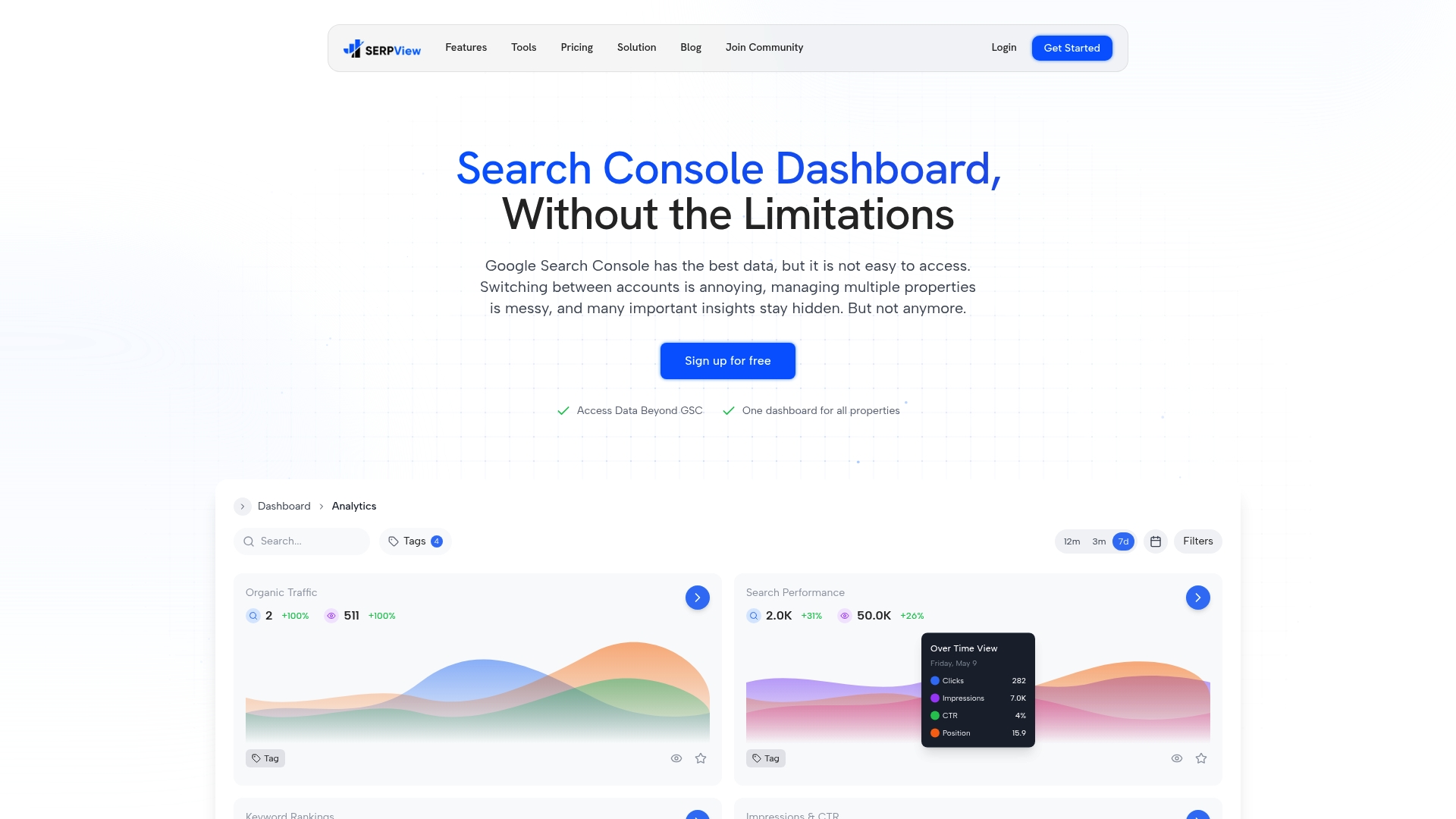
It’s built for exactly the workflow this article describes: consolidate every property past the 1,000-row export limit, filter by device, country, or keyword segment for the audience-tiered reports covered above, and hand clients a shared live dashboard instead of another PDF attachment. Agencies managing multiple client accounts get white-label exports and team invitations built in, so the governance checklist from earlier takes an afternoon instead of a sprint. If your reporting still starts with a Google Search Console export and a blank spreadsheet, that’s the step SERPView replaces first. Start by connecting your properties and running your first consolidated export to see what a validated, cross-property view actually looks like.
Sources
FAQ
Can ChatGPT Do an SEO Audit?
ChatGPT can help interpret exported data or draft report summaries, but it cannot pull live Search Console or GA4 data on its own, so it works best paired with a centralized data source rather than as a replacement for one.
What Is the 80/20 Rule in SEO?
It generally refers to the idea that a small share of pages, keywords, or fixes drives most of the traffic or ranking gains, which is exactly why prioritized KPI reporting matters more than tracking every metric equally.
What Is the Best Tool for Centralized SEO Reporting?
The right tool depends on scale: open-source options like 3h4x/seo-tools suit engineering-led teams, while platforms like SERPView suit agencies that need multi-property consolidation and client-ready dashboards without a custom build.
What Are the Four Main Types of SEO?
They’re typically categorized as technical SEO, on-page SEO, off-page SEO, and local SEO, and a centralized report should reflect diagnostic data from all four rather than focusing only on rankings.
Recommended
Ready to unlock your full GSC potential?
SERPView helps you access all your Google Search Console data without limitations. Start your free trial today.
Get Started Free