
Validate Markets With GSC Impressions: Country Segmentation for SEOs
SERPView Team
SEO Analytics
Country segmentation SEO means structuring, targeting, and measuring your site by national market rather than by language alone, and for most businesses the winning default is subfolders plus correct hreflang plus per-country reporting. This beats ccTLDs and subdomains because it consolidates domain authority instead of splitting it across separate properties. Your first move should be pulling country-level impressions in Google Search Console to see which markets already want your content before you build anything new.
TL;DR:
- Most businesses should use subfolder URL structures with hreflang and per-country reporting, as they maintain domain authority and are more cost-effective than ccTLDs.
- A country-specific version is necessary only if there are significant differences in currency, legal disclosures, prices, or search behavior; otherwise, a single English page with proper hreflang tags suffices.
- Validating demand through Google Search Console and Google Analytics before investing in localized content helps avoid unnecessary costs and ensures market viability.
- Proper implementation of hreflang tags requires self-referencing and return tags on all pages, with regular audits in GSC to prevent silent errors.
- Deep localization, including transcreation and native speaker QA, is critical for performance in key markets, while broad expansion is better supported by readiness and pipeline infrastructure.
Table of Contents
- What Country Segmentation Covers (and When to Use Country vs. Language Targeting)
- URL Architecture and Hreflang: Trade-offs and a Setup Checklist
- How Do You Find and Validate a New Country Market?
- Content Localization: Translation, Transcreation, and What AI Still Can’t Do
- Building Local Authority: Links and PR by Market
- Setting Up Per-Country Reporting in GSC and GA4
- A Phased Rollout Plan for Adding a New Market
- What the Data Actually Shows About Latent Demand and Local Links
- When Should You Localize Deep vs. Expand Broad?
- Get Country-Level Reporting Without the Row Limits
- Sources
- FAQ
What Country Segmentation Covers (and When to Use Country vs. Language Targeting)
Country targeting and language targeting solve different problems, and mixing them up is the single most common planning mistake in international SEO. A language target (like a generic en page) serves anyone who reads English, regardless of where they live. A country target serves a specific national audience, with its own currency, legal disclosures, and search behavior, even if the language is identical to another market’s.
You don’t need a country variant for every market where people share a language. You need one when the underlying business reality diverges. Ask these questions before creating a new segment:
- Do you sell, ship, or bill differently in this country (currency, tax, checkout rules)?
- Does local law require different disclosures, cookie consent, or product claims?
- Do prices, promotions, or inventory actually differ by market?
- Does the user experience change (payment methods, shipping options, support hours)?
- Do search intent and phrasing diverge enough that a shared page can’t rank for both?
If you answer “yes” to two or more, split the market. If not, a single English page with correct hreflang tagging usually outperforms three thin variants competing against each other. This is exactly the trap DevOptiv’s international SEO framework warns about: merging language and region signals carelessly creates cannibalization, where en, en-GB, and en-US all chase the same query and split the ranking signal three ways. Split en into en-US, en-GB, and en-AU only when pricing, spelling conventions, or regulatory copy genuinely differ. Otherwise, keep one en target with an en-x-default fallback and save your production budget for markets that actually need distinct pages.
URL Architecture and Hreflang: Trade-offs and a Setup Checklist
Subfolders (site.com/uk/) are the right call for most companies expanding into new countries. They inherit the root domain’s authority immediately, they’re cheaper to maintain than separate ccTLDs, and they let one Google Search Console property show you everything at once. The International Search Architecture Blueprint from SRNA SEO recommends subfolders as the default precisely because they consolidate domain authority rather than fragmenting it across country-code domains that each start from zero trust.
ccTLDs (site.co.uk) earn their cost only in specific cases: regulated industries like finance or pharma where local trust signals matter more than shared authority, or markets where a country-specific brand identity is a competitive requirement. Subdomains (uk.site.com) sit in between and rarely win outright. They isolate content from the main domain without the local-trust payoff of a true ccTLD.
Hreflang is where most implementations quietly break. Run through this checklist on every market you add:
- Every page must reference itself (a self-referencing hreflang tag), not just its counterparts.
- Every pair of tagged pages needs return tags. If page A points to page B, page B must point back to A.
- Include an
x-defaulttag for visitors who don’t match any specified language or region. - Choose one placement method: HTML head tags, HTTP headers, or an XML sitemap, and don’t mix two for the same page.
- Keep canonical tags pointing to the correct country version, never silently defaulting to the root domain.
Pro Tip: Run your hreflang audit inside Google Search Console’s International Targeting report every time you add a market. Missing return tags are invisible in a browser but show up immediately as coverage errors there.
Server location and CDN configuration deserve a mention too. Google has said page location and TLD matter less than they used to, but real users still feel latency. Route markets through a CDN edge node close to the audience rather than relying on a single origin server across oceans.
How Do You Find and Validate a New Country Market?
The lowest-risk way to pick your next market is to look at where demand already exists, not where you assume it does. Google Search Console’s country filter shows you exactly which nations are generating impressions on your current content, even markets you’ve never actively targeted. Search Engine Journal’s guide to GA4 for international SEO makes the same point from the analytics side: filtering by country and language inside GSC and GA4 is required, because global averages hide exactly this kind of signal.
Follow this sequence before committing budget to a new market:
- Pull the GSC Performance report, filter by country, and sort by impressions for pages ranking outside your primary market.
- Cross-check with GA4’s geographic dimension to see whether that traffic converts or just bounces.
- Confirm real demand with a keyword tool set to that country (Ahrefs and Semrush both let you localize search volume and CPC by country).
- Run manual SERP checks through a VPN set to that location. Automated tools sometimes miss local pack results or region-specific SERP features.
- Validate phrasing with a native speaker. A term that translates cleanly can still be the wrong term locals actually type.
DevOptiv’s framework calls this “latent demand,” and it’s the cheapest signal in international SEO because the visitors are already showing up.
Prioritization rubric: score each candidate market on volume, CPC, and competitive density, then weigh that against your production cost for that language. A market with modest volume but near-zero local competition often beats a bigger market crowded with entrenched incumbents.
Content Localization: Translation, Transcreation, and What AI Still Can’t Do
Direct translation and transcreation are not the same discipline, and treating them as interchangeable is why so many localized pages underperform. Translation converts words. Transcreation adapts the message: pricing examples, cultural references, humor, urgency cues, even the images and testimonials that sit next to the copy. Contentech’s research on literal keyword translation found that direct translation is a common trap precisely because it misses how native speakers actually phrase their searches, even when the grammar is technically correct.
What should get the transcreation treatment, not just a translation pass:
- Target keywords (native-language research, not translated English terms)
- Prices, currencies, and any comparison to local cost-of-living context
- Examples, case studies, and social proof relevant to that culture
- Calls-to-action, urgency language, and trust signals
- Structured data fields like
priceCurrencyand address schema
Pro Tip: Build a keyword map per market before writing a single word of localized copy. Native-speaker QA on that map catches mismatched intent far cheaper than QA on a finished page.
Machine translation has gotten better, but it still can’t reliably infer why a phrase converts in one culture and falls flat in another. That gap matters more now that Google’s helpful content guidance penalizes pages that read as generated for search engines rather than for people. A page transcreated by a native speaker who understands local buying psychology reads as genuinely helpful. A page that’s obviously machine-translated tends to read as exactly that, and rankings follow. Working with a partner that specializes in multilingual SEO content across dozens of languages is one way to keep that native-quality bar consistent as you scale beyond a handful of markets. Run A/B tests on localized CTAs once traffic volume allows. What converts in your home market rarely wins unchanged elsewhere.
Building Local Authority: Links and PR by Market
A link from a respected domain inside the target country carries more ranking weight in that country’s search results than an equivalent link from a foreign domain, according to DevOptiv’s international framework. This is the part of international SEO most teams underinvest in, because it requires local relationships rather than a content calendar.
Tactics that actually produce local links:
- Commission a small local data report (a survey, a pricing study, a market snapshot) and pitch it directly to regional trade publications.
- Localize your PR angle. A story that landed in a US trade outlet needs a different hook for a German or Brazilian one.
- Partner with regional industry associations or directories that carry real domain trust in that market, not generic global directories.
- Sponsor or co-author content with a local publication that already ranks for your target terms.
Measure local authority the same way you’d measure it at home: count backlinks specifically from domains registered or clearly operating in that country, track share-of-voice for your priority keywords against local competitors, and expect this to take time. Give a new market’s link profile at least two full quarters before judging whether the outreach strategy is working. Authority compounds slowly and rewards consistency over one-off campaigns.
Setting Up Per-Country Reporting in GSC and GA4

Global dashboards hide problems. A 3% dip in Canada disappears inside a healthy US number, and cannibalization between your en and en-GB pages looks like nothing at all until you filter by country. Set up GSC’s country filter as a standing report, not a one-off pull, and mirror it with a GA4 geographic segment so traffic and conversion data line up market by market.
Track these metrics per country rather than in aggregate:
- Organic sessions and organic conversion rate
- Branded search growth (a strong signal that awareness campaigns are working)
- Local click-through rate against the average for that market
- Keyword ranking position, filtered by the correct country setting in your rank tracker
| Signal | Where to check it | What it tells you |
|---|---|---|
| Impressions with no clicks in a new country | GSC country filter | Latent demand worth validating |
| Same query ranking across two country variants | GSC + keyword cannibalization check | Hreflang or content overlap issue |
| Traffic up, conversion flat | GA4 geographic segment | Localization or currency mismatch |
| Local CTR below account average | GSC country filter | Title/meta not matching local phrasing |
Cannibalization shows up as one query generating impressions across multiple country or language versions, with clicks and position split unevenly between them. Catch it early by reviewing the Performance report’s query list filtered by page, not just by country. For teams managing several properties, a shared dashboard that pulls GSC and GA4 into one view removes the manual export step and makes this a five-minute weekly check instead of a quarterly scramble.
A Phased Rollout Plan for Adding a New Market
Trying to launch five countries simultaneously is how most international SEO programs stall. Move one market through four phases, measure, then repeat.
- Discovery. Pull GSC latent-demand data for the candidate country, run manual SERP checks via VPN, and confirm real search volume with a country-localized keyword tool.
- Technical foundation. Set the subfolder structure, implement hreflang with self-references and return tags, lock canonical tags to the correct version, and confirm CDN routing serves that region efficiently.
- Content and QA. Build the keyword map, commission transcreation (not translation) for priority pages, and run native-speaker QA before publishing.
- Authority and measurement. Launch local outreach, stand up the country-filtered dashboard, and set a check-in cadence, weekly for the first month, then monthly.
Most programs need six to eighteen months per market to move from foundation to compounding authority, so budget resources accordingly rather than expecting quarter-one payback. A realistic sprint plan gives discovery two weeks, technical foundation two to three weeks, content production four to six weeks depending on page count, and authority building as an ongoing quarterly workstream that runs in parallel with the next market’s discovery phase.
What the Data Actually Shows About Latent Demand and Local Links
Two patterns show up repeatedly once you start filtering analytics by country rather than reading them in aggregate. First, sites almost always find impressions in markets they never intentionally targeted. A software company optimizing purely for the US routinely discovers meaningful GSC impressions from Canada, the UK, or Australia on pages that were never localized for those markets, exactly the “latent demand” pattern DevOptiv’s framework documents. Second, the value of a local backlink is not evenly distributed. A single placement on a respected regional publication tends to outperform several links from unrelated foreign domains in that country’s search results.
Country-level segmentation isn’t a reporting nicety. It’s the only way to see whether a market is ready for investment before you spend a production budget building for it.
Advanced SEO analytics platforms exist to make country and device segmentation fast rather than a manual export-and-pivot exercise every time someone asks “how are we doing in Germany?” The recommended approach is to check impressions, confirm volume and intent with local tools, then commit to a technical build. That order rarely fails; skipping straight to a full localized site without checking demand first is the far more common and expensive mistake.
When Should You Localize Deep vs. Expand Broad?
The honest answer is that most teams pick broad expansion by default and pay for it later with thin, underperforming pages in six markets instead of strong ones in two. Depth wins when a market shows real latent demand and a defensible competitive gap. Breadth only makes sense when you have the localization pipeline (translation vendors, native QA, a CMS that handles hreflang cleanly) already built and tested on at least one market.
The biggest blocker isn’t usually strategy, it’s governance: no one owns the decision of which market gets budget next, and the CMS wasn’t built with country variants in mind from day one. Fix that before adding a fourth market. Judge a pilot market on validation speed and early ranking movement. Judge a scaled program on branded search growth and local link velocity, because those compound in ways a 90-day traffic chart won’t show you.
— Utsav Chopra
Get Country-Level Reporting Without the Row Limits
Google Search Console caps most exports at 1,000 rows per query, which is exactly the ceiling that makes country-by-country prioritization painful once you’re managing more than a handful of markets. SERPView removes that limit, pulling up to 50,000 rows across multiple GSC properties into one dashboard, so you can filter by country, compare device performance, and spot latent demand without stitching together a dozen manual exports.
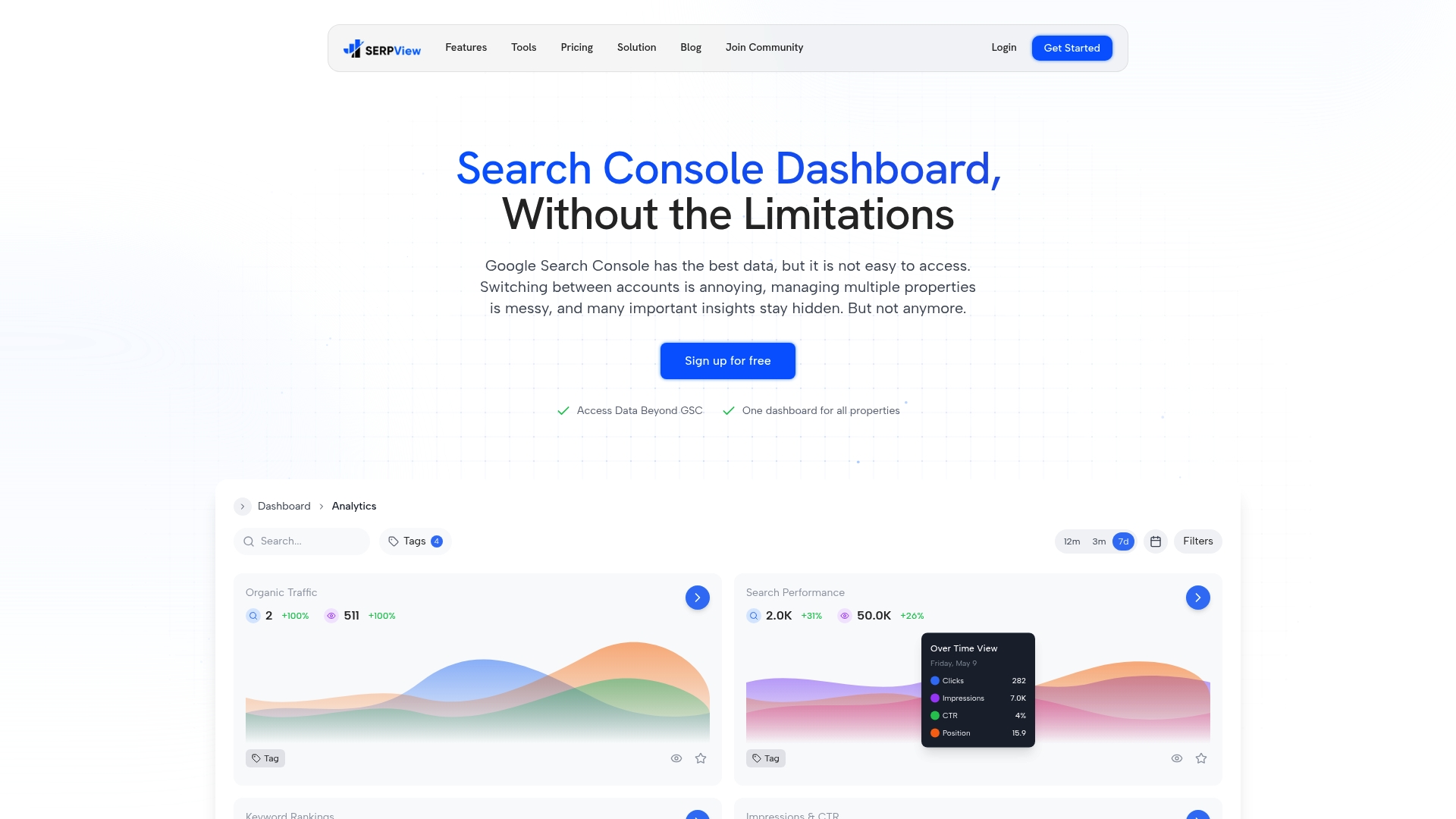
A practical quick win: export country-filtered GSC data through SERPView and rank your candidate markets by impressions and CTR before you commit a single hour of transcreation budget. The Extended Storage feature keeps that historical data available for long-term trend comparisons across markets, which matters once you’re tracking a rollout over the twelve to eighteen months a new country typically needs. Pricing starts with The Real Pro at $39 per month, or Life Time Access for a one-time $99 payment, both available on the SERPView homepage. If you’re validating your first international market this quarter, that’s the place to start.
Sources
- The hidden flaws of literal keyword translation in international SEO campaigns | Contentech
- International SEO framework for 2026 | DevOptiv
- International Search Architecture Blueprint – SRNA SEO
FAQ
How Do You Do SEO for Different Countries?
Structure the site with subfolders for each market, implement hreflang with self-references and return tags, and build a per-country GSC and GA4 reporting setup before writing localized content. Validate each market with real GSC impression data first, then commit to transcreation rather than direct translation for priority pages.
Is SEO Still Worth It in 2026?
Yes. Search remains a primary discovery channel, and international programs specifically benefit because most markets take six to eighteen months to build compounding authority, meaning early movers in underserved markets still hold a real advantage.
What Is the 80/20 Rule in SEO?
Applied to country segmentation, a small number of markets, usually the ones showing the strongest latent demand in GSC, will drive most of your international results. Prioritizing those markets over spreading effort evenly across many countries is the more efficient approach.
What Are the Four Types of SEO?
The common breakdown is technical SEO, on-page SEO, off-page SEO, and local SEO. Country segmentation SEO draws on all four: technical work for hreflang and URL structure, on-page work for transcreated content, off-page work for regional backlinks, and local SEO for market-specific listings and citations.
How Much Does SERPView Cost?
SERPView offers The Real Pro plan at $39 per month and a Life Time Access option for a one-time $99 payment, both listed on the SERPView site. A Free tier is also available for teams testing the platform before committing to a paid plan.
Recommended
Ready to unlock your full GSC potential?
SERPView helps you access all your Google Search Console data without limitations. Start your free trial today.
Get Started Free