
Measure Content Gap with Search Analytics
SERPView Team
SEO Analytics
TL;DR:
- Measuring content gaps helps prioritize pages that need building or improvement based on actual search demand. It involves analyzing impressions, ranking positions, and AI visibility to identify unranked topics with high potential. Regular analysis and cross-checking with AI answer presence ensure your site stays competitive and relevant.
A content gap is defined as any query where your site earns impressions but lacks a page that ranks in the top 10. Knowing how to measure content gap with search analytics turns that invisible traffic into a concrete list of pages you should build or improve. The process draws on three core data sources: Google Search Console, the Search Analytics API, and AI visibility monitoring tools. Done correctly, it gives you a prioritized content plan grounded in real demand rather than guesswork about what your audience wants.
What signals in search analytics indicate a content gap?
The clearest content gap signal is a query with over 100 impressions but an average position worse than 10. That combination tells you Google already associates your domain with the topic, yet no page on your site ranks well enough to earn consistent clicks. The gap is real, measurable, and fixable.
Three metrics work together to surface these signals:
- Impressions confirm that search demand exists for the query.
- Average position reveals whether your content competes or simply floats below the fold.
- CTR shows whether the gap is costing you clicks right now.
A query with 500 impressions, a position of 18, and a CTR of 0.4% is a textbook gap. Your domain appears in search results, but no page earns a meaningful click. That is the opportunity.
Scoring each gap adds discipline to the process. A gap scoring framework weighs three factors on a 1–3 scale: search volume above 2,000, keyword difficulty below 30, and business relevance to your product or service. High scores on all three make a gap worth pursuing immediately. Low scores on business relevance mean you should deprioritize the gap regardless of traffic volume.

Pro Tip: Filter your Search Console data by device type. Mobile and desktop often show different position distributions for the same query, which means the gap may be more severe on one device than the other.
What tools and data sources do you need?
The Google Search Console UI is the starting point for most content strategists, but it caps exports at 1,000 rows. That limit hides the long-tail queries where many of the best gap opportunities live. The Search Analytics API raises that ceiling to 25,000 rows per request and 50,000 rows per day. BigQuery exports remove the row limit entirely, making them the right choice for large sites with thousands of indexed pages.
| Data source | Row limit | Best use case |
|---|---|---|
| Search Console UI | 1,000 rows | Quick spot checks and small sites |
| Search Analytics API | 25,000 per request | Mid-size sites and regular exports |
| BigQuery export | No limit | Enterprise sites and full historical analysis |
AI visibility monitoring adds a layer that traditional search analytics cannot provide. Brands invisible in AI answer engines lose category presence as AI synthesis replaces traditional search results. Monitoring whether your domain appears in AI-generated answers for target queries reveals a class of gap that impressions and position data alone will not catch.
Organize your data before you analyze it. Build a content inventory that maps each existing URL to its primary query cluster. Tag queries by funnel stage: awareness, consideration, or decision. This structure makes it easy to see which clusters have no supporting pages and which funnel stages are underserved.
Pro Tip: Export your Search Console data on the same day each month. Consistent export timing removes seasonal noise and makes month-over-month comparisons reliable.
How do you analyze and prioritize content gaps step by step?
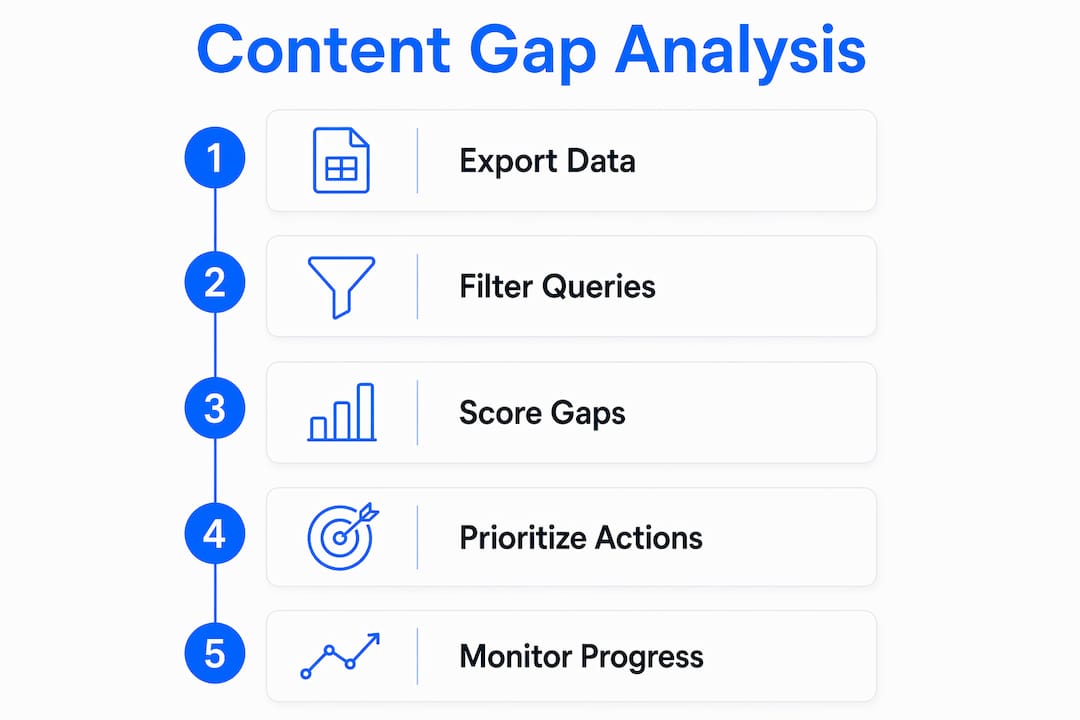
A repeatable workflow keeps gap analysis consistent across quarters. Follow these six steps to move from raw data to a publishing calendar.
-
Export your query data. Pull impressions, clicks, average position, and CTR for the past 90 days using the Search Analytics API or Serpview’s unified dashboard, which surfaces up to 50,000 rows without the UI restriction.
-
Apply the gap filter. Isolate queries where impressions exceed 100 and average position is worse than 10. This is your raw gap list.
-
Validate against competitor coverage and AI visibility. Competitor keyword gap reports are useful as validation, not as the primary signal. Check whether competitors rank in positions 1–3 for your gap queries. Also check whether AI answer engines cite competitors for those queries. Both checks confirm the gap is real and contested.
-
Score each gap. Rate every gap on search volume, keyword difficulty, and business relevance using a 1–3 scale. Sum the scores. Gaps scoring 7 or higher deserve immediate attention.
-
Organize gaps into topic clusters. Group related queries under a pillar topic. Map each cluster to a funnel stage and a buyer persona. Content gap scoring should weigh funnel stage and business fit heavily, because traffic volume alone does not predict qualified leads.
-
Build your publishing calendar. Assign the highest-scoring clusters to the next four to six weeks. Schedule lower-priority clusters for later quarters. Treat the calendar as a living document you update after each quarterly reanalysis.
Pro Tip: Use search analytics filters to segment your gap list by country or device before scoring. A gap that scores high globally may be irrelevant for your primary market.
What are the most common pitfalls in content gap measurement?
Relying on the Search Console UI export is the most common mistake. The 1,000-row cap means you analyze less than 1% of the query data available on a site with significant traffic. You will miss the long-tail opportunities that often convert at higher rates than head terms.
A second pitfall is chasing every gap without assessing business value. A query with 5,000 monthly impressions and a position of 15 looks attractive on paper. If the query has no connection to your product or buyer journey, filling that gap produces traffic with no commercial return. User feedback from support tickets and sales calls catches topic gaps before search tools do and keeps your analysis anchored to real buyer questions.
Brands that skip AI citation checks miss a growing share of search visibility. AEO gaps occur when competitors appear in AI-generated answers but your domain is absent, impacting discovery in ways that traditional rank tracking cannot measure.
Format gaps are another overlooked problem. Many SEO professionals cover the right topic but publish it in the wrong format. A query with strong video intent answered by a text article will underperform regardless of how well the content is written. A content gap analysis that includes format gaps, quality gaps, and AEO citation gaps gives you a complete picture of what is missing.
Rerun your gap analysis quarterly to reflect shifting query data and evolving search demand. A gap that scored low in january may score high by april if search volume rises or a competitor drops out of the top 10. Static analyses go stale fast.
How do you track content gap closure over time?
Tracking whether your gap-filling content actually works requires a baseline. Before you publish or update a page, record its impressions, clicks, CTR, and average position. These four numbers are your starting point for measuring content effectiveness after the page goes live.
-
Set your baseline. Export the target query’s metrics from Search Console the week before publishing. Save them in a tracking spreadsheet alongside the publish date.
-
Run monthly quick checks. Pull the same metrics 30 days after publishing. A position improvement from 18 to 12 is a positive signal even if clicks have not yet increased. Position moves first; clicks follow.
-
Run quarterly deep reviews. Compare impressions and CTR across the full cluster, not just the individual page. A well-written pillar page often lifts rankings for related queries you did not directly target.
-
Monitor AI visibility. Check whether your new content appears in AI-generated answers for the target query. AI search platforms synthesize answers from selected sources; not being cited means invisibility in a growing share of search interactions.
-
Measure engagement and conversion signals. Connect Search Console data to Google Analytics or your CRM to track whether gap-filling pages produce qualified sessions, form fills, or pipeline. SEO performance benchmarks give you a reference point for what healthy engagement looks like by industry and funnel stage.
Pro Tip: Tag each gap-filling page in your content inventory with its publish date and target query cluster. This makes quarterly reviews faster and keeps your tracking consistent across team members.
Key Takeaways
Measuring content gaps with search analytics is most effective when you combine impression and position data with AI visibility checks and a disciplined scoring framework.
| Point | Details |
|---|---|
| Core gap signal | Queries with over 100 impressions and average position worse than 10 are your primary targets. |
| Data source matters | Use the Search Analytics API or BigQuery to access data beyond the 1,000-row UI limit. |
| Score before you build | Rate each gap on search volume, keyword difficulty, and business relevance before committing resources. |
| Include format and AEO gaps | Keyword gaps alone miss format mismatches and AI citation absences that hurt visibility. |
| Track with a baseline | Record impressions, clicks, CTR, and position before publishing, then measure monthly and quarterly. |
Why I think most content gap analyses stop too short
Most content gap workflows I have seen end at the keyword list. The team exports queries, filters for weak positions, and hands a spreadsheet to the content team. That is where the real work should begin, not end.
The gap between a query list and a content strategy is where most teams lose momentum. Scoring matters more than volume. A query with 800 monthly searches and a direct connection to your product beats a 5,000-search query that attracts the wrong audience every time. I have watched teams spend three months filling high-volume gaps that produced zero pipeline because no one asked whether the traffic was qualified.
AI visibility is the blind spot I see most often. Traditional rank tracking tells you where you stand in the blue-link results. It tells you nothing about whether your brand appears when someone asks ChatGPT or Perplexity a question in your category. Those citation gaps are real, they are growing, and they require a separate monitoring habit. Combining search data insights with AI answer visibility checks gives you a fuller picture than either source provides alone.
The teams that get this right also involve sales and support in the process. Live market research from support tickets and sales calls catches topic gaps before search tools do. That qualitative layer keeps your analysis connected to real buyer friction rather than abstract search volume numbers. Pair that with a quarterly reanalysis cadence and you have a content program that adapts as search demand shifts rather than one that chases last quarter’s data.
Solid technical SEO maintenance also affects how quickly gap-filling content earns rankings. A page targeting a real gap will underperform if crawl issues or slow load times prevent Google from indexing it properly. Gap analysis and technical health belong in the same workflow.
— Utsav Chopra
How Serpview makes content gap measurement faster
Serpview addresses the core limitation that slows down most gap analyses: the 1,000-row cap in the Google Search Console UI. Its unified dashboard consolidates data from multiple properties and surfaces up to 50,000 rows, giving you a complete view of your query landscape without manual API work.
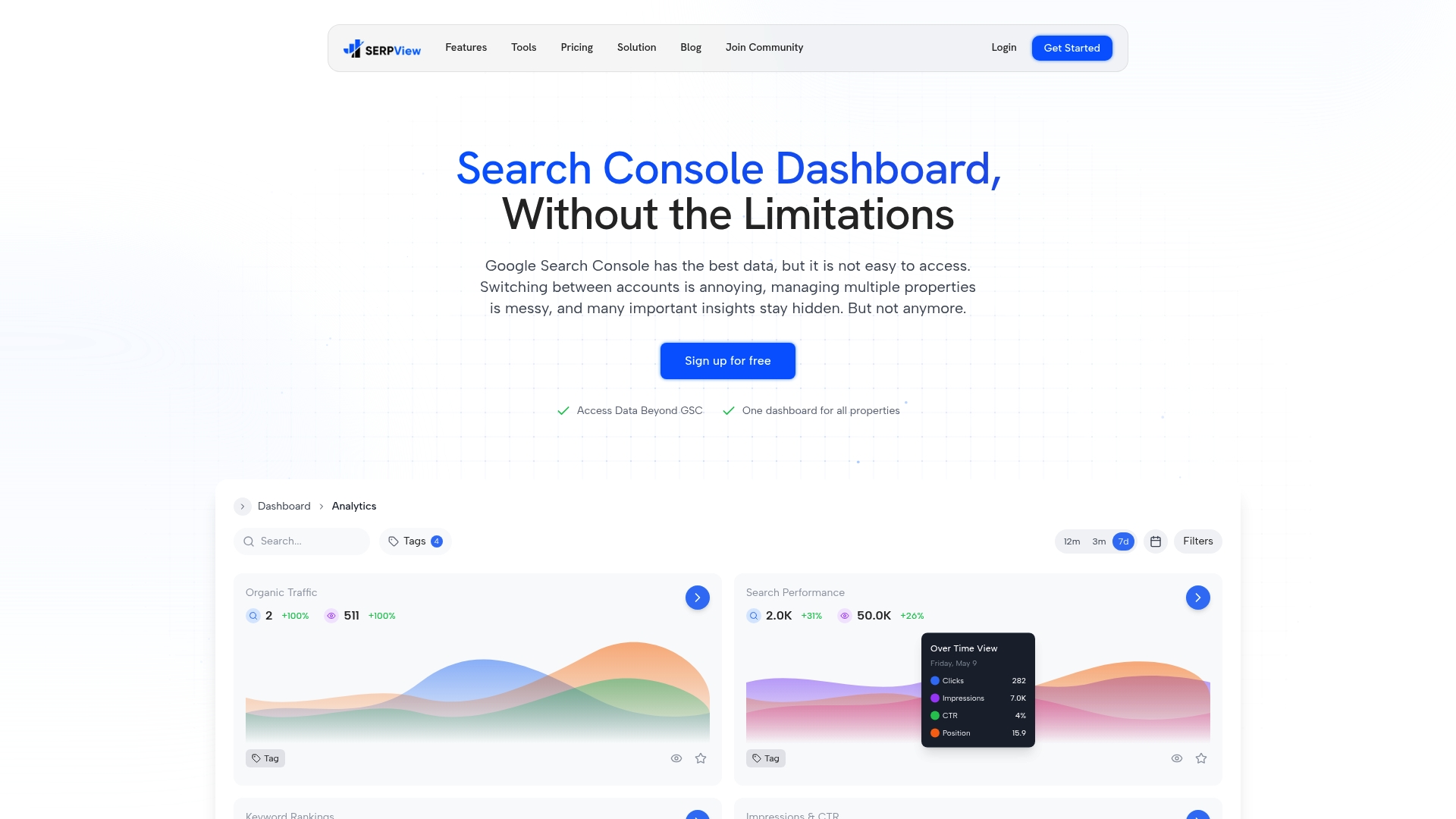
You can apply customizable filters to isolate gap signals by device, country, date range, or query cluster in seconds. Serpview’s query counting by ranking tier shows you exactly how many queries sit in positions 11–20, the zone where most content gaps live. Historical performance tracking lets you set baselines before publishing and measure improvement over time with the same dashboard. If you want to understand the foundational metrics behind gap analysis, Serpview’s Google Search Console glossary explains every key term clearly. Start with a free trial and see how much of your query data the UI has been hiding.
FAQ
What is a content gap in SEO?
A content gap is a query where your site earns search impressions but has no page ranking in the top 10 results. It represents a topic your audience searches for that your current content does not adequately cover.
How do I measure content gaps with search analytics?
Export your query data from the Search Analytics API, then filter for queries with over 100 impressions and average position worse than 10. Score each gap by search volume, keyword difficulty, and business relevance to prioritize which gaps to fill first.
Why is the Search Console UI not enough for gap analysis?
The Search Console UI exports a maximum of 1,000 rows, which hides the majority of long-tail queries on most sites. The Search Analytics API and BigQuery exports remove that restriction and give you access to the full query dataset.
How often should I rerun a content gap analysis?
Rerun your gap analysis quarterly. Query data shifts regularly, and a gap that ranked low in priority one quarter may become a high-value opportunity the next as search demand or competitor rankings change.
What is an AEO gap and why does it matter?
An AEO gap occurs when competitors appear in AI-generated answers for a query but your domain does not. As AI search platforms synthesize answers from selected sources, being absent from those citations means losing visibility in a growing share of search interactions.
Recommended
Ready to unlock your full GSC potential?
SERPView helps you access all your Google Search Console data without limitations. Start your free trial today.
Get Started Free