
Zero-Click Searches: Their Role in Marketing in 2026
SERPView Team
SEO Analytics
TL;DR:
- Zero-click searches now emphasize on-SERP influence, brand recall, and AI citation frequency over raw site visits.
- Most U.S. Google searches end without a click, reducing organic traffic and shifting measurement focus toward visibility metrics like AI citations and impression share.
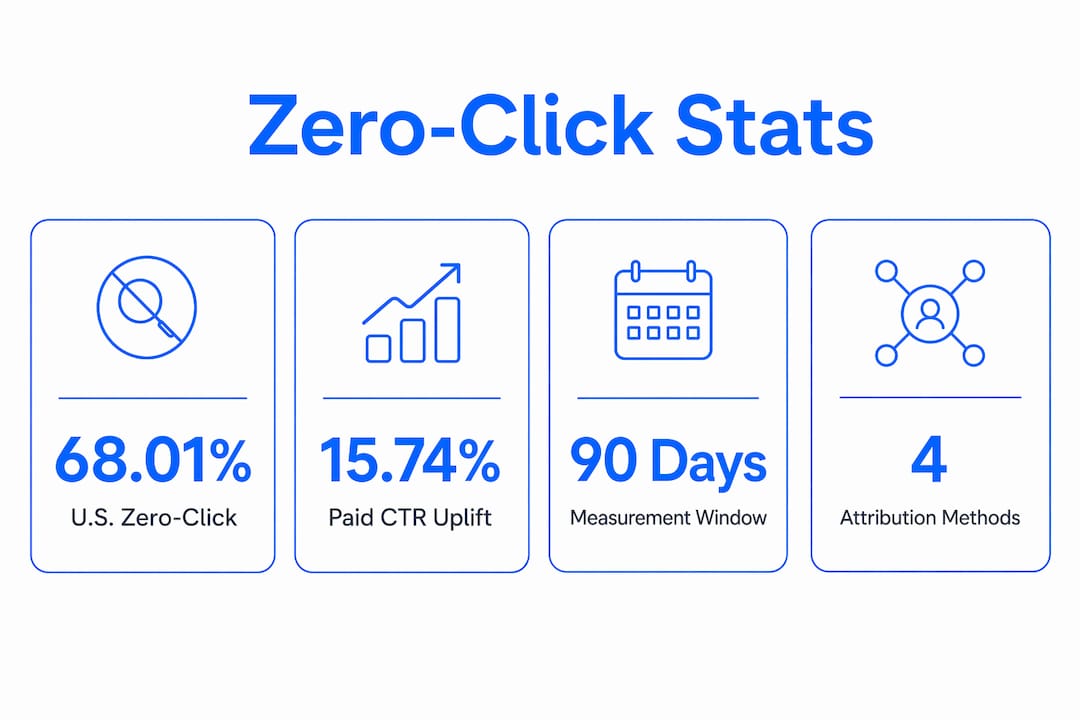
Zero-click searches now shift marketing value away from raw site visits and toward on-SERP influence, brand recall, and AI citation frequency. 68.01% of U.S. Google searches ended without a click in the first four months of 2026, reflecting a marked increase since 2024. Bain & Company estimates that about 80% of consumers rely on zero-click results for at least 40% of their searches, contributing to a 15%–25% reduction in organic web traffic across many industries. Seer Interactive found that brands cited in AI Overviews earned a 15.74% paid CTR on those same queries versus 11.19% when not cited. The practical implication: replace organic sessions as your headline KPI with visibility metrics — AI citation frequency, branded-search lift, and SERP impression share.
Table of Contents
- Why zero-click behavior matters at scale right now
- What to measure when clicks decline
- Closing the measurement gap with dashboards and attribution
- How Serpview operationalizes zero-click measurement
- SEO and content tactics to win visibility without clicks
- Recommended KPIs and a reporting template
- Your 90-day playbook for adapting to zero-click
- Key Takeaways
- The measurement-first argument most teams are still missing
- Serpview gives you the data zero-click measurement actually requires
- Cited research and sources
- FAQ
Why zero-click behavior matters at scale right now
The numbers behind zero-click search trends are large enough to affect every marketing budget decision you make this year.
| Statistic | Source | Business implication |
|---|---|---|
| 68.01% zero-click share, U.S. Jan–Apr 2026 | SparkToro / Similarweb | Majority of queries never reach your site |
| — | SparkToro | Organic traffic baselines are structurally lower |
| 15%–25% organic traffic reduction across industries | Bain & Company | Revenue models tied to sessions need recalibration |
| 15.74% paid CTR when cited in AI Overviews vs. 11.19% when not | Seer Interactive | AI citation creates measurable paid-search lift |
| AI Overviews on 20%+ of queries, reducing CTR by ~60% | SparkToro | Feature prevalence explains the click-rate drop |
Branded, local, and high-intent transactional queries remain more click-resilient. Someone searching “buy project management software free trial” still needs your page to act. But informational and navigational queries — the top of your funnel — are resolving on the SERP itself. The share of searches that led to another Google search rose 7.2 percentage points, which means users are doing more research inside Google rather than leaving it. Your content is still being read. The visit just never happens.
What to measure when clicks decline
Clicks are a proxy. The actual goal was always brand association, authority, and purchase intent. When the proxy disappears, you need direct measures of those outcomes.
Replace sessions as your primary KPI with these visibility signal categories:
- AI citation frequency: How often your content appears as a named source inside AI Overviews or LLM responses. This is the clearest signal of on-SERP authority.
- SERP impression share: Total impressions across your query clusters, regardless of click. HubSpot recommends this as a core replacement metric when clicks fall.
- Featured-snippet ownership rate: The percentage of your target queries where you hold the snippet position.
- Branded-search lift: Week-over-week growth in branded query volume. Users who encounter your brand in an AI Overview often search your name days later — that spike is a measurable downstream signal.
- Assisted conversions from SERP impressions: Conversions where a search impression preceded the converting session, even without a direct click.
Map each metric to a business outcome. AI citation frequency correlates with demo and trial uplift. Branded-search growth reflects brand recall from zero-click exposure. SERP impression share feeds pipeline influence models. To validate these correlations, run cohort analysis: identify weeks with high AI-citation share and compare them against branded search volume in the following two to three weeks.
Pro Tip: Minimum dataset for reliable measurement is a 90-day time series of impressions, AI citation counts, and conversion events across all your properties. Shorter windows produce noise, not signal.

Closing the measurement gap with dashboards and attribution
Knowing which metrics to track is only half the problem. Getting the data into one place is the other half.
The required data sources for a complete zero-click attribution stack:
- Google Search Console for impression and query data (note the GSC data limits — the default 1,000-row export misses most of your query tail)
- Paid-search platforms (Google Ads, Microsoft Ads) for paid CTR segmented by queries where AI Overviews appear
- Server-side or enhanced analytics for session and conversion data with reduced sampling
- CRM or pipeline data for revenue-stage events tied to search-origin leads
- SERP monitoring tools for AI citation tracking and featured-snippet ownership
| Data source | Strength | Limitation |
|---|---|---|
| Google Search Console | Authoritative impression and click data | 1,000-row default cap; — |
| Paid-search platforms | Paid CTR by query | No organic impression data |
| Web analytics | Session and conversion paths | Sampling; zero-click journeys invisible |
| CRM / pipeline | Revenue attribution | Requires UTM discipline and CRM hygiene |
| SERP monitoring | AI citation and snippet ownership | Manual or tool-dependent; no API standard |
For attribution, four approaches work in practice. Impression-to-branded-search correlation is the most accessible: compare SERP impression volume against branded query volume with a one-to-three-week lag. Assisted-conversion modeling credits search impressions that preceded a converting session. Time-lag cohort analysis groups users by their first SERP exposure week and tracks downstream conversion rates. Probabilistic matching fills gaps when deterministic links (UTM, CRM ID) are absent. You can find practical guidance on linking search trends to campaign performance to structure these models.
Pro Tip: Run a controlled experiment before committing to a correlation model. Increase bids on queries where you hold AI citations and measure paid CTR lift versus a control group of similar queries without citation. That test converts a correlation assumption into a causal signal.
How Serpview operationalizes zero-click measurement
The measurement framework above requires consolidating data across multiple properties at scale. Serpview is built specifically for that problem.
Serpview consolidates Google Search Console data across all your properties into a single dashboard, removes the 1,000-row export cap with up to 50,000 rows of data, and surfaces the query-cluster and impression-share views that zero-click measurement depends on.
Key capabilities that map directly to the zero-click measurement framework:
- Cross-property GSC consolidation: Roll up impression share, click data, and query clusters across every domain you manage without manual exports.
- Up to 50,000 rows of exportable data: Capture the full query tail that standard GSC exports cut off, which is where most AI-citation queries live.
- Historical trend visualization: Track branded-search lift and impression share over time with algorithm-update overlays to separate Google changes from content performance.
- CTR benchmarking and cannibalization reports: Identify which pages are losing clicks to SERP features and which are holding conversion rates.
- Custom annotations: Mark campaign launches, algorithm updates, and content refreshes so your correlation analysis stays reproducible.
- Shared dashboards and white-label reports: Deliver client-ready zero-click visibility reports without rebuilding them each month.
Pro Tip: Set up dataset annotations on the day you launch any snippet-friendly content test. Without a timestamp, you cannot isolate the content change from concurrent algorithm shifts when you review results four weeks later.
SEO and content tactics to win visibility without clicks
Being cited in an AI Overview or featured snippet is not accidental. It follows from specific content and technical choices.
- Answer-first formatting: Open every target page with a direct, one-sentence answer that names your brand and core value. Craft snippet-ready answers so the result itself functions as a branded touchpoint — a generic answer that gets featured helps the engine. A branded one builds recognition.
- Structured data: Apply FAQ, HowTo, and product structured data schema to increase machine readability and eligibility for SERP features. Use Serpview’s free schema tools to generate and validate markup without a developer.
- Long-tail, conversational query clusters: Long-tail keywords that mirror how users phrase multi-turn AI queries build topical authority and reduce misattribution risk.
- High-intent CTAs above the fold on cited pages: Pages likely to appear in AI Overviews should carry a visible demo, trial, or contact CTA. The user who does click is already pre-warmed.
Pro Tip: Author one canonical, high-authority “source” page per major informational query cluster rather than letting multiple short posts compete. A single authoritative page earns citations more reliably than fragmented coverage.
Recommended KPIs and a reporting template
| KPI | Definition | Data source | Business rationale | Cadence |
|---|---|---|---|---|
| AI citation frequency | Times your content is cited in AI Overviews per query cluster | SERP monitoring | Measures on-SERP authority | Weekly |
| SERP impression share | Impressions / total available impressions by cluster | GSC + Serpview | Tracks visibility regardless of click | Weekly |
| Featured-snippet ownership | % of target queries where you hold the snippet | SERP monitoring | Signals content authority | Bi-weekly |
| Branded-search growth | Week-over-week change in branded query volume | GSC / Serpview | Downstream demand from zero-click exposure | Weekly |
| Assisted conversions | Conversions with a prior search impression | Analytics + CRM | Pipeline influence from SERP presence | Monthly |
| Paid CTR lift when cited | Paid CTR on queries with AI citation vs. without | Paid platform | Validates citation’s commercial value | Monthly |
Dashboard checklist: include impression-share trend charts, branded-search volume over time, snippet ownership by cluster, and an alert when branded-search growth drops below your baseline threshold. That alert is your content-refresh trigger. Search visibility metrics explain how to set realistic thresholds for each KPI type.
Your 90-day playbook for adapting to zero-click
- Days 1–30: Audit all data sources. Unify GSC properties in Serpview to remove the row cap. Baseline AI citation frequency and branded-search volume for your top 20 query clusters. Add FAQ and HowTo schema to your five highest-impression informational pages.
- Days 31–60: Build the consolidated dashboard with impression share, branded-search lift, and assisted-conversion widgets. Run one controlled snippet-copy experiment on a mid-funnel query. Map assisted conversions to pipeline stages in your CRM.
- Days 61–90: Lock in a weekly reporting cadence. Adjust your content roadmap to prioritize canonical source pages over thin informational posts. Refine paid campaigns to increase bids on queries where you hold AI citations, using the paid campaign search data to guide budget shifts.
Pro Tip: If bandwidth is limited, sequence tasks by data dependency: you cannot build a reliable dashboard without unified data, and you cannot validate experiments without a dashboard. Do days 1–30 fully before moving on.
Key Takeaways
Zero-click searches have structurally shifted marketing success from session counts to SERP-level influence, making AI citation frequency, branded-search lift, and impression share the metrics that actually predict pipeline growth.
| Point | Details |
|---|---|
| Clicks are no longer the scorecard | 68.01% of U.S. searches ended without a click in the first four months of 2026; replace sessions with visibility metrics. |
| AI citation creates paid-search lift | Brands cited in AI Overviews earned 15.74% paid CTR vs. 11.19% when not cited, per Seer Interactive. |
| Branded-search growth is the key proxy | Impression-to-branded-search correlation with a 1–3 week lag is the most accessible attribution method. |
| Consolidate data before you measure | GSC’s 1,000-row default cap hides most of your query tail; full-row exports are required for reliable analysis. |
| Serpview unifies the measurement stack | Cross-property GSC consolidation, up to 50,000 rows, and pre-built reports operationalize zero-click KPIs for multi-site teams. |
The measurement-first argument most teams are still missing
The debate about zero-click search usually gets framed as a traffic problem. Teams watch sessions fall and respond by either panicking or dismissing the data. Both reactions miss the real issue.
The search funnel is not broken. It is restructured. Users are doing more research inside Google, forming opinions about brands, and arriving at your site later in the buying cycle with higher intent. The Seer Interactive paid-CTR finding makes this concrete: being cited in an AI Overview does not just build awareness, it pre-warms the audience so that when they do click, they convert at a higher rate. That is not a consolation prize. That is a different, and arguably better, conversion mechanism.
The teams that will fall behind are the ones that keep optimizing for the click while the decision is being made one step earlier. Informational content is not dead weight because it does not drive direct clicks. It is the infrastructure that earns AI citations, builds topical authority, and creates the brand association that fires a branded search three weeks later. Cutting it to focus on “conversion pages only” removes the foundation those conversion pages depend on.
The practical recommendation: run small, measurable experiments that link AI citation frequency to branded-search lift through multiple marketing channels. Keep your informational content and instrument it properly. The brands that treat SERP presence as a pipeline signal, not a vanity metric, will have a measurable advantage as AI Overviews continue to expand.
Serpview gives you the data zero-click measurement actually requires
Most teams trying to measure zero-click impact hit the same wall: fragmented GSC data across properties, the 1,000-row export cap cutting off the query tail, and no single view of impression share over time. Serpview removes those constraints directly.
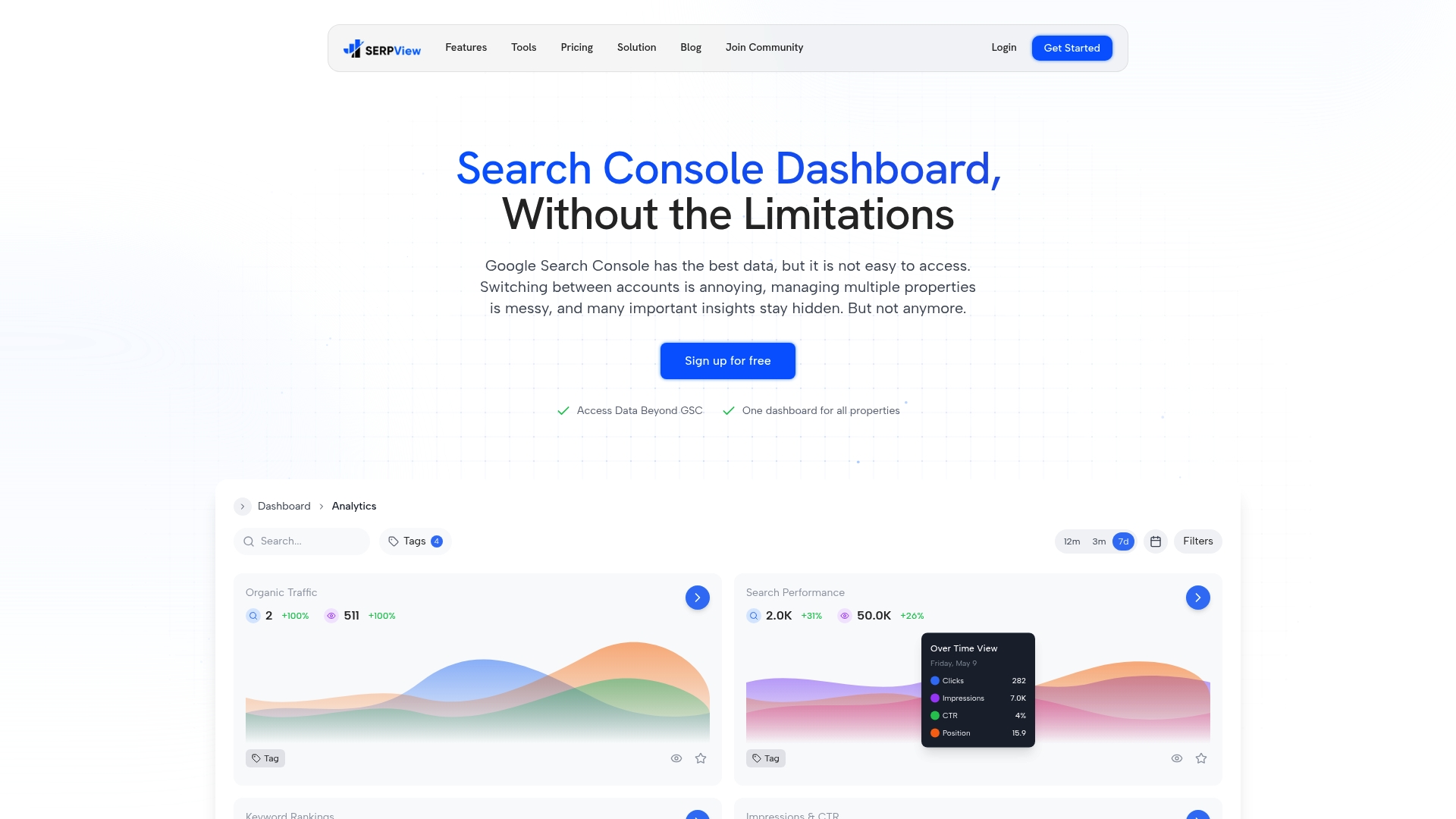
With Serpview, you get cross-property GSC consolidation, up to 50,000 rows of exportable query data, historical trend views with algorithm-update overlays, and pre-built reports for CTR benchmarking and content decay. Agencies get white-label shared dashboards to deliver zero-click visibility reports to clients without rebuilding them each month. The query counting by ranking tier feature lets you segment impression share by cluster, which is exactly the view the 90-day playbook above requires. Start your trial at serpview.com and get your consolidated zero-click dashboard running within your first 30 days.
Cited research and sources
- SparkToro / Similarweb (2026) — Primary source for the 68.01% zero-click rate and AI Overview CTR impact data used throughout this guide.
- Bain & Company — Consumer reliance estimate (80% / 40% threshold) and 15%–25% organic traffic reduction figure.
- Seer Interactive via TechWyse — Downstream paid-CTR lift data (15.74% vs. 11.19%) for brands cited in AI Overviews.
- Search Engine Land — Summary of re-querying behavior and the 7.2 percentage-point increase in searches leading to another Google search.
- HubSpot — Practitioner recommendation to add AI citation frequency and SERP impression share to standard reporting.
- Flux — Tactical guidance on answer-first content design and snippet engineering for zero-click visibility.
FAQ
What are zero-click searches and why do they matter for marketers?
Zero-click searches are queries that end on the SERP without the user visiting any website, because a featured snippet, AI Overview, or knowledge panel answered the question directly. They matter because 68.01% of U.S. searches now end this way, making on-SERP visibility a primary marketing channel.
Which metrics should replace clicks in zero-click reporting?
Replace sessions with AI citation frequency, SERP impression share, featured-snippet ownership rate, and branded-search growth. HubSpot and Seer Interactive both recommend these as the core visibility KPIs when organic clicks decline.
How does being cited in an AI Overview affect paid search performance?
Seer Interactive found that brands cited in AI Overviews earned a 15.74% paid CTR on those same queries versus 11.19% when not cited, a meaningful lift that makes AI citation a paid-search efficiency signal, not just a branding one.
How does Serpview help measure zero-click impact across multiple sites?
Serpview consolidates Google Search Console data across all your properties, removes the 1,000-row export cap with up to 50,000 rows, and provides historical impression-share trends and CTR benchmarking reports that make cross-property zero-click measurement practical for agencies and multi-site teams.
Should you cut informational content if it no longer drives clicks?
No. Informational pages build the topical authority and entity signals that earn AI citations and drive branded-search growth downstream. Cutting them removes the foundation that commercial pages depend on for visibility and conversion.
Recommended
Ready to unlock your full GSC potential?
SERPView helps you access all your Google Search Console data without limitations. Start your free trial today.
Get Started Free